Market Valuation
-
Is Japan the Next Black Swan?
Roger Montgomery
May 22, 2012

 Forget Europe. That’s old news. The next surprise might just be a bursting of Japan’s bond bubble. Nay, a bursting of Japan itself?
According to Fitch, gross general government debt of Japan is likely to reach 239 percent of GDP by end-2012, the highest for any Fitch-rated sovereign. Moreover, Japan’s Fiscal Management Strategy envisages declines in the government debt/GDP ratio only from fiscal year 2021.
Would you lend Japan money (or any country with these financials) at rates approaching zero?
Strong private savings contribute to the country’s persistent current account surpluses. But that’s all going to change as ageing baby boomers (who the government has been borrowing money from at near zero rates – its called financial repression) start to ‘dissave’. As they get older they will stop saving and start needing the cash to finance retirement and healthcare. The result is that the government will need to turn to foreign investors for cash and they are not going to accept zero rates when the country has debt of 240% of GDP.
According to Bloomberg: “How low can bond yields go without triggering a meltdown?
“This question gains urgency as 10-year government yields disappear before the world’s eyes. At 0.83 percent, the lowest level since 2003, they hardly compensate investors for the risks inherent in buying IOUs from the most indebted nation. Public debt is more than twice the size of the $5.5 trillion economy. Worse, it’s still growing. Fitch Ratings today lowered the sovereign-credit rating by one step to A+ with a negative outlook because of Japan’s “leisurely” efforts to cut debt.
“Ignore news that gross domestic product rose an annualized 4.1 percent from the final three months of 2011. The only reason Japan is growing at all is excessive borrowing and zero interest rates. The moment Japan trims its debt, growth plunges, deflation deepens and politicians will demand that the Bank of Japan do more. That’s been Japan’s lot for 20 years now.
Yet what if the BOJ isn’t just setting Japan up for the mother of all crises, but holding the economy back?“A bizarre dynamic is dominating Japan’s financial system, one evidenced by two-year debt yields falling to about 0.095 percent. That is below the upper range of the BOJ’s zero-to-0.1 percent target for official borrowing costs. It’s below the 0.1 percent interest rate the BOJ pays banks for excess reserves held at the central bank. Such rates raise serious questions.
“The BOJ does reverse auctions where it buys government debt from the market. Last week, it failed to get enough offers from bond dealers. Now think about that: The BOJ prints yen and uses it to buy government debt from banks, which typically hoard the stuff. Last week, banks essentially said: “No, thank you. We’d rather have these dismal interest-bearing securities than your cash, because there’s really nowhere to put that cash anyway.” Banks certainly aren’t lending.
“Politicians are pounding the table demanding that the BOJ expand its asset-purchase program. That, of course, isn’t possible. The BOJ can hardly force banks to swap their bonds for cash. So Japan is left with a problem unique to modern finance. Banks like to keep more cash on deposit at the BOJ than they need to in order to earn a 0.1 percent rate of return, which is pretty good by Japan standards. To pay that rate, the BOJ creates new money, which does nothing to help the economy.
“This dynamic keeps Japan’s monetary engine in neutral at best, and at times running in reverse. Japan’s central bank is essentially now there to support bond prices. It’s a huge intervention that gets little attention. Headlines roll every time the Ministry of Finance sells yen in currency markets. The BOJ’s debt manipulation barely registers.”
Why today?
Last year it was Iron Ore and recently it was minings services for which we suggested conventional wisdom should be questioned. I am posting this topic today because Fitch Ratings lowered Japan’s credit ratings citing rising risks to the sovereign credit profile due to higher public debt ratios.
The long-term foreign and local currency Issuer Default Ratings were lowered to ‘A+’ from ‘AA’ and ‘AA-‘ respectively. The Negative outlook on ratings was maintained.
“The country’s fiscal consolidation plan looks leisurely relative even to other fiscally-challenged high-income countries, and implementation is subject to political risk,” Andrew Colquhoun, Head of Asia-Pacific Sovereigns at Fitch.
The agency warned that a lack of new fiscal policy measures aimed at stabilizing public finances amid continued rises in government debt ratios could lead to a further downgrade.
Posted by Roger Montgomery, Value.able author, Skaffold Chairman and Fund Manager, 22 May 2012.
by Roger Montgomery Posted in Foreign Currency, Global markets, Market Valuation.
-

MEDIA
Are we in the middle of another US share market bubble?
Roger Montgomery
March 19, 2012
On ABC Radio’s ‘The World Today’ Roger Montgomery discusses with David Taylor why he can foresee a corrections to the US equity markets. Read/Listen here.
This program was broadcast on the 19th March 2012.
by Roger Montgomery Posted in In the Press, Market Valuation, Radio.
- save this article
- POSTED IN In the Press, Market Valuation, Radio
-
MEDIA
Value Investing ‘on air’.
Roger Montgomery
March 11, 2012
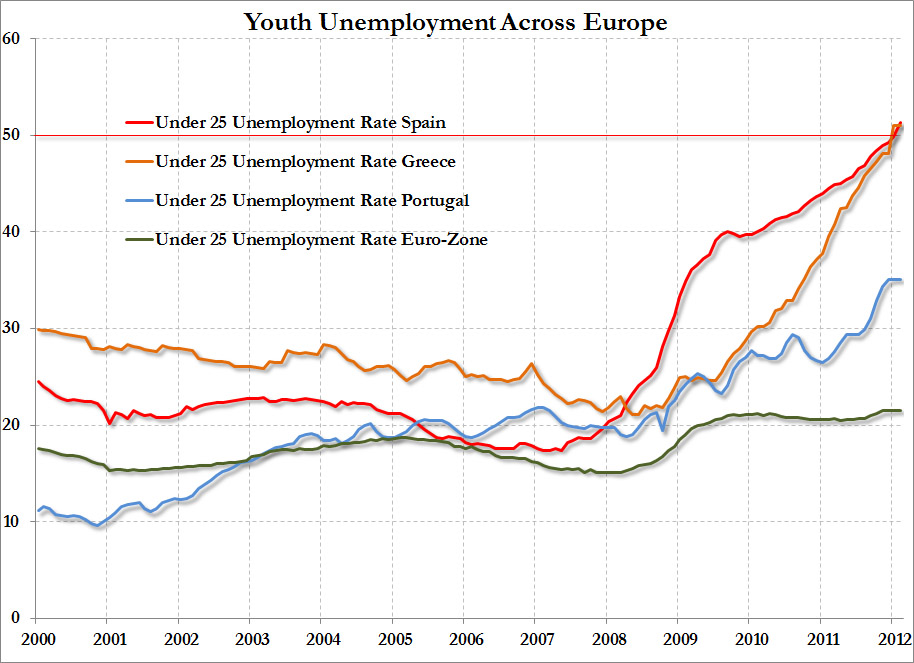 A busy week last week for value investing. Presenting in Perth for the ASX and in Melbourne as well as chatting to Ross Greenwood and Ticky Fullerton as I do regularly has cemented in my mind the idea that the case is building for a protracted de-leveraging (Click the European youth unemployment chart at left). I will bring you more about this de-leveraging vs recession idea soon as well as what I believe it means for share portfolios but for now I thought you might like a shortcut to some of the chats. And of course, all proudly brought to you by my very good friends at Skaffold.
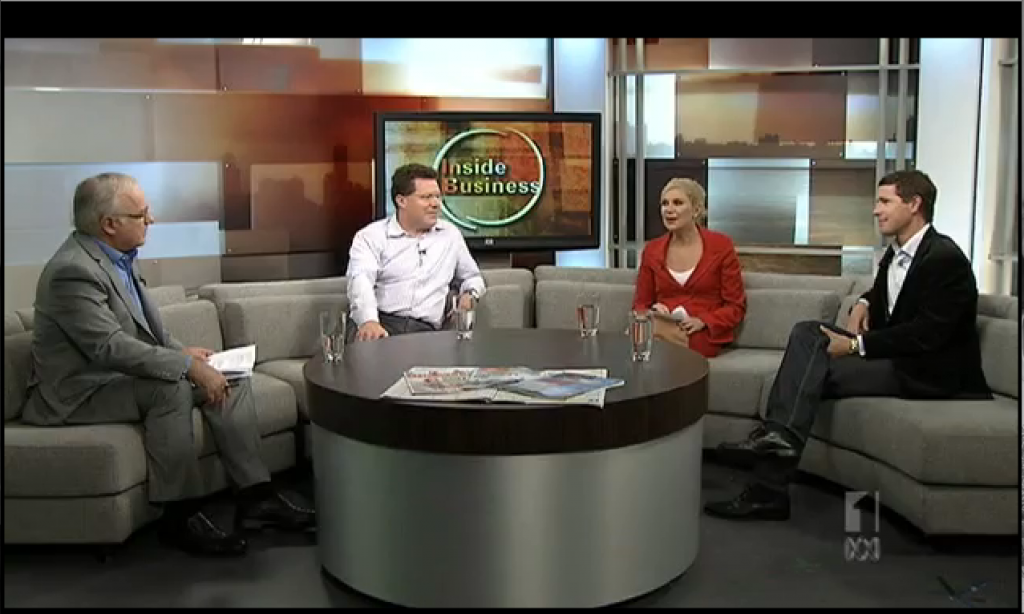
The subject came up with Alan Kohler last weekend on the ABC’s Inside Business. You can watch it by clicking here
It also came up on the ABC’s The Business with Ticky Fullerton, which airs at 8.30pm and just after 11pm Monday to Thursday. You can watch it by clicking here
And finally, here is the talk I gave recently for the ASX Investor Hour. You can simply click on the video below to watch the seminar or click HERE to view the seminar with slides.
There’s plenty to think about and stay tuned to find out what stocks we have been buying in the most recent quarter. If you are looking for hot tips you are at the wrong blog, as we may have bought the stocks I mention as being worthy of careful study as many as three months ago. And sadly, we have already benefited greatly from someone spruiking some of these stocks online and I am told by one CEO that they have been reported to ASIC.
Posted by Roger Montgomery, Value.able author, Skaffold Chairman and Fund Manager, 11 March 2012.
by Roger Montgomery Posted in Market Valuation, TV Appearances.
- save this article
- POSTED IN Market Valuation, TV Appearances
-
Is the rally over?
Roger Montgomery
March 8, 2012
 At the outset, let me say I am not going forecast anything. I don’t know whether the market will rise or fall next. Andy Xie however, in his column entitled; A world flying blind wrote: “Playing with expectations works temporarily. The risk-on trade is in a mini bubble, as today’s, buyers want to be ahead of the slower ones. The buying trend is sustainable only if the global economy strengthens, which is unlikely. The stocks aren’t cheap. Desirable consumer stocks are selling for 20 times earnings. Banks are cheap for a reason. Internet stocks suggest another bubble in the making. The Fed is trying to inflate an expensive asset. The rally, hence, is quite fragile. As soon as a shock like Greece defaulting or bad economic news unfolds, the market will quickly head south.”
In the great de-leveraging we are witnessing, cutting interest rates (monetary policy) doesn’t spur economic activity because businesses and individuals are simply trying to get out from under a mountain of debt first. The next option is to simply hand over money (quantitative easing) and then if that doesn’t work expand budget deficits through government spending (fiscal policy). A positive by-product of the money printing is that lower long-term bond rates guarantee a negative real yield – How can bonds be seen as ‘safe’ if they are 100% guaranteed to result in less purchasing power? – and investors are forced to buy other assets like stocks and pile into the “risk on” trade referred to above. Sadly, just as the money being printed isn’t finding its way into the economy – its being hoarded by the zombie banks who should have been allowed to collapse and/or write off their bad loans – the rally in the stock market isn’t helping the masses and indeed may itself be fading.
Chart 1 suggests to some investors that the latest attempt to encourage participation in the stock market hasn’t worked.
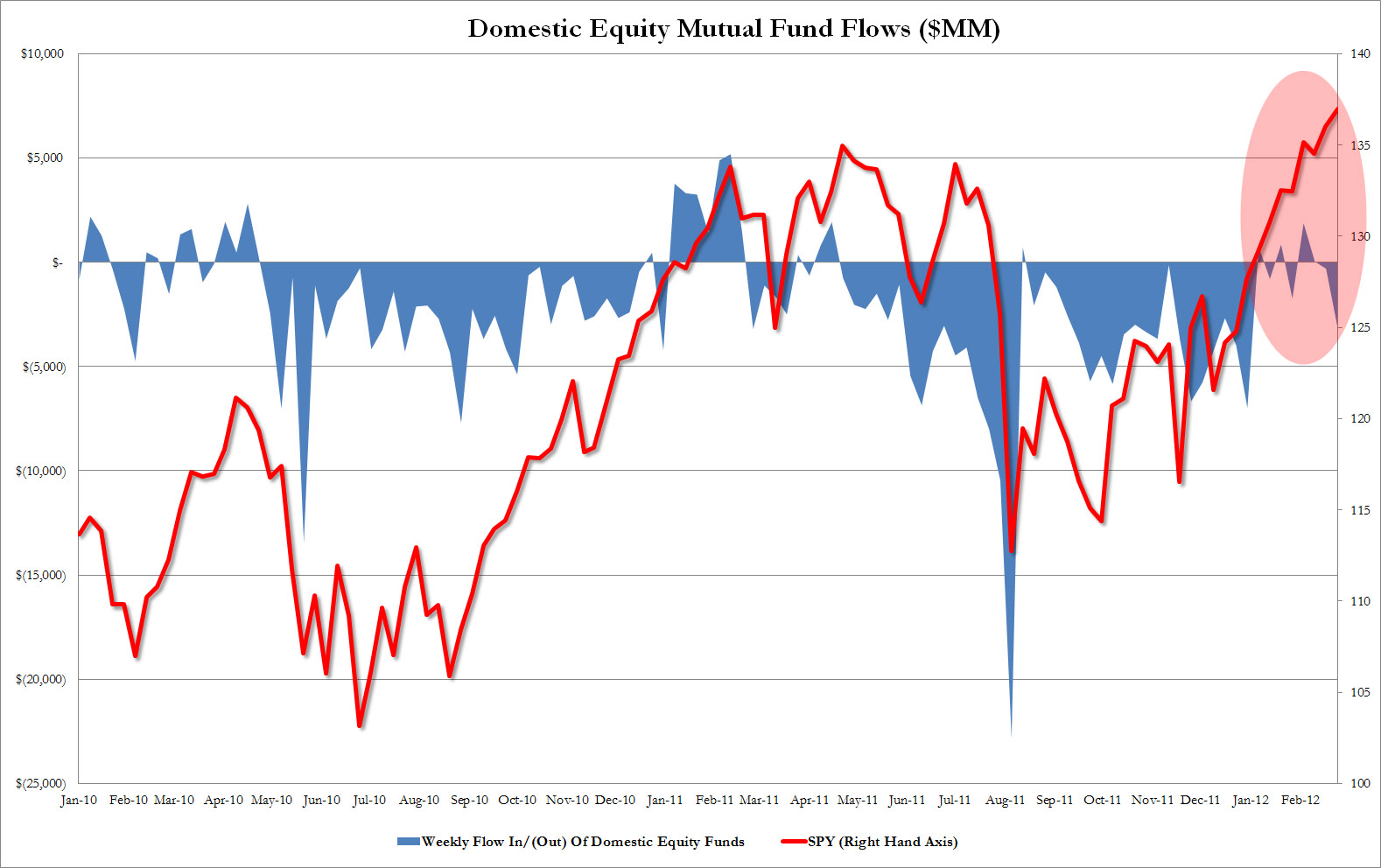
Chart 1 reveals that not only have retail investors continued to pull out cash from US equity mutual funds (about $66 billion since October), but the market peak of the week of February 29 coincided with the biggest weekly outflow for 2012 – $3 billion.
The Globe&Mail reported: “Retail investors, after gutting it out through years of awful returns, have finally fled. In a normal market, retail participation – Mr. and Mrs. Public trading their personal accounts – should be about 20 per cent. That plunged in November and December, traders say…
Traders Magazine noted: “On Wall Street, risk is suddenly a four-letter word. Retail investors can’t stomach it. Pension plan sponsors are allocating away from it.
“That’s bad news for stocks. Volume has been dropping almost nonstop for three years and shows no signs of improvement. The situation is worse than it was following the crash of 2000. It’s worse than it was after the crash of 1987. Fearful of the future and still wincing from 2008, investors are moving funds into bonds, commodities, cash, private equity, hedge funds and even foreign securities-anything but U.S. stocks.
“Our bread and butter is the retail investor,” Scott Wren, a senior equity strategist at Wells Fargo Advisors, one of the country’s four largest retail brokerages, told Bloomberg Radio recently. “They’re not jumping into the market. They’re not chasing it. Those who have been around for a little bit have been probably burned twice here in the last 10 years or so. They’re definitely gun-shy. They’re not believers. I’m not sure what it’s going to take to get them back in the market.”
As an aside, the reference to declining volumes over the last three years reminds me to republish the chart that I first published here: http://rogermontgomery.com/perhaps-one-of-the-most-important-charts/
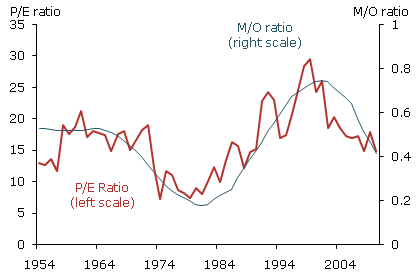
We wrote back in February; “A key demographic trend is the aging of the baby boom generation. As they reach retirement age, they are likely to shift from buying stocks to selling their equity holdings to finance retirement. Statistical models suggest that this shift could be a factor holding down equity valuations over the next two decades.
“The baby boom generation born between 1946 and 1964 has had a large impact on the U.S. economy and will continue to do so as baby boomers gradually phase from work into retirement over the next two decades. To finance retirement, they are likely to sell off acquired assets, especially risky equities. A looming concern is that this massive sell-off might depress equity values.”Chart 2. Ratio of accumulators to dissavers plotted against P/E ratios
Back to more recent observations and the 20% stock market rally over the last four months has been described as a completely artificial “ramp” by some and has been driven entirely by the global liquidity injections of the US, UK, European and Japanese central banks. The conclusions for some investors is that the smart money – those that have bought in anticipation of retail ‘follow-through’ will soon scramble for the exits. What do you think?
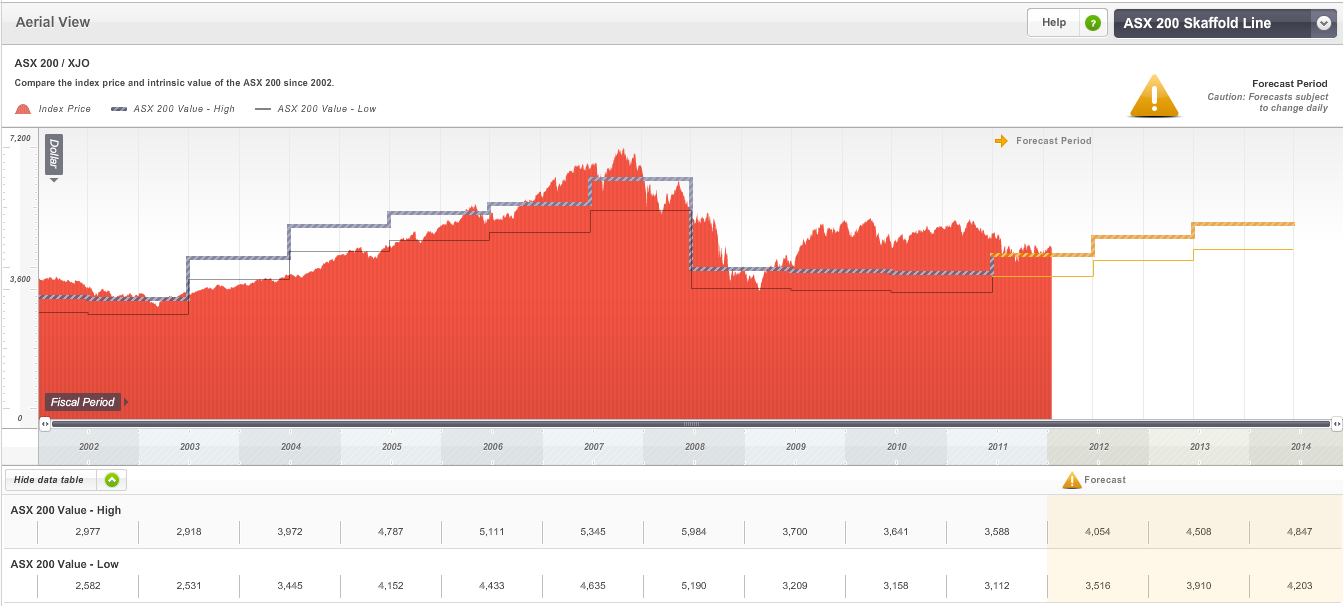
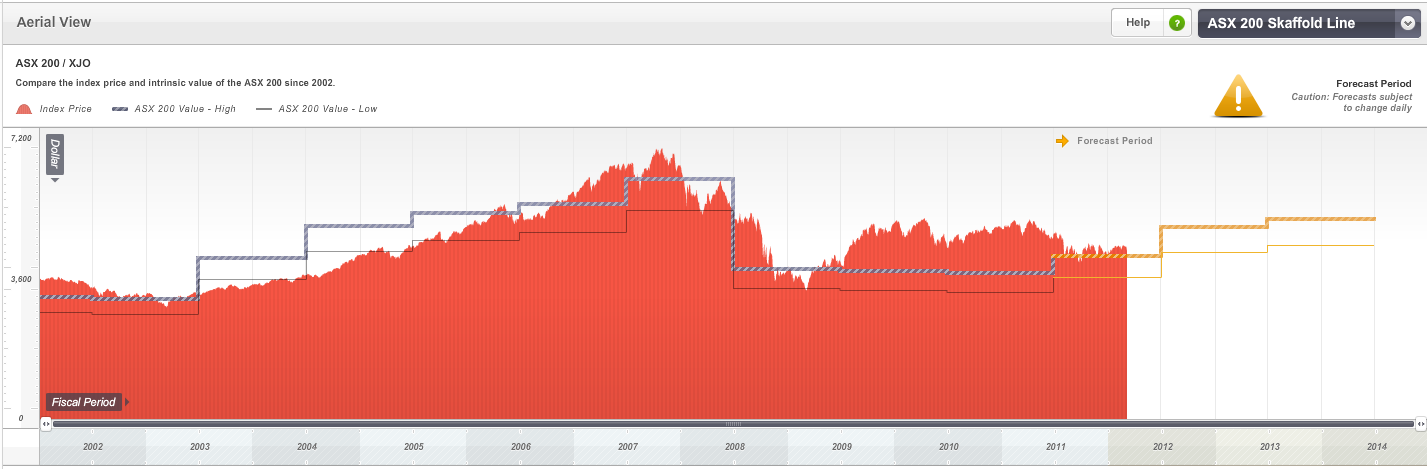
Skaffold’s ASX200 Value Indicator is a live and automatically-updated valuation estimate of the ASX200. It updates and changes every day. The future valuation estimates are based on the the constantly updated forecasts for earnings and dividends of the biggest 200 companies. You can’t beat it as a guide to the overall market level and whether you should be enthusiastic or not about looking more deeply for value.
Chart 3. ASX200 Value Indicator
Source: Skaffold.com
Based on current forecasts for 2012 you can see that the market looks about fair value. It isn’t overly expensive but neither is it, in aggregate, cheap. Based on 2013 forecasts however the market appears to be reasonable value. So the question is whether those 2013 forecasts are reasonable. Typically, forecasts are optimistic. We have previously written here of the persistence of optimism in forecasts by analysts. If that is again the case for 2013, then you wouldn’t be getting overly enthusaistic about our market unless there was a pull back. And according to those referenced above, a pull back is on the cards. What do you think?
I believe there are individual companies that have produced amazing results this reporting season and in an upcoming post we will list the very best. I also think that there is still some value among these companies. The challenge for those new to long term value investing is to be able to stick to your guns, accumulate positions in extraordinary companies at deep discounts to rational estimates of intrinsic value and stand apart from the daily gyrations of fear and rumour about default, money printing and recession.
Looking forward to your comments.
Posted by Roger Montgomery, Value.able author, Skaffold Chairman and Fund Manager, 8 March 2012.
by Roger Montgomery Posted in Companies, Insightful Insights, Market Valuation.
-
Is your portfolio filled with quality and margins of safety?
Roger Montgomery
February 20, 2012
 Click on the image at left to see a close up of the stocks we like.
I reckon 2012 will be the year to get set and fill your portfolio with high quality businesses, demonstrating bright prospects for intrinsic value growth and a margin of safety. That will be the topic of my talk today as I kick off the ASX’s 2012 Investor Hour series. Here are the details:
Topic: Buying opportunity
When: Tuesday 21 February
Where: Wesley Conference Centre, 220 Pitt Street, Sydney (venue location)
Time: 12 noon – 1pm. Please arrive by 12.00 noon for start
Details:The time to get interested in share investing and make good returns is precisely when everyone else isn’t. But know that the key to slowly and successfully building wealth in the sharemarket is to avoid losing money permanently.
At this event Roger will set out his principles for stock selection.
Roger Montgomery is a highly-regarded value investor, analyst and author and a regular contributor and commentator across the media. Roger is an analyst at Montgomery Investment Management Pty Ltd.
Presenter(s): Roger Montgomery, www.Skaffold.com, www.Montinvest.com
Posted by Roger Montgomery, Value.able and Skaffoldauthor and Fund Manager, 21 February 2012.
by Roger Montgomery Posted in Companies, Investing Education, Market Valuation.
-

WHITEPAPER
WHY I'M DOUBLING DOWN ON THE CALL TO INVEST IN PRIVATE CREDIT AND DIGITAL INCOME
Discover how private credit and market-neutral digital income strategies may enhance portfolio diversification in an environment where the traditional 60/40 approach is proving less effective.
READ HERE -
First base.
Roger Montgomery
February 6, 2012
 US jobs data was stronger than expected and resulted in global equity markets following the US reaction higher. But is all as it seems?
The increase in jobs was 243,000 but 490,000 were said to be temporary jobs. The employment number is now the same as a decade ago but a decade ago there were 30 million fewer people living in the US!
Charles Biderman notes that “Either there is something massively changed in the income tax collection world, or there is something very, very suspicious about today’s BLS hugely positive number,” adding, “Actual jobs, not seasonally adjusted, are down 2.9 million over the past two months. It is only after seasonal adjustments – made at the sole discretion of the Bureau of Labor Statistics economists – that 2.9 million fewer jobs gets translated into 446,000 new seasonally adjusted jobs.” A 3.3 million “adjustment” solely at the discretion of the BLS? And this from the agency that just admitted it was underestimating the so very critical labor participation rate over the past year? Perhaps with a hint of conspiracy theorist (all hints of which we run from as fast as possible) Biderman wonders whether the BLS is being pressured by the Obama administration during an election year to paint an overly optimistic picture. Hmmmmm…
The BLS however constantly ‘adjust’ its numbers and an January overadjustment occurs annually. Without the BLS smoothing calculation, the real economy lost 2,689,000 jobs, while net of the adjustment, it actually gained 243,000. So are conditions really getting better in the US or only in the adjustment column on an analyst’s spreadsheet?For those of you who have seen the amazing Abbott and Costello skit ‘Who’s on first’, here’s another take on it:
COSTELLO: I want to talk about the unemployment rate in America.
ABBOTT: Good Subject. Terrible Times. It’s 8.3%.
COSTELLO: That many people are out of work?
ABBOTT: No, that’s 16%.
COSTELLO: You just said 8.3%.
ABBOTT: 8.3% Unemployed.
COSTELLO: Right 8.3% out of work.
ABBOTT: No, that’s 16%.
COSTELLO: Okay, so it’s 16% unemployed.
ABBOTT: No, that’s 8.3%…
COSTELLO: WAIT A MINUTE. Is it 8.3% or 16%?
ABBOTT: 8.3% are unemployed. 16% are out of work.
COSTELLO: IF you are out of work you are unemployed.
ABBOTT: No, you can’t count the “Out of Work” as the unemployed. You have to look for work to be unemployed.
COSTELLO: BUT THEY ARE OUT OF WORK!!!
ABBOTT: No, you miss my point.
COSTELLO: What point?
ABBOTT: Someone who doesn’t look for work, can’t be counted with those who look for work. It wouldn’t be fair.
COSTELLO: To who?
ABBOTT: The unemployed.
COSTELLO: But they are ALL out of work.
ABBOTT: No, the unemployed are actively looking for work… Those who are out of work stopped looking.
They gave up and if you give up, you are no longer in the ranks of the unemployed.
COSTELLO: So if you’re off the unemployment rolls, that would count as less unemployment?
ABBOTT: Unemployment would go down. Absolutely!
COSTELLO: The unemployment just goes down because you don’t look for work?
ABBOTT: Absolutely it goes down. That’s how you get to 8.3%. Otherwise it would be 16%. You don’t want to read about 16% unemployment do ya?
COSTELLO: That would be frightening.
ABBOTT: Absolutely.
COSTELLO: Wait, I got a question for you. That means there are two ways to bring down the unemployment number?
ABBOTT: Two ways is correct.
COSTELLO: Unemployment can go down if someone gets a job?
ABBOTT: Correct.
COSTELLO: And unemployment can also go down if you stop looking for a job?
ABBOTT: Bingo.
COSTELLO: So there are two ways to bring unemployment down, and the easier of the two is to just stop looking for work.
ABBOTT: Now you’re thinking like an economist.
COSTELLO: I don’t even know what the I just said!While we are not waiting around for the swallows to sing – then spring will be over – we are buying stocks in a slow and measured way. We haven’t added any new stocks to our portfolio so we are adding to existing holdings.
In Australia, the situation may not be much better. Last year here at the blog we discussed the impending job losses at banks, manufacturers and retailers and all of that appears to be rolling along as predicted. But as my friend Bob Gottliebsen noted today; “At the weekend, Roy Morgan Research reported a big jump in unemployment during January. Almost certainly that will be reflected in the official figures when they are released later this month. Morgan uses a different method to calculate unemployment to the statisticians and Morgan’s December unemployment was 8.6 per cent, compared with the statisticians’ 5.2 per cent. But now Morgan estimates that January unemployment has skyrocketed from 8.6 to 10.3 per cent – the highest level since Morgan began calculating unemployment.”
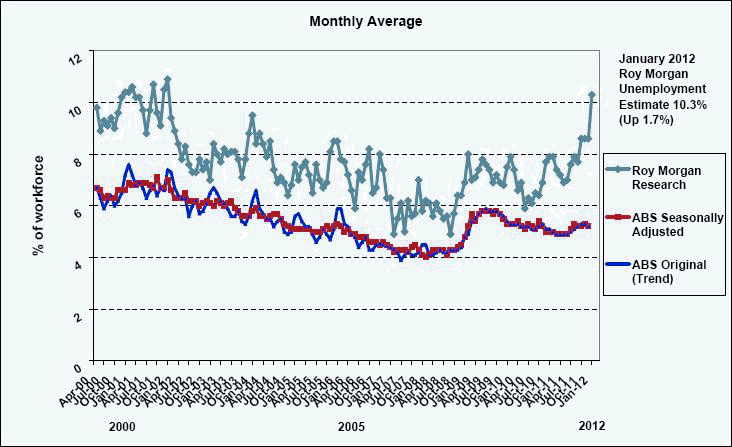 “There is no doubt there are seasonal issues as those leaving tertiary education try to join the labour force. They are usually not employed until February or later months. A rise of the proportion shown by Morgan reflects much greater forces than seasonal influences and in 2012 it will be much harder for students to gain employment than in 2011.”
What does it all mean for value investors – remember, we are not economists and macro economics is not part of the value.able bottom-up approach to investing? The implications are that we should be seeking deeper discounts to intrinsic value estimates and those estimates could decline further.
Given Skaffold (click here to Join) is currently suggesting the ASX200 is not cheap, we tend to be cautious even though my learned peers are betting with the world’s central banks that their printing of money and associated reduction in interest rates will force the world out of being defensively cash weighted and into equities and commodities.
We reckon gold makes sense in these times of destabilised fiat money. As you know we own a number of gold stocks (some of which have returned nearly 100%) and I bought more gold (physical) before Christmas.
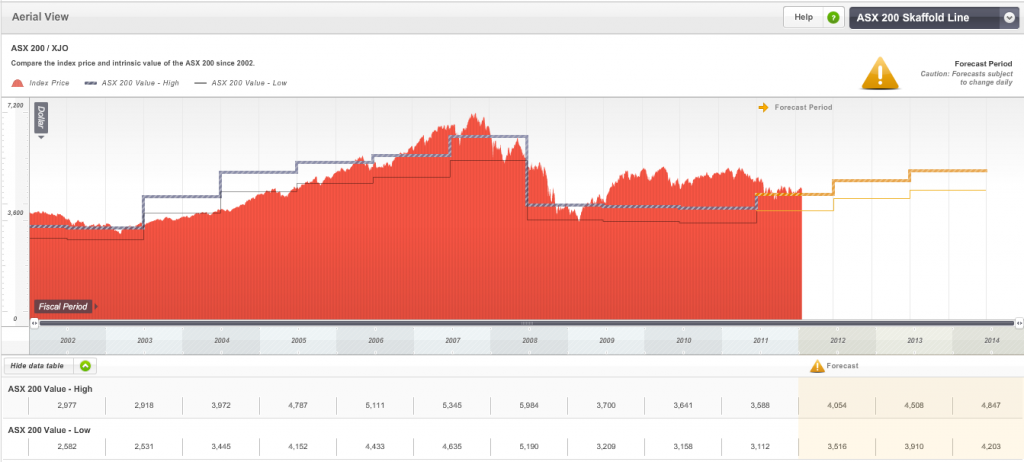 Here is the latest chart of the ASX200 plotted against Skaffold’s estimates of intrinsic value. You can see that the market is trading a little higher than the estimated intrinsic value for the index. That doesn’t mean it can’t go a lot higher, just that if you are a genuine bargain hunter, you may need to be patient. In light of the unemployment situation noted above and the painfully strong Australian dollar, that makes sense.
In addition to the powerful benefit of such a chart as the ASX 200 Skaffold line, which by the way, is automatically keeping you up-to-date daily for changes in analysts estimates of earnings and dividends for each of the 200 indices’ constituents, Skaffold members will enjoy an unprecedented level of interactivity in upcoming updates. By the way, I trust you are enjoying the enhanced search functionality the team delivered last week.
My team noted a few wanna-be competitors trying to plagiarise little aspects of Skaffold recently and I explained that they and you should “be flattered” and I told the team; “if you can see the competition, you aren’t at the front of the race”. Concentrate on staying in front by looking ahead and not at those trying to catch up. They respect Skaffold members too much to insult them by delivering second-hand ideas or technology. Skaffold keeps you in front with world beating ideas – remember the team that works on Skaffold works for Nike, Porsche, EA Games and Google. What possible hope do the competitors have? We’ve retained one of the world’s decorated design and development teams so Skaffold is.
Posted by Roger Montgomery, Value.able and Skaffold author and Fund Manager, 6 February 2012.
by Roger Montgomery Posted in Insightful Insights, Market Valuation, Skaffold.
-
MEDIA
Why does Roger Montgomery think 2012 may be our toughest year yet?
Roger Montgomery
February 1, 2012
Roger Montgomery discusses why the global investing outlook for 2012 will be impacted by a variety of negative influences in this Money Magazine article published February 2012. Read here.
by Roger Montgomery Posted in Insightful Insights, Investing Education, Market Valuation, On the Internet, Value.able.
-
Are investors giving up?
Roger Montgomery
December 20, 2011
 We have talked here at the blog about hypothecation, re-hypotecation and hyper-hypothecation, about credit default swaps about a Chinese property bubble bursting, about lower iron ore prices, slower economic growth, increased savings and declining rates of credit expansion and a European sovereign default. Always the value investor, we are on the look out for anything that can impact the values of companies and those things that might offer the prospect of picking up a few bargains.
If your portfolio still has some rubbish in it, then being able to identify it is a key part of preparing for cheaper prices if they eventuate.
I recently wrote a column for the ASX and pondered the possibility of a climactic event coinciding with a complete throwing in of the towel by equity investors who are simply fed up with poor medium term returns and increased volatility recently.
The ASX200 hasn’t generated a positive capital return since 2005 but quality companies have. The ASX200 contains stocks that are rubbish so it is no wonder that an index based on that rubbish has gone nowhere. Step 1 then is to clean up the portfolio and step 2 is to be ready for quality bargains when they arise.
This is just one of many scenarios and frameworks I am operating with and I wonder what would transpire if the poor returns or the recent heightened volatility continues for a little longer? Will investors simply throw in the towel, leave equities and believe all those advisors offering their own brand of ‘safe’, ‘secure’ and stable investments? On the one hand, I hope so. It would mean certain bargains.
Here’s the Column:
As global sharemarkets decline, remain volatile and produce poor historical returns compared to other asset classes, it will be easy to be swayed by the latest investment trend – to move out of shares. I believe the trend away from shares will gather pace soon as more and more “experts” use the rear-view mirror to demonstrate why sharemarket investors would have been better off somewhere else.
In 1974 US investors had just endured the worst two-year market decline since the early 1930s, the economy entered its second recessionary year and inflation hit 11 per cent as a result of an oil embargo, which drove crude oil prices to record levels. Interest rates on mortgages were in double digits, unemployment was rising, consumer confidence did not exist and many forecasters were talking of a depression.
By August 1979, US magazine BusinessWeek ran a cover story entitled ‘The Death of Equities’ and its experts concluded shares were no longer a good long-term investment.
The article stated: “At least 7 million shareholders have defected from the stockmarket since 1970, leaving equities more than ever the province of giant institutional investors. And now the institutions have been given the go-ahead to shift more of their money from stocks – and bonds – into other investments.”
But be warned. The time to get interested in share investing and make good returns is precisely when everyone else isn’t.
Your own once or twice-in-a-lifetime opportunity may not be that far away and Labor’s promised tax cut on interest earnings may sway even more to give up shares and put their money in a bank, providing the opportunity to obtain even cheaper share prices.
If prices do fall further – and they could – you will need to be ready and will need some cash. The very best returns are made shortly after a capitulation. Cleaning up your portfolio becomes crucial and this article looks at how to do that.
Rule one: Don’t lose money
The key to slowly and successfully building wealth in the sharemarket is to avoid losing money permanently. Sure, good companies will see their shares swing but the poor companies see the downswings more frequently.
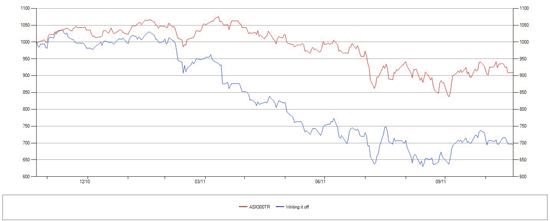
Therefore, the easiest way to avoid losing money is to avoid buying weak companies or expensive shares. One of the simplest ways I have avoided losing money this year in The Montgomery [Private] Fund has been to steer clear of low-quality businesses that have announced big writedowns.
These are easy to spot using Skaffold.
Not-so-goodwill
I have often seen companies make large and expensive acquisitions that are followed by writedowns a couple of years later. Writedowns are an admission by the company that they paid too much for an asset.
When Foster’s purchased the Southcorp wine business in 2005 for $3.1 billion, or $4.17 per share, my own valuation of Southcorp was less than a quarter of that amount. Then in 2008 Foster’s wrote down its investment by about $480 million, and then again by another $700 million in January 2009 and a final $1.3 billion in 2010.
When too much is paid for an acquisition, equity goes up but profits do not and you can see that too much was paid because that ratio I have worked so hard to make popular, return on equity (ROE), is low.
These low rates of return are often less than you can get in a bank account, and bank accounts have much lower risk. Over time, if the resultant low rates of return do not improve, it suggests the price the company paid for the acquisition was well and truly on the enthusiastic side and the business’s equity valuation should now be questioned. If return on equity does not improve meaningfully, a large writedown could be in the offing. This will result in losses if you are a shareholder, and you have also paid too much.
Just remember one of the equations I like to share:
Capital raised + acquisition + low rate of return on equity = writedown.When return on equity is very low it suggests the business’s assets are overvalued on the balance sheet. That, in turn, suggests the company has not amortised, written down or depreciated its assets fast enough, which in turn means the historical profits reported by the company could have been overstated.
Scoring bad companies: B4, B5, C4 and below…
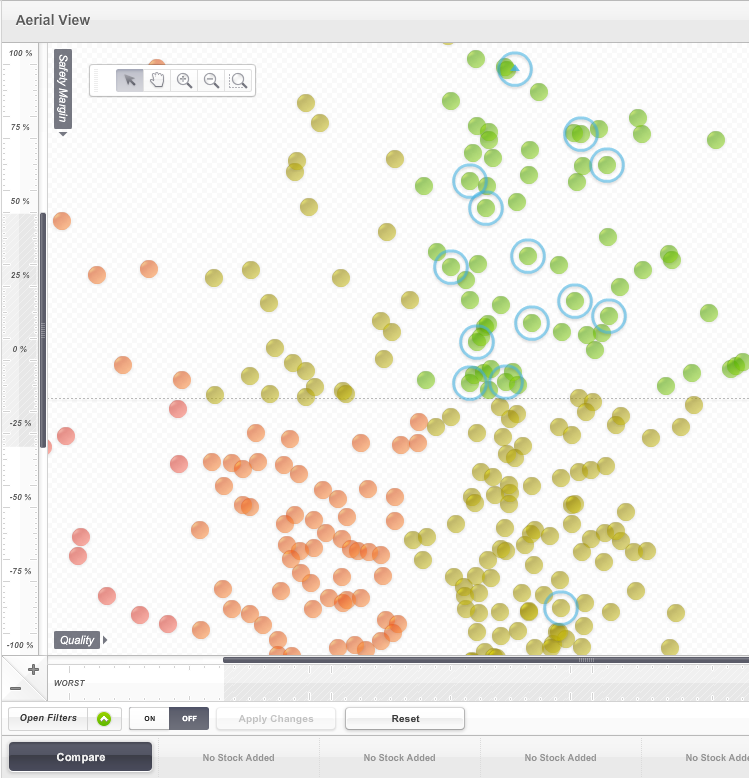
These sorts of companies tend to have very low-quality scores and often appear down at the poor end of the market – the left side of the screen shot in Figure 1 below.
Figure 1. The sharemarket in aerial view (Source; Skaffold.com)
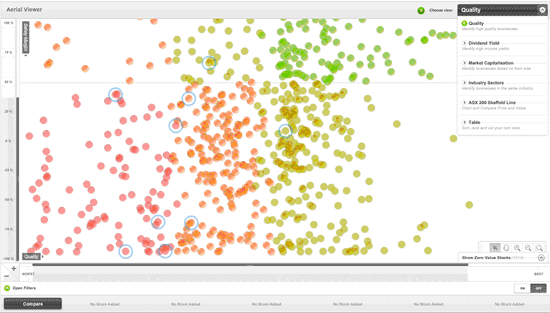
Each sphere in Figure 1. represents a listed Australian company and there are more than 2000 of them. The diagram is taken from Skaffold. Their position on the screen can change daily as the price, intrinsic value and quality changes. The best quality companies and those with positive estimated margins of safety (the difference between the company’s intrinsic value and its share price) appear as spheres at the top right.
Companies that are poor quality (I call them B4, C4 and C5 companies, for example) are found on the left of the screen and if they have an estimated negative margin of safety, they are estimated to be expensive and will be located towards the bottom of the screen.
Highlighted with blue rings in Figure 1 are eight of the companies that announced this year’s biggest writedowns. Notice they tend to be at the lower left of the Australian sharemarket, according to my analysis.
If your portfolio contains shares that are red spheres and on the lower left, you could also be at risk because these companies tend to have low-quality ratings and are also possibly very expensive compared to their intrinsic value.
As is clear from Figure 1, this year’s biggest writedown culprits were all already located in the area to avoid.
The impact of owning such a business outright would be horrendous. Table 1 below reveals the size and details of these writedowns and as you can see, collectively the losses to shareholders amount to $4.6 billion.
Table 1. Predictable losses?

Warren Buffett once said that if you were not prepared to own the whole business for 10 years, you should not own a piece of it for 10 minutes.
Clearly you would not want to own businesses that pay too much for acquisitions and subsequently write down those assets. If you are not willing to own the whole business, don’t own the shares. Although in the short run the market is a voting machine and share prices can rise and fall based on popularity, in the long run the market is a weighing machine and share prices will reflect the performance of the business. Time is not the friend of a poor company, and companies Skaffold rates C4 or C5 are best avoided if you want the best chance of avoiding permanent losses.
Look at Figure 2 below. Those big writedown companies not only performed poorly but so did their shares. These companies (shown collectively as an index in the blue line below) produced bigger losses for investors than the poorly performing indices of which they are part. And that’s just over one year.
Figure 2. The biggest writedowns compared to the market
Take a look at the companies in your portfolio. Do they have large amounts of accounting goodwill on their balance sheet as a portion of their equity? Have they issued lots of shares to make acquisitions and are they producing low and single-digit returns on equity? If the answer to all these questions is yes, you may have a C5 company.
Cleaning up your portfolio not only lowers its risk but will produce cash that may just prove handy in coming months.
If you have made it this far then here’s evidence of the giving up I referred to in the column: http://www.smh.com.au/business/investors-turn-to-term-deposits-in-shift-away-from-equities-20111219-1p2ir.html
Posted by Roger Montgomery, Value.able author and Fund Manager, 20 December 2011.
by Roger Montgomery Posted in Companies, Insightful Insights, Market Valuation, Skaffold, Value.able.
-
Returning to regular programming shortly…we hope!
Roger Montgomery
December 16, 2011
 Continuing on our hypothecation theme, David Stockman, former Director of the White House Office of Management and Budget during the Reagan Administration penned the following to Mrs Lee Adler of the Wall Street Examiner. Stockman is currently writing a book on the financial crisis and some of the thoughts he expresses in his exchanges with Adler relate to the ideas he is developing in the book.
Those you hoping for a quick end to the ructions in Europe and a return to normal levels of volatility may wish to ponder Mr Stockman’s thoughts on why European Banks are on the verge of collapse:
“The real story of the present is the shadow banking system, the unstable and massive repo market, and the apparent daisy chain of hyper-rehypothecated collateral. It looks like the sound bite version amounts to the fact that the European banking system is on the leading edge of collapse for the whole system. These institutions are by all evidence now badly deficient of the three hallmarks of real banks—deposits, capital and collateral.
BNP-Paribas is the classic example: $2.5 trillion of asset footings vs. $80 billion of tangible common equity (TCE) or 31x leverage; it has only $730 billion of deposits or just 29% of its asset footings compared to about 50% at big U.S. banks like JPMorgan; is teetering on $500 billion of mostly unsecured long-term debt that will have to be rolled at higher and higher rates; and all the rest of its funding is from the wholesale money market , which is fast drying up, and from repo where it is obviously running out of collateral.
Looked at another way, the three big French banks have combined footings of about $6 trillion compared to France’s GDP of $2.2 trillion. So the Big Three [F]rench banks are 3x their dirigisme-ridden GDP. Good luck with that! No wonder Sarkozy is retreating on France’s AAA and was trying so hard to get Euro bonds. He already knows he is going to be the French Nixon, and be forced to nationalize the French banks in order to save his re-election.
By contrast, the top three U.S. banks which are no paragon of financial virtue—JPM, Bank of America, and Citigroup—have combined footings of $6 trillion or 40% of GDP. The French equivalent of that number would be $45 trillion. Can you say train wreck!
It is only a matter of time before these French and other European banks, which are stuffed with sovereign debt backed by no capital due to the zero risk weighting of the Basel lunacy, topple into the abyss of the shadow banking system where they have funded their elephantine balance sheets. And that includes Germany, too. The German banks are as bad or worse than the French. Did you know that Deutsche Bank is levered 60:1 on a TCE/assets basis, and that its Basel “risk-weighted” assets are only $450 billion, but actual balance sheet assets are $3 trillion? In other words, due to the Basel standards, which count sovereign and other AAA assets as risk free, DB has $2.5 trillion of assets with zero capital backing!
This is all a product of the deformation of central banking and monetary policy over the last four decades and the destruction of honest capital markets by the monetary central planners who run the printing presses. Furthermore, this has fostered monumental fiscal profligacy among politicians who have been told for years now that the carry cost of public debt is negligible and that there would always be a central bank bid for government paper. Perhaps we are now hearing the sound of some chickens coming home to roost.”
Posted by Roger Montgomery, Value.able author and Fund Manager, 16 December 2011.
by Roger Montgomery Posted in Financial Services, Market Valuation.
-
Is the bubble bursting?
Roger Montgomery
December 8, 2011
 In 2010 here at the Insights Blog I wrote:
“a bubble guaranteed to burst is debt fuelled asset inflation; buyers debt fund most or all of the purchase price of an asset whose cash flows are unable to support the interest and debt obligations. Equity speculation alone is different to a bubble that an investor can short sell with high confidence of making money.
The bubbles to short are those where monthly repayments have to be made. While this is NOT the case in the acquisitions and sales being made in the coal space right now, it IS the case in the macroeconomic environment that is the justification for the purchases in the coal space.
China.
If you are not already aware, China runs its economy a little differently to us. They set themselves a GDP target – say 8% or 9%, and then they determine to reach it and as proved last week, exceed it. They do it with a range of incentives and central or command planning of infrastructure spending.
Fixed asset investment (infrastructure) amounts to more than 55% of GDP in China and is projected to hit 60%. Compare this to the spending in developed economies, which typically amounts to circa 15%. The money is going into roads, shopping malls and even entire towns. Check out the city of Ordos in Mongolia – an entire town or suburb has been constructed, fully complete down to the last detail. But it’s empty. Not a single person lives there. And this is not an isolated example. Skyscrapers and shopping malls lie idle and roads have been built for journeys that nobody takes.
The ‘world’s economic growth engine’ has been putting our resources into projects for which a rational economic argument cannot be made.
Historically, one is able to observe two phases of growth in a country’s development. The first phase is the early growth and command economies such as China have been very good at this – arguably better than western economies, simply because they are able to marshal resources perhaps using techniques that democracies are loath to employ. China’s employment of capital, its education and migration policies reflect this early phase growth. This early phase of growth is characterised by expansion of inputs. The next stage however only occurs when people start to work smarter and innovate, becoming more productive. Think Germany or Japan. This is growth fuelled by outputs and China has not yet reached this stage.
China’s economic growth is thus based on the expansion of inputs rather than the growth of outputs, and as Paul Krugman wrote in his 1994 essay ‘The Myth of Asia’s Miracle’, such growth is subject to diminishing returns.
So how sustainable is it? The short answer; it is not.
Overlay the input-driven economic growth of China with a debt-fuelled property mania, and you have sown the seeds of a correction in the resource stocks of the West that the earnings per share projections of resource analysts simply cannot factor in.
In the last year and a half, property speculation has reached epic proportions in China and much like Australia in the early part of this decade, the most popular shows on TV are related to property investing and speculation. I was told that a program about the hardships the property bubble has provoked was the single most popular, but has been pulled.
Middle and upper middle class people are buying two, three and four apartments at a time. And unlike Australia, these investments are not tenanted. The culture in China is to keep them new. I saw this first hand when I traveled to China a while back. Row upon row of apartment block. Empty. Zero return and purchased on nothing other than the hope that prices will continue to climb.
It was John Kenneth Galbraith who, in his book The Great Crash, wrote that it is when all aspects of asset ownership such as income, future value and enjoyment of its use are thrown out the window and replaced with the base expectation that prices will rise next week and next month, as they did last week and last month, that the final stage of a bubble is reached.
On top of that, there is, as I have written previously, 30 billion square feet of commercial real estate under debt-funded construction, on top of what already exists. To put that into perspective, that’s 23 square feet of office space for every man, woman and child in China. Commercial vacancy rates are already at 20% and there’s another 30 billion square feet to be supplied! Additionally, 2009 has already seen rents fall 26% in Shanghai and 22% in Beijing.
Everywhere you turn, China’s miracle is based on investing in assets that cannot be justified on economic grounds. As James Chanos referred to the situation; ‘zombie towns and zombie buildings’. Backing it all – the six largest banks increased their loan book by 50% in 2009. ‘Zombie banks’.
Conventional wisdom amongst my peers in funds management and the analyst fraternity is that China’s foreign currency reserves are an indication of how rich it is and will smooth over any short term hiccups. This confidence is also fuelled by economic hubris eminating from China as the western world stumbles. But pride does indeed always come before a fall. Conventional wisdom also says that China’s problems and bubbles are limited to real estate, not the wider economy. It seems the flat earth society is alive and well! As I observed in Malaysia in 1996, Japan almost a decade before that, Dubai and Florida more recently, never have the problems been contained to one sector. Drop a pebble in a pond and its ripples eventually impact the entire pond.
The problem is that China’s banking system is subject to growing bad and doubtful debts as returns diminish from investments made at increasing prices in assets that produce no income. These bad debts may overwhelm the foreign currency reserves China now has.”
I now wonder whether we are seeing the bubble slip over the precipice? Falling property prices (10 per cent of the Chinese economy) leads to lower construction activity, leads to declining demand for Australian commodities, leads to falling commodity prices, leads to bigs drops in margins for a sizeable portion of the market index…
Watch this video and decide for yourself.
Posted by Roger Montgomery, Value.able author and Fund Manager, 8 December 2011.
by Roger Montgomery Posted in Energy / Resources, Insightful Insights, Market Valuation, Property, Value.able.