

Right now, concentration is your portfolio’s biggest threat
On the surface, markets appear remarkably resilient, so if you’ve felt a sense of calm looking at your portfolio performance lately, you aren’t alone.
But look beneath the surface and the structural fragility you’ll see in valuations, government debt, and global trade makes holding a narrow, concentrated equity portfolio (including any portfolio largely invested in index ETFs) one of the more dangerous bets an investor can make right now.
- One-way markets don’t exist
Under the banner and theme of American exceptionalism, it’s easy to look at the massive gains in big tech, artificial intelligence (AI), and broad U.S. indices over the past few years and think, “Why own anything else?”
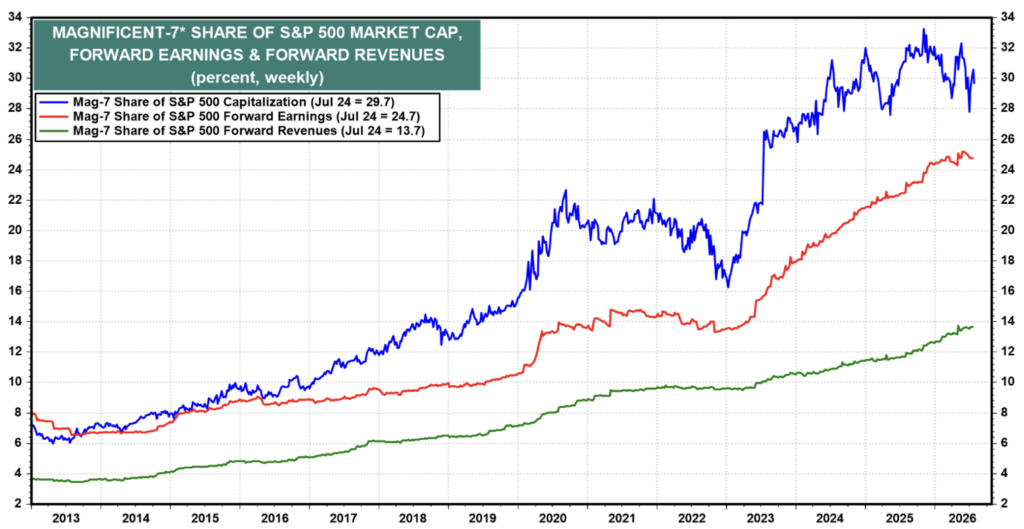
The problem is those index gains have become deceptively narrow. As Figure 1., reveals, a tiny handful of mega-cap companies have been carrying the weight of the entire stock market.
Figure 1. Mag 7 market share
Source: LSEG Datastream and Yardeni Research. Standard & Poor’s and I/B/E/S.
Meanwhile:
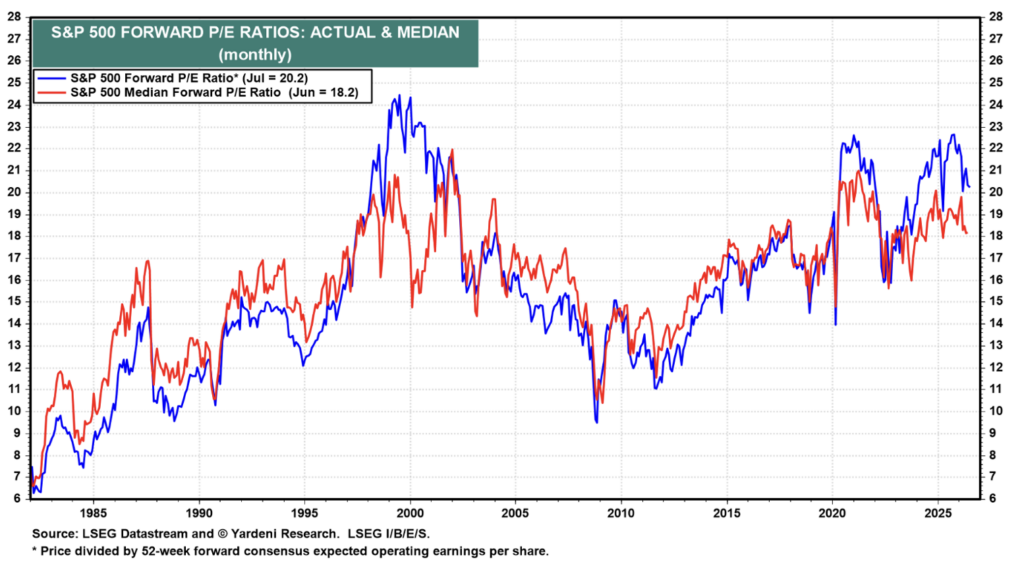
- Valuations are stretched to extremes: The S&P 500’s price-to-earnings ratios (P/Es) are near historic highs seen a couple of times in the last century. See Figure 2.
- Expectations are priced for perfection: AI will reshape productivity over the next decade, but the market has priced in decades of future earnings right now.
- The macro environment is tighter: High interest rates, persistent services inflation, and squeezed consumer budgets haven’t disappeared – they are simply being ignored by market headlines.
When a portfolio is concentrated in a few high-flying names, you aren’t just betting on tech – you are betting that the macro economy will perform perfectly. If reality chips away at that perfection, concentrated holdings reprice fast.
Figure 2. S&P500 P/E ratio
Source: LSEG Datastream and Yardeni Research. LSEG I/B/E/S.
- A new macro era:The death of cheap input costs
For thirty years, global corporate profits enjoyed three massive tailwinds: cheap manufacturing in Asia, cheap energy in Europe, and friction-free global trade.
The old regime, particularly in the U.S. was marked by frictionless global trade, ultra-low input costs and low government debt. That regime has been summarily flipped on its head. Today we have Trump-commanded reshoring, geopolitically-inspired supply chain disruption, and the soaring interest servicing costs on US$39 trillion of debt, which is moving many central banks to reduce their demand for U.S. bonds (which the U.S. needs to sell to finance it’s debt) and buy gold.
As countries pull supply chains back home and geopolitical friction rises, production costs go up. At the same time, major governments are running record deficits – the U.S. federal debt alone now incurs interest payments that exceed its total defence budget.
What does this mean for your money?
It means the companies that won the last decade by relying on cheap debt and low-cost global supply chains may not be the companies that win the next one.
- Diversification: moving beyond “60/40”
When complex systems face stress from multiple directions at once, they may appear to adjust gradually – until they reprice overnight.
I’ve seen it before. Markets drift lower initially until you wake up one morning and the S&P500 has fallen 600 points or over eight per cent from today’s levels.
Historical precedence
The S&P 500 has experienced several single-day drops exceeding 8 per cent:
- October 19, 1987 (Black Monday): -20.47 per cent
- March 16, 2020 (COVID-19 Crash): -11.98 per cent
- March 12, 2020: -9.51 per cent
- October 15, 2008 (Global Financial Crisis): -9.03 per cent
- December 1, 2008: -8.93 per cent
Of course, it’s not the goal of investing to guess the exact day the market shifts; it’s to build a portfolio that thrives no matter what happens next.
True diversification in today’s environment goes far beyond just buying a basic bond index. It means owning uncorrelated assets that handle different economic weather:
- Value & quality-focused equity funds: These are the active managers that have underperformed for years because they’ve stuck to their knitting and eschewed the hype cycle of AI. Remember Warren Buffett is now sitting on US$400 billion in cash and has underperformed the S&P500 for five years. Tilt your equity portfolio under-allocated factors and sectors that are trading at massive discounts compared to U.S. growth stocks.
- Tangible & real assets: Consider incorporating commodities (gold might be an option of the U.S. debt story becomes seriously problematic), infrastructure, and other scarce physical assets that hold their ground during periods of structural inflation.
- High-quality cash-flow winners: Prioritising ‘quality’ businesses with clean balance sheets, pricing power, and zero need to refinance debt at high interest rates.
- Alternative income: Consider private, floating-rate, short-duration, and non-traditional yield strategies that are uncorrelated with equities.
Diversification isn’t about giving up upside. It’s about taking some profits from equities that have done well (and yes paying a little tax), while making sure a single bad shift in sentiment, inflation, or interest rates doesn’t reset your retirement timeline by five years or more.
Concentration risk
If you haven’t adjusted your asset mix recently, recent equity market gains have likely pulled your allocation out of balance – leaving you far more exposed to single-sector risks than you think.
Consider a factor analysis of your portfolio, identify hidden concentration risks, and lay out a strategic plan tailored for the road ahead. There are multiple tools available online to assist you with your portfolio analysis.
For further information please contact David Buckland, Chief Executive Officer, or Rhodri Taylor, Account Manager, on (02) 8046 5000 or investor@montinvest.com.

Roger Montgomery is the Founder and Chairman of Montgomery Investment Management. Roger has over three decades of experience in funds management and related activities, including equities analysis, equity and derivatives strategy, trading and stockbroking. Prior to establishing Montgomery, Roger held positions at Ord Minnett Jardine Fleming, BT (Australia) Limited and Merrill Lynch.
He is also author of best-selling investment guide-book for the stock market, Value.able – how to value the best stocks and buy them for less than they are worth.
Roger appears regularly on television and radio, and in the press, including ABC radio and TV, The Australian and Ausbiz. View upcoming media appearances.
This post was contributed by a representative of Montgomery Investment Management Pty Limited (AFSL No. 354564). The principal purpose of this post is to provide factual information and not provide financial product advice. Additionally, the information provided is not intended to provide any recommendation or opinion about any financial product. Any commentary and statements of opinion however may contain general advice only that is prepared without taking into account your personal objectives, financial circumstances or needs. Because of this, before acting on any of the information provided, you should always consider its appropriateness in light of your personal objectives, financial circumstances and needs and should consider seeking independent advice from a financial advisor if necessary before making any decisions. This post specifically excludes personal advice.


