Monthly Archives: April 2011
What did Ben Graham get right?
Roger Montgomery
April 29, 2011

 If you are new to our Value.able community, Ben Graham’s concepts may be foreign to you. Ben is the author of Security Analysis. He is regarded as the father of security analysis and the intellectual Dean of Wall Street.
I support Ben’s revered status and what he has to say on the subject of investing, but perhaps controversially, I also believe that, had he access to a computer that allowed him to properly test his ideas, he may not have reached all of the same conclusions.
It is exactly one year since I first penned some of my thoughts about Ben Graham on this blog here: http://rogermontgomery.com/should-a-value-investor-imitate-ben-graham/
There are many things that Ben said that not only make sense, but has also made significant contributions to investment thinking. Indeed they have become seminal investment principles. These are the things to which Value.able investors should hold firm.
Ben Graham authored the Mr Market allegory and also coined the three most important words in value investing: Margin of Safety. In fact Ben said this: “Confronted with the challenge to distill the secret of sound investment into three words, I venture the motto: Margin of Safety”
These are two concepts that value investors hold dear and which have, in many different ways, become a formal part of our Value.able investing framework.
Mr. Market is of course a fictitious character, created by Ben to demonstrate the bipolar nature of the stock market.
Here is an excerpt from a speech made by Warren Buffett about Ben Graham on the subject:
“You should imagine market quotations as coming from a remarkably accommodating fellow named Mr Market who is your partner in a private business. Without fail, Mr Market appears daily and names a price at which he will either buy your interest or sell you his.
“Even though the business that the two of you own may have economic characteristics that are stable, Mr Market’s quotations will be anything but. For, sad to say, the poor fellow has incurable emotional problems. At times he feels euphoric and can see only the favorable factors affecting the business. When in that mood, he names a very high buy-sell price because he fears that you will snap up his interest and rob him of imminent gains…
“Mr Market has another endearing characteristic: He doesn’t mind being ignored. If his quotation is uninteresting to you today, he will be back with a new one tomorrow.
Transactions are strictly at your option…But, like Cinderella at the ball, you must heed one warning or everything will turn into pumpkins and mice: Mr Market is there to serve you, not to guide you.
“It is his pocketbook, not his wisdom that you will find useful. If he shows up some day in a particularly foolish mood, you are free to either ignore him or to take advantage of him, but it will be disastrous if you fall under his influence.”
If you have read Value.able you will understand Margin of Safety, know exactly what a suitable Margin of Safety is and also how to apply it to Australian stocks.
Despite the high profile of these two enduring lessons, I believe there is a third observation of Graham’s, which is equally important. Fascinatingly, with the benefit of computers, I can also demonstrate that Graham was spot on.
Graham was paraphrased by Buffett in 1993 thus:
“In the short run the market is a voting machine – reflecting a voter-registration test that requires only money, not intelligence or emotional stability – but in the long run, the market is a weighing machine”
What Graham described is something that, as both a private and professional investor, I have observed myself; in the short term the market is a popularity contest – prices often diverge significantly from that which is justified by the economic performance of the business. But in the long-term,prices eventually converge with intrinsic values, which themselves follow business performance.
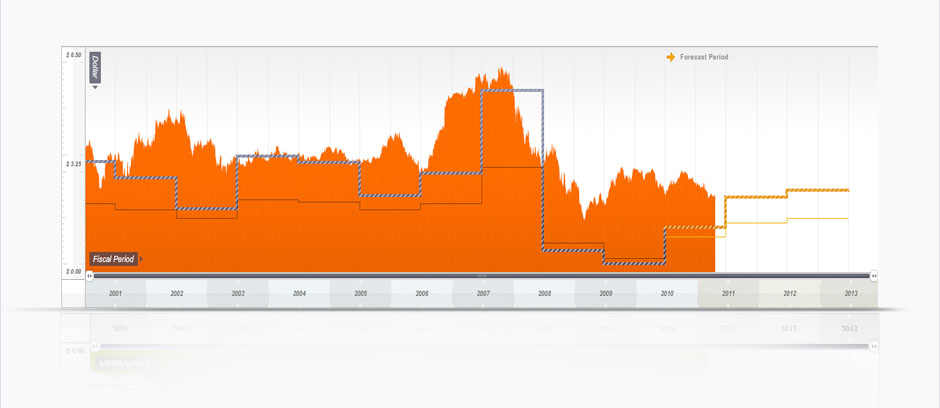
Have a look at the amazing chart below.
(c) Copyright 2011 Roger Montgomery
Its Qantas (ASX:QAN, MQR: B3, MOS-44%): – its my ten-year history of price and intrinsic value (and three year forecast of intrinsic value which updates daily). Now right click on the chart and open it in a new tab. Zoom in. Now stand back from your computer screen. What do you see?
First you will notice two intrinsic values – a range is produced. Next you might notice that there have been short term bouts of both optimism and despondency and this is reflected in the short term share price changes. The final observation you might make and which the charts make most powerfully, is that since 2001, the intrinsic value of Qantas, which is based on its economic performance has, at best, not changed. Look closer and you will notice that the intrinsic value of Qantas today (2011) is lower than it was a decade ago. Even by 2013, intrinsic value is not forecast to be materially different from that of 2002.
Just as Ben Graham predicted, the long-term weighing machine has correctly appraised Qantas’ worth. Unsurprisingly, the share price today of Australia’s most recognised airline, is also lower than it was a decade ago. And unbelievably, the total market capitalisation of Qantas today is less than the money that has been ‘left in’ and ‘put in’ by shareholders over the last ten years!
These charts aren’t just easy or nice to look at, they are incredibly powerful. If you can calculate intrinsic values for every listed company, you can turn the stock market off and simply pay attention to those values. Then, during those times that the market is doing something irrational, you can take advantage of it or ignore it, just as Ben Graham advised.
Unless you can see a reason for a permanent change in the prospects of Qantas, the long-term trend in intrinsic value gives you all the information you need to steer well clear of this B3 business.
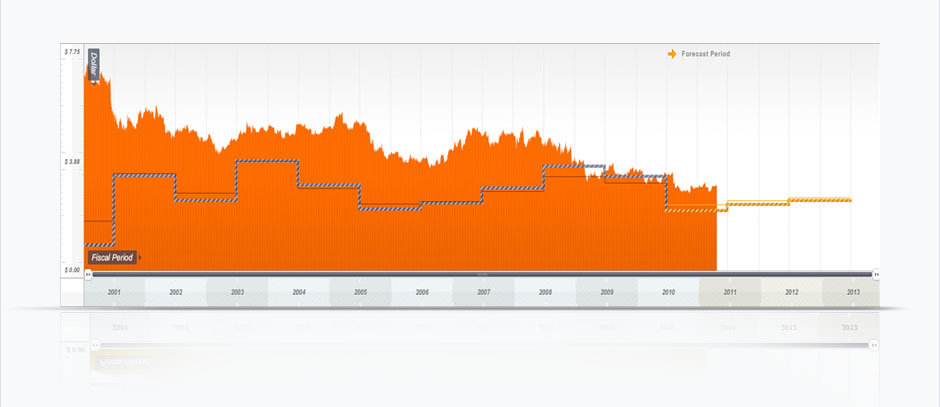
Now have a look at the second chart. What does it tell you?
(c) Copyright 2011 Roger Montgomery
There have been short-term episodes of price buoyancy, but over the long run the weighing machine has done its work. The intrinsic value has not changed in ten years so, over time, the share price has once again reflected the company’s worth and gradually but perpetually fallen until it reaches intrinsic value. This is my ten-year historical price and intrinsic value chart (and three year forecast) for Telstra (ASX:TLS, MQR: B3, MOS:-32%).
What about an extraordinary A1 business?
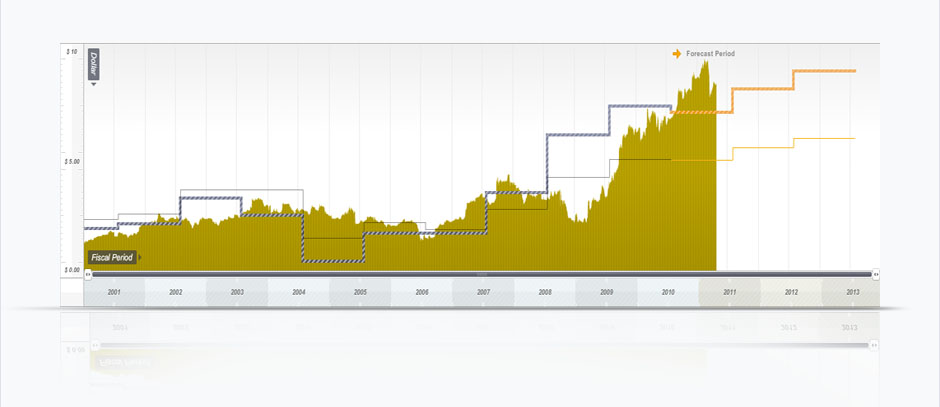
Sally Macdonald joined Oroton (ASX:OTN, MQR: A1, MOS:-17%) as CEO in 2005/06. Observe the strong correlation between price and value since Sally’s appointment.
(c) Copyright 2011 Roger Montgomery
I acknowledge that there are critics of the approach to intrinsic value we Value.able Graduates follow. But like me, you should be delighted there are. Indeed, we should be encouraging departure from this approach!
The critics are necessary. Not only do they help refine your ideas, but without them, how else would we be able to buy Matrix at $3.50, Forge at $2.60, Vocus at $1.60 or Zicom at $0.32! And how else would we be able to navigate around and away from Nufarm or iSoft, and not fall into the trap of buying Telstra at $3.60 because the ‘experts’ said it had an attractive dividend yield? If it was universal agreement I was after, I would just keep writing about airlines.
The Value.able approach works. If you have been visiting the blog for a while, you will know this only too well.
The above charts (automatically updated daily – and I have one for every, single, listed company) confirms what Ben Graham had discovered without the power of modern computing; In the short run the market is indeed a voting machine, and will always reflect what is popular, but in the long run the market is a weighing machine, and price will reflect intrinsic value.
If you concentrate on long-term intrinsic values and avoid the seduction of short-term prices, I cannot see how, over a long period of time, you cannot help but improve your investing.
…And in case you are wondering about the link between Ben Graham and the photograph of Comanche Indian ‘White Wolf’… the photo of White Wolf was taken in 1894 – the year Ben Graham was born.
HOMEWORK RESULTS: I will publish the holiday results homework on Monday. Thank you to all who participated. It is vital what you continue to practice your technique. With repetition you’ll get to the point where you can simply ‘eye-ball’ Value.able intrinsic value.
Posted by Roger Montgomery, author and fund manager, 29 April 2011.
by Roger Montgomery Posted in Companies, Consumer discretionary, Insightful Insights, Investing Education, Technology & Telecommunications, Value.able.
How should investors read a prospectus?
Roger Montgomery
April 28, 2011
I read recently that Kerry Stokes didn’t understand his company’s prospectus. What hope do retail investors have?
Kerry’s revelation emphasises the need for ASIC to intervene and make prospectus documents clear and concise. Last Thursday evening I shared my thoughts with Peter on Switzer TV. If you kept your copy of the Myer prospectus, watch the interview then flick past the first 28 pages of glamorous photography to the Pro Forma balance sheet.
What Value.able IPOs have you uncovered recently?
Posted by Roger Montgomery, author and fund manager, 28 April 2011.
by Roger Montgomery Posted in Investing Education.
- 79 Comments
- save this article
- 79
- POSTED IN Investing Education.
ValueLine: Where does IPO money go?
Roger Montgomery
April 27, 2011
When it comes to company floats, there’s one piece of information Roger Montgomery looks for above all others. Read Roger’s article at www.eurekareport.com.au.
by Roger Montgomery Posted in Media Room, On the Internet.
- 5 Comments
- save this article
- 5
- POSTED IN Media Room, On the Internet.
When to sell shares
Roger Montgomery
April 21, 2011
You can’t buy shares in a business and hold them forever. Business is dynamic and unfortunately many of those listed on the sharemarket are destined to be liquidated, or go into receivership or administration. Companies disappoint operationally, their prospects become less bright, they take on too much debt, pay too much for an acquisition, or their share price simply rallies far above any reasonable estimate of value. How then can you hold these shares and expect to do well? Read Roger’s article.
by Roger Montgomery Posted in Media Room, On the Internet.
- 57 Comments
- save this article
- 57
- POSTED IN Media Room, On the Internet.
How does Roger Montgomery read a Prospectus?
Roger Montgomery
April 21, 2011
ASIC specifies the information that companies seeking to float on the ASX must include in their prospectus. Yet Australia’s corporate landscape has a scattered history of hyped up floats followed by disappointment for many investors — Telstra, Qantas and Cool or Cosy are just a few. In this appearance with Peter on Switzer TV Roger Montgomery tells investors exactly what to look for in a prospectus. Roger’s advice? Go to the second last page – the Pro Forma balance sheet. And Roger’s advice for ASIC? Ensure vendors specify the impact of the float on the post listing balance sheet, write the prospectus in natural English and put the most important page – the Pro Forma balance sheet – on Page One! Watch the interview at youtube.com/rogerjmontgomery.
by Roger Montgomery Posted in Media Room, TV Appearances.
- save this article
- POSTED IN Media Room, TV Appearances.
ValueLine holiday homework for investors: how many of these ‘blue chips’ do you own?
Roger Montgomery
April 20, 2011
Roger Montgomery’s ValueLine portfolio for Alan’s Eureka Report rose by 12.79% in its first year of operation (with less than half the portfolio invested), compared to the index gain of 9.69%. This financial year the portfolio has grown by 15.11% compared to the index, which has grown by 12.71%. The invested portion of the portfolio returned 27.6% in year one and 23.4% this year thus far. It goes to show that Roger’s Montgomery’s Value.able strategy of buying the best stocks – those with the higher Montgomery Quality Ratings or MQRs – for less than they’re worth leads to meaningful outperformance over time. How the ‘blue chips’ in your portfolio compare? Compare your portfolio to Roger’s list of 51 companies and their Montgomery Quality Ratings. Read Roger’s article at www.eurekareport.com.au.
by Roger Montgomery Posted in Media Room, On the Internet.
- 76 Comments
- save this article
- 76
- POSTED IN Media Room, On the Internet.
Who asked for Easter holiday homework?
Roger Montgomery
April 14, 2011
 My team tell me that this year’s combination of Easter and Anzac Day has produced a once-in-a-lifetime succession of public holidays. I have encouraged them to use the time wisely – practicing Value.able intrinsic value calculations. In addition to spending precious time with family and friends, I encourage you to do the same.
We have an extraordinarily generous community of Value.able Graduates here at the blog and on my Facebook page. Special thanks to Ashley, Kent B, Lloyd, Rob, Matt R, Steve, Andrew, Gavin, Ken, William (Bill), Greg, John M, Ron, Joab (whom we will miss dearly – please keep in touch), Jonesy, Brad, Ann, O’Reilly, James, Trav, Omar, Michael, Costas, Emily and Anthony. If I have left anyone out please let me know. Thank you for sharing your wisdom with our community! I am sure there are many others who are delighted to help recent Graduates.
Before I reveal your Easter homework, here are a couple of links you may find helpful:
Webinar – I guide you, step-by-step, through a valuation
Data sources – The Value.able community’s guide to finding the data you need to calculate your own valuations.
Now to the homework…
I began with 1847 businesses and removed the 1168 that didn’t make any money last year (put $0 into the Value.able formula and you will get $0 out). That cut out 63 per cent of the Australian market… a useful first filter.
Then I applied the following criteria;
1) ROE > 20 per cent: (Chapter 6 – The ABC of Return on Equity)
2) Debt/Equity Ratio < 50 per cent: (Chapter 8 – Debt Is Not Always Good)
And then I refined the list further as follows;
3) 2011 forecast Earnings and Dividends are available: (Chapter 5 – Pick Extraordinary Prospects)
4) Must achieve one of the following Montgomery Quality Rating (MQR) – A1, A2, A3, B1, B2, B3: (Part Two – Identifying Extraordinary Businesses)
That left 255 stocks as the subject of your holiday homework. Using my discretion, I reduced the list to 14: The Reject Shop (ASX:TRS/MQR:A2), West Australian Newspapers (ASX:WAN/MQR:A2), Computershare (ASX:CPU/MQR:A2), Mermaid Marine (ASX:MRM/MQR:A3), Flexigroup Limited (ASX:FXL/MQR:A3), Cedar Woods Properties (ASX:CWP/MQR:A3), SAI Global Limited (ASX:SAI/MQR:B2), Fortescue Metals Group (ASX:FMG/ MQR:B2), Coca-Cola Amatil Limited (ASX:ASX:CCL/ MQR:B2), Retail Food Group (ASX:RFG/ MQR:B3), Telstra (ASX:TLS/ MQR:B3), McMillian Shakesphere (ASX:MMS/ MQR:B3), Bradken Limited (ASX:BKN/ MQR:B3) and Aristocrat Leisure Limited (ASX:ALL/ MQR:B3).
This homework is not about finding cheap stocks – it is about understanding businesses, return on equity, debt, cashflow and identifying extraordinary prospects. Effort calculating intrinsic value should only be exerted once you’re satisfied the business is extraordinary.
If you are keep to improve your investing with some useful examples, your holiday homework is as follows:
1. Download the 2011 Easter holiday homework worksheet – click here.
2. Calculate the 2010 Value.able intrinsic value and 2011 forecast Value.able intrinsic value (populate into the worksheet)
3. Then answer the following questions and perform the following tasks:
A. Of the 14 companies, list those demonstrating a rising value over the next twelve months.
B. The stocks of which companies, if any, are offering a margin of safety?
Important things to note:
- For consistency, use 10% Required Return
- 2011 Forecast Earnings Per Share and Dividends Per Share numbers are included in the Easter holiday homework spreadsheet. Use these numbers.
- You will have to get the 2010 ending equity (which is also the 2011 Beginning equity – from the annual reports)
If you need some guidance about how to calculate future valuations you can also read this post.
For those seeking a real challenge, re-read Value.able Chapter 9 on Cashflow (from page 152) and analyse the cashflow of each company using the balance sheet method. Click here to download the Cash Flow homework worksheet. At Montgomery Investment Management we only invest in businesses with strong cash flow. I will produce the cash flow analysis for The Reject Shop (TRS), Retail Food Group (RFG) and Aristocrat Leisure (ALL) after Easter.
My team and I wish you a happy Easter. I really do hope you have an enjoyable and rewarding break and that you enjoy the tasks I have set for you. I look forward to reviewing your results after the break.
Posted by Roger Montgomery, author and fund manager, 14 April 2011.
by Roger Montgomery Posted in Companies, Investing Education.
- 403 Comments
- save this article
- 403
- POSTED IN Companies, Investing Education.
Which small cap stock is Roger Montgomery’s fund buying right now?
Roger Montgomery
April 13, 2011
Roger Montgomery has picked some winning A1 stocks over the past twelve months — Forge and Matrix are just two. In this appearance on Your Money Your Call Roger reveals a new small cap stock that makes his Value.able grade. Roger also shares his insights on AMP, Woodside (WPL), Paladin Energy (PDN), TFS Corporation (TFC), and Australia’s big four banks. Is CBA still Roger’s preferred bank stock? Watch the interview.
by Roger Montgomery Posted in Media Room, TV Appearances.
- 8 Comments
- save this article
- 8
- POSTED IN Media Room, TV Appearances.
How does Roger Montgomery value speculative miners?
Roger Montgomery
April 13, 2011
In this appearance on Your Money Your call Roger Montgomery shares his thoughts about CEOs and founding shareholders selling shares. Does he begrudge Matrix CEO Aaron Begley selling 350,000 recently? Absolutely not! Roger also reveals his Value.able formula for calculating the cash burn rate of mining exporation businesses. Watch the interview.
by Roger Montgomery Posted in Media Room, TV Appearances.
- save this article
- POSTED IN Media Room, TV Appearances.
Which small cap gold stock is Roger Montgomery currently buying?
Roger Montgomery
April 13, 2011
Roger Montgomery and Ross Greenwood talk gold, commodities, inflation and the US economy on 2GB Money News. Listen to Podcast.
by Roger Montgomery Posted in Media Room, Radio.
- save this article
- POSTED IN Media Room, Radio.
- 1
- 2