

Why cheaper AI doesn’t mean easy profits
If you’ve been following the technology headlines, you might be confused by two seemingly contradictory statements. The first is that artificial intelligence (AI) is becoming dramatically cheaper to run, and the second is that tech companies are spending more money on AI compute than ever before.
How can we reconcile these statements, and what does the conclusion mean for companies like Pro Medicus (ASX: PME), Xero (ASX: XRO), NEXTDC (ASX: NXT), Megaport (ASX: MP1) and others?
If the unit price of AI is plummeting, shouldn’t the overall costs be going down? And if AI software is taking over the world, shouldn’t every startup building an AI application (App) be printing money?
To help explain the apparent dichotomy, you need to understand a 160-year-old economic concept called Jevons Paradox that’s currently being referenced everywhere and said to be driving the entire AI industry.
Back in 1865, an English economist named William Stanley Jevons noticed something counterintuitive. He observed that when steam engines became more fuel-efficient, overall coal consumption didn’t fall. It skyrocketed. Why? Because cheaper, more efficient engines suddenly made steam power practical for hundreds of new industries that couldn’t previously afford it.
At the same time, the falling price of coal spurred innovative novel uses that might not have been imagined before.
According to Wikipedia, “the Jevons paradox or Jevons effect is an economic phenomenon said to occur when technological improvements that increase the efficiency of a resource’s use lead to a rise, rather than a fall, in total consumption of that resource.”
Today, Jevon’s Paradox is being associated with artificial intelligence’s evolution.
The falling cost of ‘Inference’
In AI, every time a model answers a prompt, analyses a document, or writes code, it performs inference (the process of running a trained model to generate an output). The fundamental unit of measure for this work is a “token”. In standard English text, a Large Language Model (LLM) output uses about 1.33 tokens per word and since 2023, the over-the-counter cost of running these inference tokens has dropped by over 98 per cent. That means tasks that used to cost dollars now cost fractions of a cent.
In economics, when demand responds positively to the drop in price of a product or service, we say demand for that product or service is ‘elastic’.
Supporters of the AI thematic note that customers aren’t using the 98 per cent price drop to shrink their AI spend. Instead, because intelligence is so cheap, they are giving AI entirely new jobs. The bulls point to the shift from simple chatbots to autonomous AI agents that continuously run autonomous digital workers capable of multi-step execution, planning, and tool use, particularly for administrative workflow automation, autonomous software development, and specialised industry applications.
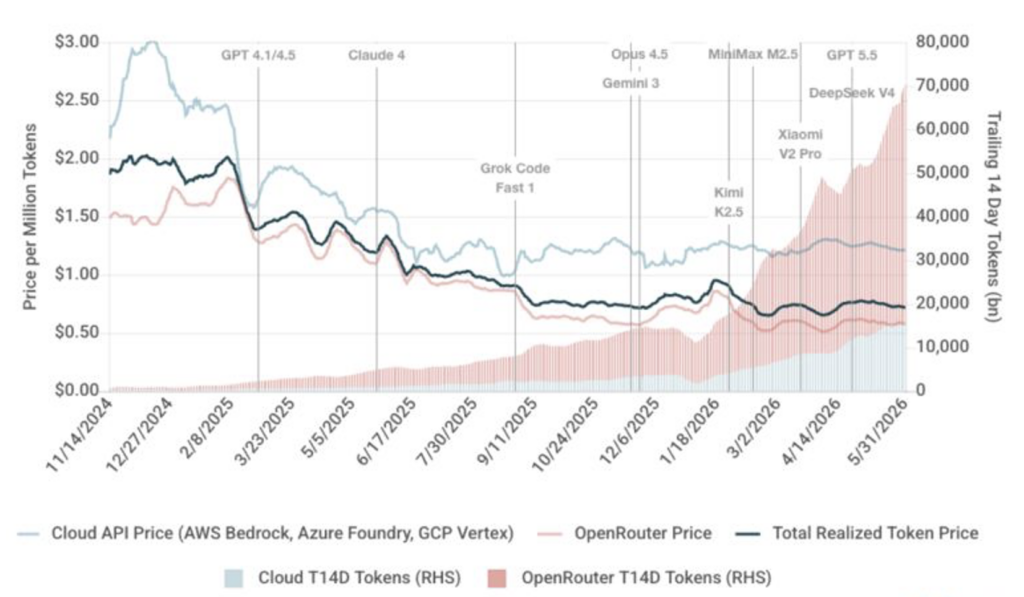
Because these new automated workflows run constantly, total token consumption has exploded. In other words, lower per-token prices haven’t cut company spending, but rather they’ve unlocked massive new use cases, driving total organisational spend on AI operations higher than ever.
Figure 1. Token prices vs. Token consumption
Source: Yipit Data
According to Yipit Data, while lower-cost models and optimisation techniques continue to gain traction, the data suggests the market is stabilising, especially among enterprise buyers who remain willing to pay [up] for leading model performance.
The risk of being underweight in the AI boom
Despite these surging usage metrics, many fund managers remain hesitant. Industry specialists, such as Fawaz Chaudhry, head of equities at UK-based Fulcrum Asset Management, point out a common fear among investors is that AI represents a market bubble waiting to burst.
Consequently, he asserts portfolios are under-allocated to tech.
The reality, however, is the top ten companies in the S&P 500 make up roughly 40 per cent of the index. That level of concentration and the popularity of index investing (according to the CBOE, index funds are responsible for 80 per cent of trading and active managers 10 per cent) means it’s near impossible for most investors to be underweight.
A source of fear for active managers is low-cost Chinese open-source AI models, such as DeepSeek or MoonshotAI. Many are panicked that vastly cheaper inference costs would slash demand for hardware. The bulls point to an economic reality that mirrors the classic Jevons effect. Lower costs render computing exponentially more accessible, triggering wider integration, requiring more data centres, and ultimately driving memory chip and hardware consumption upward rather than suppressing it.
Meanwhile, security considerations prevent Western enterprises from switching entirely to foreign open-source alternatives, ensuring the market expands for all primary compute providers.
But who takes the cash?
For investors, skyrocketing demand sounds like a dream. But here’s the catch: higher usage does not automatically mean higher profit margins for every company in the ecosystem.
The AI economy is bifurcating.
Upstream
At the top of the chain are the hyperscalers (Microsoft, Google, Amazon, and Meta) and foundation model creators (OpenAI, Anthropic, Cohere and Mistral AI).
These are the companies you have heard are shouldering hundreds of billions of dollars in capital expenditures (capex) to build massive data centres and buy specialised chips.
Because of their immense scale, they absorb efficiency gains as expanded capacity. In other words, they keep expanding and ‘reinvesting’ (spending) the gains. But they do hold long-term corporate contracts and control the physical pipelines, allowing them to capture a steady share of the sector’s revenue.
Downstream
At the bottom of the chain are software startups and traditional Software-as-a-Service (SaaS) companies building customer-facing AI tools.
This is where it gets really interesting. In traditional SaaS software economics, once you write a program, it costs virtually nothing extra to sign up a thousand extra users. The revenue drops straight to the bottom line. In other words, marginal gross margins of 80 to 100 per cent.
But AI software doesn’t work like traditional software code. Every time an AI app user clicks a button or prompts an agent, the app must call an underlying AI model, incurring a direct, linear cost per token.
If an app’s users start heavy automated workflows, the startup’s marginal costs explode. This keeps profit margins thin, fragile, and capped unless the app can charge customers significantly more than the compute costs. The possibility of that is almost impossible in a competitive market.
And that’s where debate lies. Token usage is rising as its cost is falling, but it seems there’s little money to be made from AI for the downstream application creators.
If these downstream customers discover they can’t make money offering AI software to customers, then why would they create the tools in the first place? And it follows then that money won’t flow upstream to the hyperscalers for the compute?
Perhaps we haven’t reached that point yet.
Structural losers
As AI evolves and unit economics transforms, investors will have to identify structural losers that are vulnerable to rapid obsolescence.
One theory goes that legacy Software-as-a-Service (Saas) platforms face severe headwinds when small developer teams leveraging modern AI can rapidly replicate complex enterprise codebases. But if those teams cannot offer an alternative that is profitable for them (because the marginal costs of AI keep rising with customer token usage), then the legacy software companies are killed off, but the disruptors fail too.
Beyond public equity markets, the structural shift poses challenges for private equity and private credit markets.
A substantial portion of U.S. private credit portfolios remains concentrated in software and services businesses, which are highly exposed to AI disruption, while holding minimal exposure to thriving physical sectors like energy and industrials. As legacy software valuations face downward pressure, portfolio managers are expected to experience mounting difficulty in generating liquidity without marking down stale asset values.
Power & energy
There’s another force capping margins, and that’s imposed by the physical environment.
It’s now well-known that data centres require colossal amounts of electricity and specialised cooling. As hyper-scalers build bigger facilities, local power grids are hitting their physical limits. Rising electricity costs and infrastructure bottlenecks act as a natural brake on profit margins. Software optimisations can only go so far when constrained by finite power grid and fresh water supply.
Beyond ‘Tokenmaxxing’
Earlier in the boom, which wasn’t that long ago, many software teams engaged in something called ‘tokenmaxxing’ – indiscriminate AI use that chewed up as many tokens as necessary because compute seemed cheap.
By 2026, the market matured, and businesses began to realise that unmonitored AI and token usage burns through cash fast, so the market pivoted towards, or at least began to prioritise, efficiency, strict Return On Investment (ROI), and workflow governance.
Putting aside the risk of the whole thing being a bubble that’s about to burst, there are a few things investors might want to think about if investing in the next phase of the AI boom.
- Vertical integration: Find companies that fully own or tightly control their entire tech stack – from specialised data processing up to the user interface. That should mean they can optimise costs at every layer rather than paying the full retail price for third-party Application Programming Interfaces (APIs).
- On-premises compute strategy: Find companies utilising custom, dedicated, or ‘on-premises’ infrastructure for core workloads, which is estimated to reduce compute costs by 40 to 60 per cent compared to standard public cloud pricing.
- Avoid cost-cutters: Companies using AI simply to lay off staff often hit a ceiling in efficiency. At the moment, they also hit limits in product and service quality. The long-term winners are more likely to be those using AI to multiply what their existing workforce can produce, creating entirely new revenue streams rather than just marginal savings.
Conclusion
Jevons Paradox says that as AI gets cheaper, the total market for intelligence will keep expanding. But investors mustn’t confuse market growth with company profitability.
Be cautious with ‘middleman’ software companies that simply resell third-party AI APIs – they risk being squeezed between rising backend compute costs and price-sensitive customers.
Some examples of companies benefitting from AI
An Australian example might be Xero (ASX: XRO), which sits on a powerful trove of proprietary small-business financial data. As it rolls out generative AI tools (such as “JAX” embedded within accounting workflows) powered by partnerships with Anthropic (Claude) and Microsoft, it has to carefully manage token usage. While higher AI usage introduces additional compute costs, Xero’s large customer base, pricing power and embedded workflows could help it to capture the benefits of AI while preserving margins.
Another local example might be TechnologyOne (ASX: TNE): An enterprise ERP software provider for government and education. Like Xero, it has strong data lock-in, but as it embeds AI assistants into its enterprise platform, it faces the challenge of absorbing third-party model costs without eroding its profit margins. While AI introduces API and compute expense friction that must be monetised, over the longer term their deep institutional data and single-instance ERP software may mean generic AI wrappers can’t displace them.
You may also want to focus your research on the infrastructure builders, the vertically integrated platforms, and the efficient enterprises that treat AI as a multiplier for human capacity.
Consider researching NEXTDC (ASX: NXT): Australia’s largest independent pure-play data centre developer. Rather than competing on software, NEXTDC sells the hyper-dense power, cooling, and rack space required for heavy AI inference and training. It serves foundational hyperscalers and key global AI platforms, turning raw hardware demand into long-term contracted utility revenues.
Goodman Group (ASX: GMG): Historically a logistics real-estate giant, Goodman transformed into one of the region’s largest AI infrastructure land and power owners. They hold multi-gigawatt power banks and high-capacity sites. Because grid connections and power permits are the single largest physical bottleneck for AI expansion worldwide, Goodman possesses pricing power.
Megaport (ASX: MP1): AI agents and foundation models generate massive data transfers across clouds. Megaport’s “Network-as-a-Service” provides the elastic, high-speed interconnectivity that routes heavy compute workloads between data centres, enterprise hubs, and cloud providers. Positioning themselves as a critical piece of AI infrastructure.
Pro Medicus (ASX: PME): A health-tech leader in cloud-based medical imaging (Visage). Pro Medicus owns deep, proprietary algorithms and direct workflow integration in hospital systems. Because clinical diagnostics require high regulatory precision, safety, and proprietary domain processing, it operates with high, defensible profit margins (~65 per cent+ operating margins) that generic AI APIs might not be able to easily replicate.
At risk
Appen (ASX: APX), a data-labelling vendor rather than a software wrapper, represents the ultimate victim of the AI shift. As foundation models gain the ability to self-label data and images, and as synthetic data generation matures, Appen’s core human-in-the-loop business model loses its value proposition.
Disclaimer:
The Montgomery [Private] Fund, The Montgomery Fund, Australian Eagle Equities Fund own shares in Xero, Megaport, and Technology One. The Montgomery [Private] Fund, The Montgomery Fund, Australian Eagle Equities Fund, and Montgomery Small Companies Fund own shares in Megaport.
This article was prepared 24 July 2026 with the information we have today, and our view may change. It does not constitute formal advice or professional investment advice. If you wish to trade any of these companies you should seek financial advice.

Roger Montgomery is the Founder and Chairman of Montgomery Investment Management. Roger has over three decades of experience in funds management and related activities, including equities analysis, equity and derivatives strategy, trading and stockbroking. Prior to establishing Montgomery, Roger held positions at Ord Minnett Jardine Fleming, BT (Australia) Limited and Merrill Lynch.
He is also author of best-selling investment guide-book for the stock market, Value.able – how to value the best stocks and buy them for less than they are worth.
Roger appears regularly on television and radio, and in the press, including ABC radio and TV, The Australian and Ausbiz. View upcoming media appearances.
This post was contributed by a representative of Montgomery Investment Management Pty Limited (AFSL No. 354564). The principal purpose of this post is to provide factual information and not provide financial product advice. Additionally, the information provided is not intended to provide any recommendation or opinion about any financial product. Any commentary and statements of opinion however may contain general advice only that is prepared without taking into account your personal objectives, financial circumstances or needs. Because of this, before acting on any of the information provided, you should always consider its appropriateness in light of your personal objectives, financial circumstances and needs and should consider seeking independent advice from a financial advisor if necessary before making any decisions. This post specifically excludes personal advice.


