
Summarising my current AI thesis – Part 1
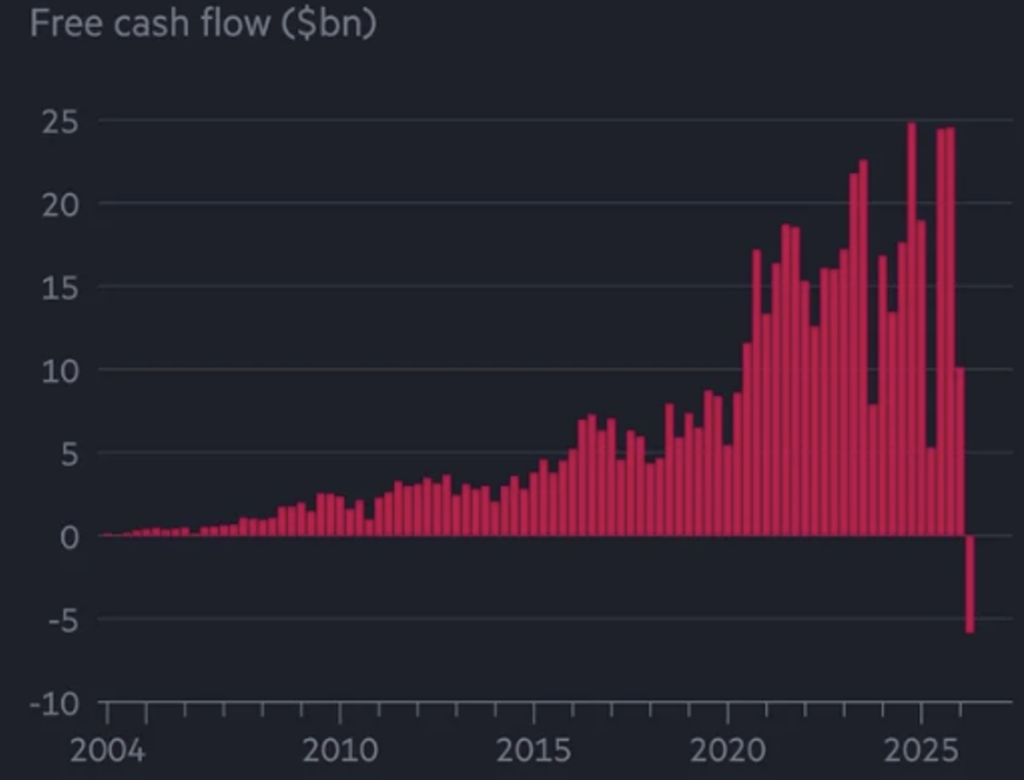
Last week, Google reported its first ever quarter of negative cash flow, surprising analysts who thought Q1 2027 would be when pressure on cash flows could seriously emerge, and causing the share price to plunge more than seven per cent.
With the clear exception of Tesla, most of the Mag 7 once deserved high earnings multiples because they were asset-light businesses with competitive advantages that didn’t require money to be defended. The artificial intelligence (AI) race has quickly eroded those moats and their characterisation as asset-light, because, over the last two years, they have had to spend hundreds of billions building data centres to remain competitive.
Figure 1. Google reports first quarter of negative cash flow.
Source: Bloomberg
Here, I summarise my current AI thesis using analysis from my previous posts, including July’s Watching Hyperscaler Debt, June’s The AI Bubble – Cracks Beneath the Surface, and the more recent The AI Boom Turns S&P 500 into a Dangerous Bet.
Is The AI Boom on borrowed time? Five ideas:
- Precipitous deterioration of Hyperscaler Free Cash Flow (FCF)
The primary financial engine behind the AI buildout is suffering a severe cash bleed. While tech giants like Microsoft, Alphabet, Amazon, and Meta report strong operating cash flows, their record capital expenditures (capex) – poured into data centres, power infrastructure, and Graphics Processing Units (GPUs) – are consuming almost all of it. And for Google, last quarter, it consumed all of it and more.
Capex across the hyperscalers is consuming upwards of 80–90 per cent of operating cash flow, causing free cash flows to plummet. When adjusted for lease liabilities (like equipment and server right-of-use assets), real free cash flow yield is heavily squeezed. Spending cash faster than generating it creates a widening gap between physical factory construction and net cash left over. And that means borrowing.
- Transition from cash-funded growth to debt issuance
The initial wave of the AI boom was comfortably funded out of tech companies’ vast cash reserves. However, as capex needs exploded past operational earnings, hyperscalers and infrastructure players (e.g., Oracle, CoreWeave) switched heavily to debt markets.
AI-related debt surged to account for roughly 18 per cent of all U.S. investment-grade bond supply in H1 2026, with hyperscaler gross leverage doubling from 0.9x to 1.8x – a leverage ratio higher than the energy sector. Credit default swap (CDS) spreads on hyperscalers have widened significantly, signalling that bond markets are beginning to price in rising credit risk as corporate debt collides with falling cash flows.
- Monetisation lag, falling token prices, and margin compression
For massive infrastructure investments to pay off, return on invested capital (ROIC) must materialise before debt and depreciation costs overwhelm the profit and loss (P&L). However, the economic reality of AI software is facing structural headwinds.
AI token prices are falling rapidly due to fierce competition as players like OpenAI, Anthropic, and Google keep slashing API prices to win market share. Meanwhile, High-performing open-source models (like Meta’s Llama) and foreign models (like DeepSeek, Qwen and now, Kimi3) give businesses free or near-free alternatives. When high-quality alternatives are virtually free, charging high margins becomes nearly impossible.
Meanwhile, market forecasts assume rapid monetisation and revenue uplift, but history shows General-Purpose Technology (GPT) infrastructure cycles feature a long lag between buildout and meaningful enterprise adoption. In fact, many GPTs through history have first endured and crash and near wipeout before the associated lower prices permitted wide customer adoption. If payoffs take years longer than priced in, analyst earnings forecasts will face downward revisions.
- Overstated reported earnings and accounting nuances
Reported price-to-earnings (P/E) ratios across major tech companies can look deceptively reasonable, masking an underlying earnings bubble.
Standard accounting often understates true capital commitments by excluding finance lease principal repayments and off-balance-sheet leasing arrangements from capex. Furthermore, short depreciation timelines on rapidly obsolete AI hardware mean true economic depreciation is higher than what is currently being amortised. As a result, reported net income overstates actual economic profitability.
- Dangerous market concentration and dot-com era parallels
The AI narrative has created historic market concentration, turning major benchmark indices like the S&P 500 into concentrated bets on a single theme.
Today’s tech leaders are different to the profitless peers of the 1999 Dot-Com bubble, but the market dynamics are similar. And don’t forget markets can crash, and have crashed, from low P/E levels too. Roughly 75 per cent of historical tech booms follow the exact same arc: initial hype lowers cost of capital, leading to colossal over-investment, followed by financial carnage and eventual price rationalisation. When equity risk appetite wanes or higher interest rates persist, a sentiment shift can trigger a market-wide equity re-rating across chips, energy, cloud, and broader indices.
Read Summarising my current AI thesis – Part 2 here.

Roger Montgomery is the Founder and Chairman of Montgomery Investment Management. Roger has over three decades of experience in funds management and related activities, including equities analysis, equity and derivatives strategy, trading and stockbroking. Prior to establishing Montgomery, Roger held positions at Ord Minnett Jardine Fleming, BT (Australia) Limited and Merrill Lynch.
He is also author of best-selling investment guide-book for the stock market, Value.able – how to value the best stocks and buy them for less than they are worth.
Roger appears regularly on television and radio, and in the press, including ABC radio and TV, The Australian and Ausbiz. View upcoming media appearances.
This post was contributed by a representative of Montgomery Investment Management Pty Limited (AFSL No. 354564). The principal purpose of this post is to provide factual information and not provide financial product advice. Additionally, the information provided is not intended to provide any recommendation or opinion about any financial product. Any commentary and statements of opinion however may contain general advice only that is prepared without taking into account your personal objectives, financial circumstances or needs. Because of this, before acting on any of the information provided, you should always consider its appropriateness in light of your personal objectives, financial circumstances and needs and should consider seeking independent advice from a financial advisor if necessary before making any decisions. This post specifically excludes personal advice.


