

Sovereign debt yields continue to climb – is a debt crisis on the cards?
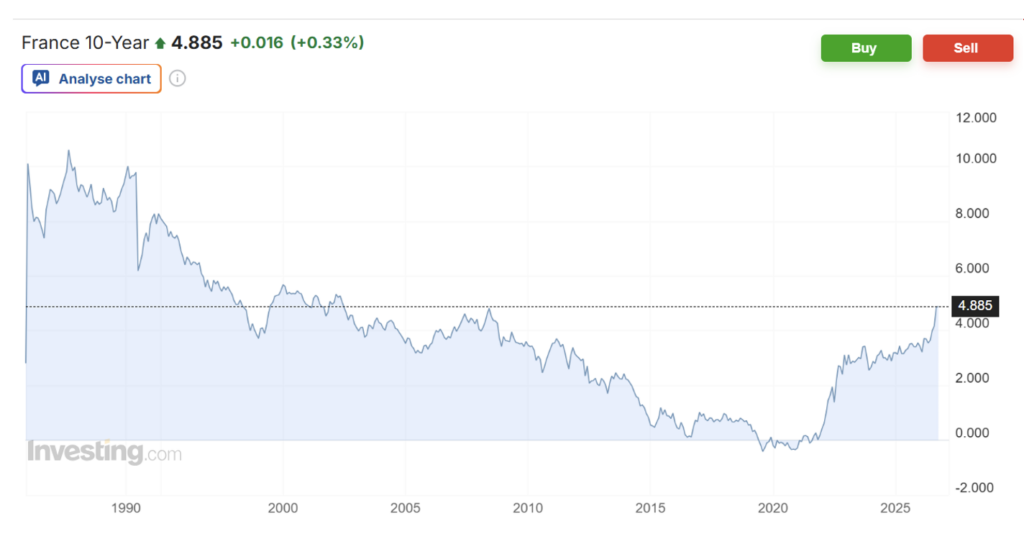
In the past six years, French Government ten-year bond yield has jumped from negative 0.3 per cent to 4.9 per cent, the highest level in 24 years. Investors are starting to differentiate between each euro-denominated country with German and Dutch ten-year bonds yielding 3.5 per cent and 3.6 per cent, respectively. Meanwhile, Greek and Italian ten-year bonds yield 4.55 per cent and 4.65 per cent, respectively, indicating potential contagion as confidence appears to be in short supply.
Graph 1. France ten-year bond yield
Source: Investing.com
During the COVID-19 pandemic, when many countries’ bond yields were either negative or at a record low, many Governments behaved as though this was a permanent feature of the sovereign debt market. As governments have generally expanded their expenditure, the borrowings at very low rates of interest will eventually need to be replaced with borrowings at much higher rates of interest, thus paying much more for the same quantum of debt.
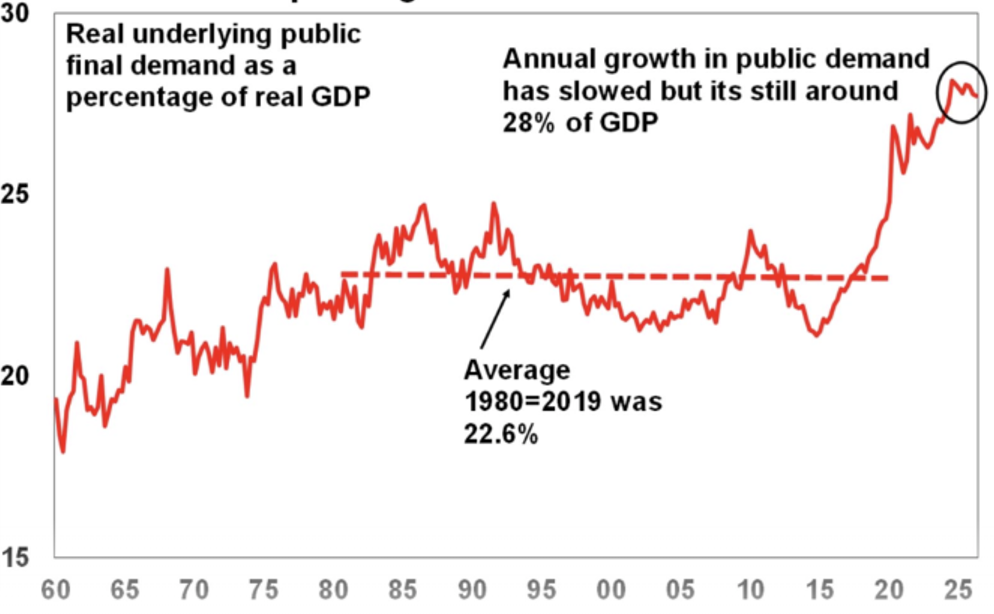
Take Australia, for example. Public expenditure has jumped from a 40-year average of around 22.6 per cent of Gross Domestic Product (GDP) to approximately 28 per cent of GDP. On Australia’s A$2.6 trillion economy, the 5.4 per cent uplift in public spending as a percentage of GDP equates to around A$140 billion per annum.
Graph 2. Public spending as a share of Australian GDP
Source: Shane Oliver (AMP)
According to the Parliamentary Budget Office (PBO), the combined state and federal government debt is on track to hit $2 trillion, or 58 per cent of GDP, by 2030. As the COVID-era debt is rolled over on significantly higher interest rates, a much higher portion of collective government revenue would be devoted to interest payments. The forecast is 6.2 per cent of revenue will be required to pay debt interest by 2030 (up from 4.1 per cent in Fiscal 2025 and 1.9 per cent two decades ago).
According to the PBO, Victoria and South Australia, who incidentally currently receive $1.06 and $1.36, respectively, from the Federal Government, per $1.00 of GST raised, are forecast to be spending close to 10 cents and 8 cents, respectively, for every $1.00 of revenue on debt interest by 2030.
Committing Government revenue, and our taxes, to unavoidable interest costs by the Australian and state governments clearly reduces fiscal flexibility – possibly at a most inopportune time!
It seems voters will likely receive a shock when the higher yielding bond markets require certain countries (and states) to deliver a long period of austerity.

Chief Executive Officer of Montgomery Investment Management, David Buckland has over 40 years of industry experience.
David is a deeply knowledgeable and highly experienced financial services executive. Prior to joining Montgomery in 2012, David was CEO and Executive Director of Hunter Hall for 11 years, as well as a Director at JP Morgan in Sydney and London for eight years.
This post was contributed by a representative of Montgomery Investment Management Pty Limited (AFSL No. 354564). The principal purpose of this post is to provide factual information and not provide financial product advice. Additionally, the information provided is not intended to provide any recommendation or opinion about any financial product. Any commentary and statements of opinion however may contain general advice only that is prepared without taking into account your personal objectives, financial circumstances or needs. Because of this, before acting on any of the information provided, you should always consider its appropriateness in light of your personal objectives, financial circumstances and needs and should consider seeking independent advice from a financial advisor if necessary before making any decisions. This post specifically excludes personal advice.


