

Silver lining in bond market carnage
For decades, the 60/40 Balanced Portfolio was zealously and even religiously adhered to. The fixed income component was the dependable anchor, providing a steady yield, protection against stock market volatility, while allowing investors to sleep soundly at night.
More recently, bond returns have given sleeping investors a rude awakening.
U.S. analyst Ben Carlson recently highlighted this shift, pointing out that modern bondholders have endured a catastrophe, describing the market as “…the most brutal bond market in modern finance history,” adding, “It’s no wonder bonds are the most hated asset class in the world.”
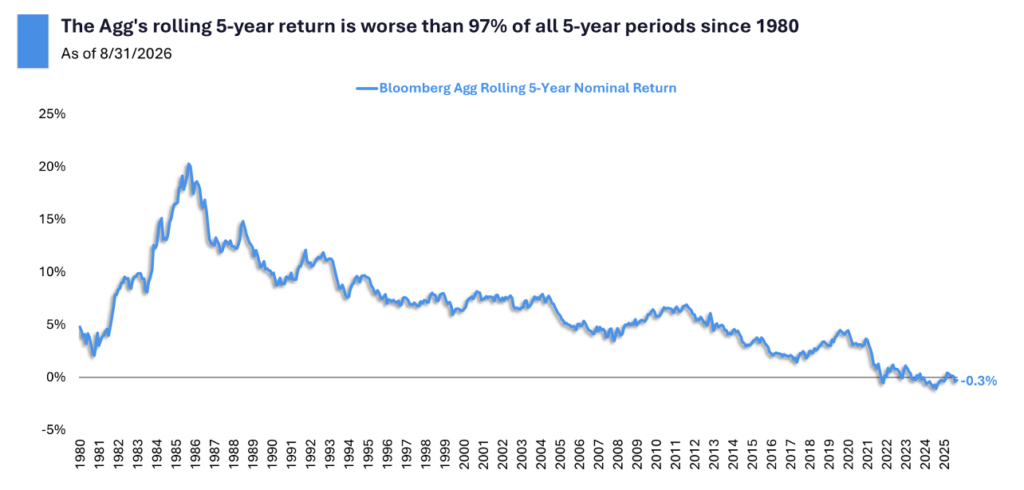
The historical metrics illustrate his point. Since the inception of the Bloomberg Aggregate Bond Index (Agg) in 1976, fixed income investors have never experienced a multi-year downturn quite like this one.
Figure 1. Bloomberg Agg rolling 5-year nominal returns
Source: The Compound Media, YCharts
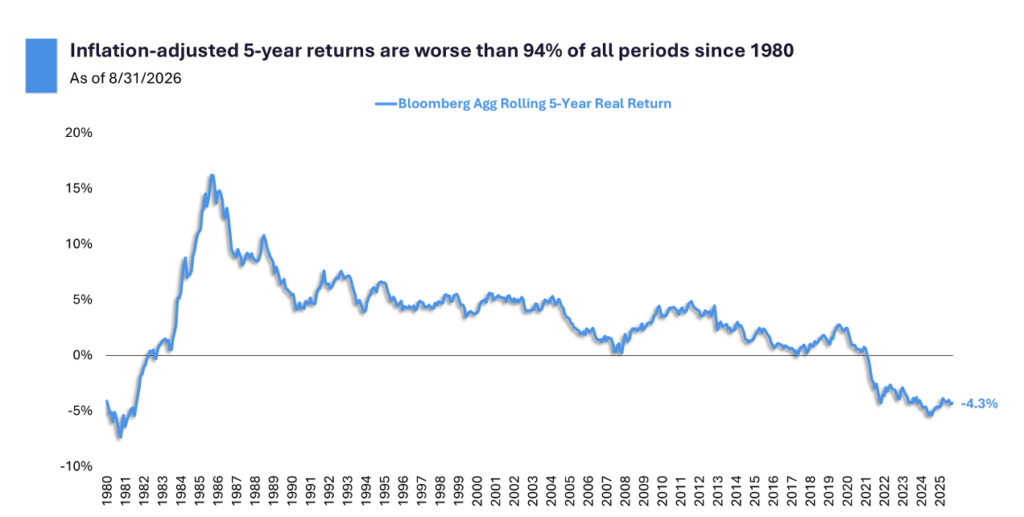
The picture for bond investors is even worse on an inflation adjusted basis. The only time returns were worse was in the early-1980s. Back then, however, inflation was running in the double digits.
Figure 2. Bloomberg Agg rolling 5-year inflation-adjusted (real) returns
Source: The Compound Media, YCharts
Inside the unprecedented bond bear market
Historically, nominal bond returns rarely stayed negative for extended periods. Even during the high-inflation environment of the late 1970s, high starting coupons helped insulate nominal returns. The Agg’s first official down year came in 1994, when it dropped roughly 3 per cent.
The current cycle has broken that historical precedent:
- Back-to-back loss years: 2021 (-1.5 per cent) and 2022 (-13 per cent) marked the first back-to-back negative years for the Agg in recorded history.
- Historic drawdowns: The peak-to-trough decline reached nearly 18.5 per cent, a figure traditionally associated with equity market corrections rather than investment-grade bonds.
- Inflation erosion: On a real, inflation-adjusted basis, rolling 5-year returns dropped to -4.3 per cent, and -1.9 per cent on a rolling 10-year basis, marking a true “lost decade” for purchasing power.
Carlson notes that this outcome stemmed from a convergence of conditions: ultralow starting yields, a rapid spike in interest rates, and elevated inflation. When starting yields hovered near zero, there was zero buffer to absorb price declines as central banks hiked rates.
The case for forward-looking optimism
While the recent track record looks grim, focusing solely on past performance misses how fixed income mechanics operate going forward. The primary driver of future long-term bond returns is starting yield.
As Carlson observes, “The good news is that yields are now higher because bond investors just lived through a terrible period of performance… The higher rates go, the higher forward returns expectations should go.”
With the Bloomberg Aggregate Bond Index yielding around 5.5 per cent to six per cent, cash yielding over four per cent, and investment-grade corporate bonds offering yields above six per cent, the math for fixed income investors has improved – which should be a point of interest to equity investors !
Income generated from existing holdings, for example, can now be reinvested into significantly higher-yielding securities, accelerating long-term compound growth. Meanwhile, higher baseline coupon payments provide a meaningful cushion against short-term price fluctuations if interest rates move even higher. And finally, at current yields, bonds regain their capacity to generate meaningful real returns and offer downside protection during economic slowdowns or equity market pullbacks.
Navigating the future
Advisers and investors, should note that predicting short-term interest rate movements or macroeconomic shifts remains notoriously unreliable and somewhat pointless. Instead of trying to time yield curves or anticipate central bank moves, portfolio construction should focus on the long term – aligning duration, credit risk, and income needs.
Sure, the bond market drawdown of recent years was severe, but it effectively recalibrates fixed income yields back to levels unseen in nearly two decades.
For investors looking forward rather than backward, the bond market is positioned far more attractively today than it was at the start of the decade.
Of course, if rates surge further, as they did in 1967 amid federal government fiscal profligacy and commodity shocks, there might be some interim pain.

Roger Montgomery is the Founder and Chairman of Montgomery Investment Management. Roger has over three decades of experience in funds management and related activities, including equities analysis, equity and derivatives strategy, trading and stockbroking. Prior to establishing Montgomery, Roger held positions at Ord Minnett Jardine Fleming, BT (Australia) Limited and Merrill Lynch.
He is also author of best-selling investment guide-book for the stock market, Value.able – how to value the best stocks and buy them for less than they are worth.
Roger appears regularly on television and radio, and in the press, including ABC radio and TV, The Australian and Ausbiz. View upcoming media appearances.
This post was contributed by a representative of Montgomery Investment Management Pty Limited (AFSL No. 354564). The principal purpose of this post is to provide factual information and not provide financial product advice. Additionally, the information provided is not intended to provide any recommendation or opinion about any financial product. Any commentary and statements of opinion however may contain general advice only that is prepared without taking into account your personal objectives, financial circumstances or needs. Because of this, before acting on any of the information provided, you should always consider its appropriateness in light of your personal objectives, financial circumstances and needs and should consider seeking independent advice from a financial advisor if necessary before making any decisions. This post specifically excludes personal advice.


