PORTFOLIO POINT: Office provider Servcorp is basking in strong earnings forecasts from analysts, but a capital raising in 2010 raises some important questions about the company.
Recently (Click here), I discussed Leighton and the quality of management’s relationship with its employees. Here I look at another company with a shareholder who holds a controlling stake, and examine its relationship with minority shareholders.
You can look at anything from a number of angles and, more often than not, reach an entirely different conclusion. Two investors, for example, presented with the same set of facts can reach polar opposite conclusions. It’s the old glass half-full versus half-empty line.
I find that having a set view and unwittingly being tied to that perspective limits one’s ability to switch fast enough when the evidence is mounting that the view might be wrong. Few are completely immune, but self-awareness is the first step to conquering any weaknesses.
The investing consequence of opening one’s mind to change is that portfolio turnover goes up. I may buy something back that I recently sold, because new evidence suggests I should, and that ‘re-purchase’ may be at a higher price. This may be seen as somewhat flaky and I agree it would be, if it were not evidence-based.
Looking at things differently, however, is necessary because it does produce fresh insights. On page 20 of Warren Buffett’s 2003 annual letter to shareholders, he wrote: “…I made a big mistake in not selling several of our larger holdings during The Great Bubble.” Shining a light – or perhaps a light with a different filter – undeniably helps our investment analysis.
With that in mind, I want to present some numbers from Servcorp’s annual reports and ask you to think about what your conclusion might be.
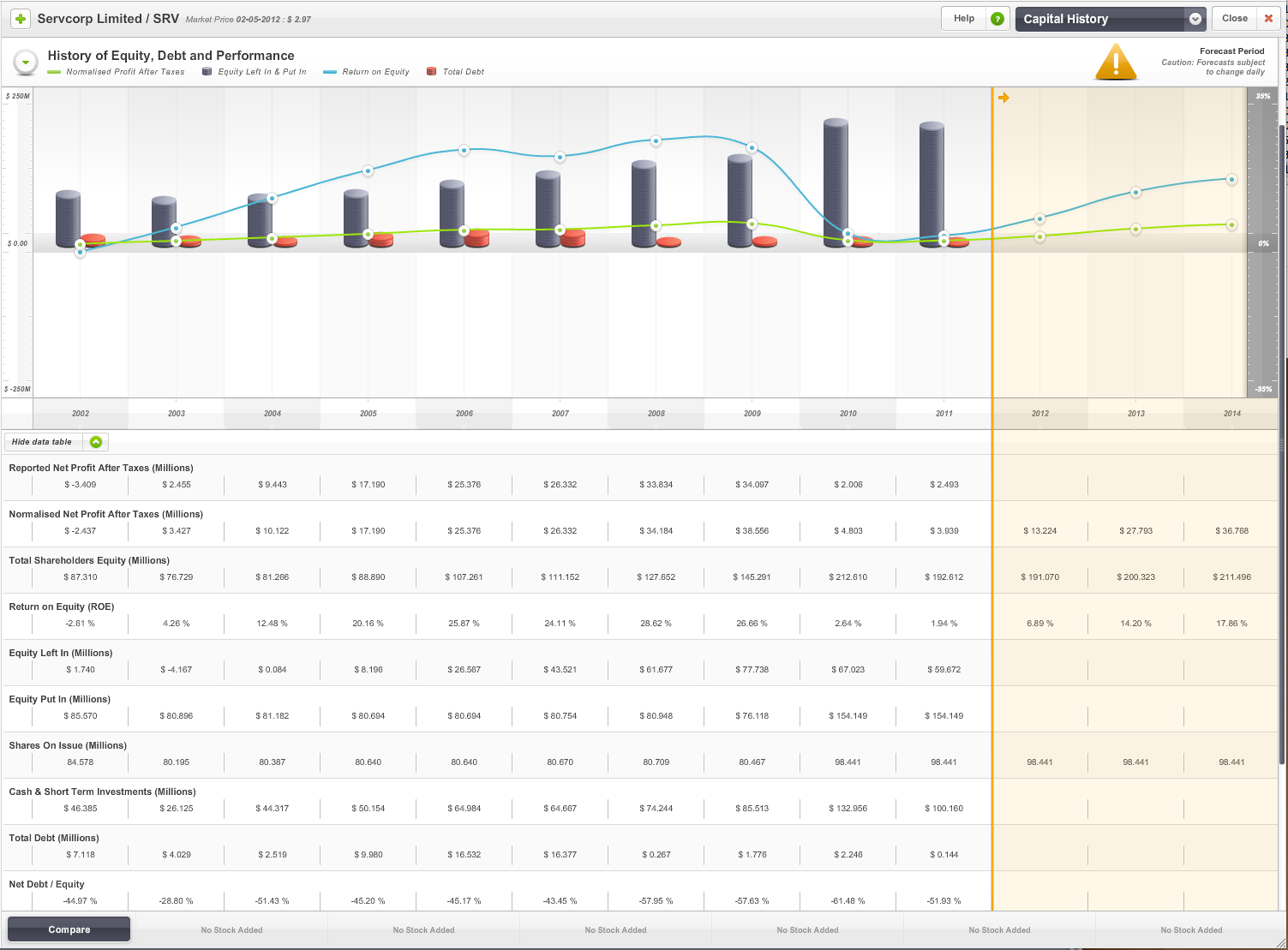
This service and virtual office provider has not produced growing profits since 2007.

Source: www.Skaffold.com PATENTS PENDING.
Back then, profits were $34 million, and while they grew to $39 million in 2009, they subsequently fell to $5 million in 2010 and $4 million in 2011. For the record, analysts are in aggregate forecasting profits to grow to $13 million in 2012, and $28 million and $37 million in 2013 and 2014, respectively.
So that’s one way of looking at this business and on that basis, you may be tempted to investigate the opportunity as a turnaround story. I certainly am, as any global recovery from the Euro crisis would position Servcorp well with the rollout of its floor leasing operations.
Is there another perspective?
But before I go jumping in, here’s another way to consider the information. In 2010, the full year profits plunged to $5 million, the company raised $78 million – on top of the $76 million already invested – by issuing 18 million shares. This move took shares on issue to 98 million and capital raised to $154 million. And looking at the retained earnings account for that year reveals that the balance declined by $10 million. This is something I want to pick up on.
When a company earns a profit of $5 million, as Servcorp did in 2010, retained earnings rise by this amount. Then, if dividends are paid, retained earnings goes down by the amount of the dividend. A net decline of $10 million in retained earnings after a $5 million profit suggests $15 million was paid in dividends.
One way to look at this situation is to assume that the capital raising is for growth; I will give the company the benefit of the doubt and agree. An alternative and admittedly more cynical way to look at it is to assume the capital raising might have been designed to pay for the dividend.
One response to the latter proposition and the one I am leaning towards is that the capital raising was much larger than the amount the dividend exceeded earnings by and therefore the real intention of the capital raising was, indeed, growth. In turn, one retort from a much more jaded or cynical investor could be that the capital raising was made larger to disguise the fact that a larger dividend was desired. It’s all rather circular, as you will discover in a moment.
Perhaps we might never know the thought process of the board at the time and such postulations are only speculative at best, but there are two important questions, answers to which would provide some illumination. The first would be whether the money invested does indeed lead to the growth in earnings that the analysts seem to be expecting – albeit growth that will only produce profits in 2014 that are in line with those of 2007/08. The second might be to ask whether a majority and controlling shareholder is present. Once again, we can’t prove motives, but as investors we are certainly within our rights to enquire.
In the first instance, only time will tell us whether the money is invested profitably. The cash is certainly now available to help grow the business, revenue and profits. To the credit of management, first-half 2012 profits were over $8 million. So the numbers are indeed moving in the right direction.
Regarding the latter issue of ownership, we find the managing director and CEO also owns 51% of the company. Of course, to retain control they must have participated in the capital raising during the 2010 financial year, but keep in mind it could be argued that half the dividend helped fund it.
And I always ask the following question: If a company is in need of capital, why pay a dividend? It’s a basic question and often – but not always – the answer seems to point to maintaining support for the share price, a noble (if perhaps unsustainable and diluting) goal. Directors are arguably acting in shareholder’s best interests by doing things that support the share price but it is imperative the techniques are sustainable. Ultimately the best method is a sound business.
In 2011, the company did almost the same thing as it did in 2010. While no additional equity was raised, and thus the controlling shareholder was therefore spared the requirement of writing another cheque, profits of $4 million were reported, but dividends of $16 million (51% of which went to entities associated with the CEO/MD) ensured that retained earnings fell to $59 million. The $8 million dollars (50% of the dividend) arguably further reduced the personal contribution of the majority shareholder to the capital raising.
For our fund, a return on equity now of just 7% suggests Servcorp is currently not investment grade, and its share price also appears to be expensive compared to our estimate of its intrinsic value. That would change if upgrades to guidance are provided.
While we haven’t answered the questions we posed, we have certainly raised the one we should ask management before we decide to invest. In theory the board works for the shareholders so you are within your rights to ask questions such as these of the board. For your own investing, I can only leave it to you to decide whether the cup is half-full or half-empty.
Posted by Roger Montgomery, Value.able author, SkaffoldChairman and Fund Manager, 3 May 2012.