

The 60/40 portfolio: Is it dead, or is it dying?
For some time now, I have been writing about the fundamental structural shift occurring in global asset allocation, and specifically, the figurative death of the traditional 60/40 portfolio.
For many years, the typical approach to wealth management and balanced portfolios was to allocate 60 per cent to growth equities for potential capital gains and 40 per cent to public bonds to provide stability and income.
When a recession struck and equity markets ran into headwinds, central banks cut interest rates, driving bond prices higher and shielding portfolio returns by offsetting stock market losses.
That negative correlation was considered the cornerstone of modern portfolio theory. However, I have repeatedly cautioned that ongoing inflation has broken this link. Traditional sovereign bonds and public fixed income now fall short of providing the downside protection or real yields investors need.
To preserve capital and secure true uncorrelated cash flow, investors must replace the traditional public bond component with high-quality, investment-grade – specifically BBB and better – private credit allocations.
Recently, one of Wall Street’s most respected macroeconomic strategists has reiterated the same conclusion.
In a note published by Apollo Global Management, Chief Economist Torsten Sløk issued an unequivocal assessment, stating, “60/40 is no longer working.”
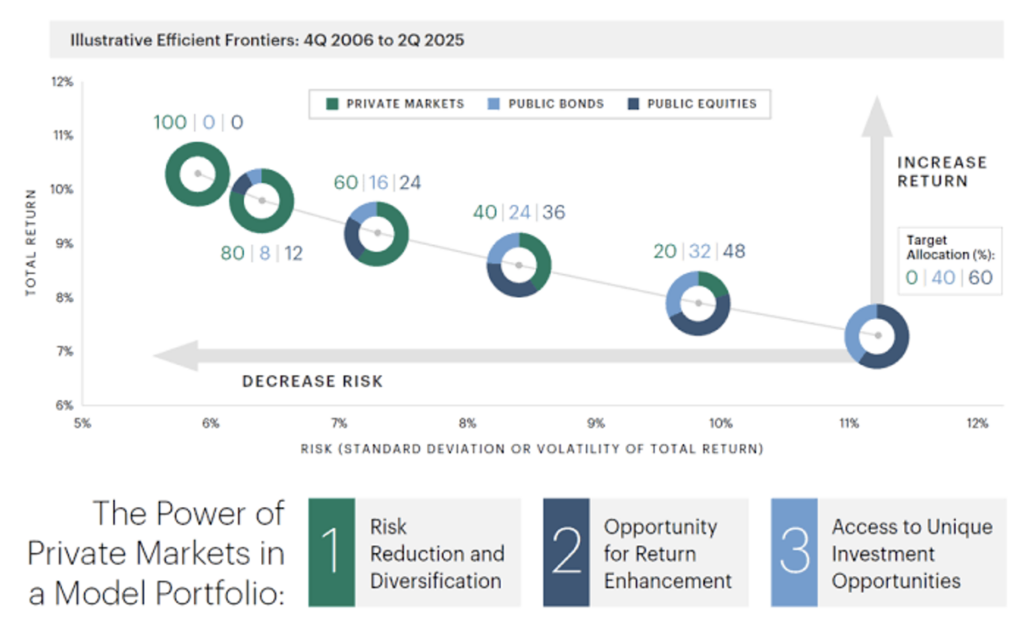
Figure 1. Efficient frontier benefits from adding Private Markets
Source: Apollo Academy
The dual structural flaws of the 60/40 model
As Sløk points out, the failure of the 60/40 portfolio isn’t a temporary cyclical blip. He sees it as a structural consequence of how public equity and fixed-income markets operate today. Neither side of the equation responds to the economic drivers that helped the strategy work in the past.
Equities (60 per cent)
Traditionally, broad equity indices reflected broad macroeconomic growth. Today, returns in major equity benchmarks like the S&P 500 are overwhelmingly dominated by a handful of mega-cap technology firms tied to the artificial intelligence (AI) boom.
Rather than pricing in broader business cycle fundamentals, index movements are dictated by index fund and ETF flows, capital expenditure (capex) cycles, chip supply chains, and AI adoption rates among a tiny concentration of market leaders.
When equity returns are driven by thematic hype and narrow concentration rather than broad economic health, the ’60’ per cent allocation exposes investors to heightened systemic single-factor risk.
Bonds (40 per cent)
The conventional bond component was expected to rally during economic downturns as central banks lowered policy rates. Today, sovereign bond dynamics are increasingly dictated by severe fiscal constraints rather than interest rate cycles.
According to long-term fiscal models from the U.S. Congressional Budget Office (CBO), total U.S. government debt held by the public is on track to hit 175 per cent of Gross Domestic Product (GDP). As sovereign debt loads escalate, bond yields are increasingly subject to debt-issuance supply shocks, term premium expansion, and persistent deficit fears.
Public debt markets can no longer easily rally during equity drawdowns when financial markets are simultaneously digesting monumental fiscal supply.
Table 1. Change is Afoot.
|
Portfolio component |
Traditional economic driver |
Modern structural reality |
|
60 per cent public equities |
Broad macroeconomic business cycle & earnings growth |
Extreme thematic concentration (AI trade) |
|
40% Public Bonds |
Central bank interest rate cycles & flight-to-quality |
Unprecedented sovereign fiscal deficits & debt supply |
The non-correlation illusion and systemic risk
The most dangerous implication for investors, of course, is the erosion of diversification benefits. As Sløk emphasises, as many advisers and planners experienced in 2022, the real danger for investors lies in a coincident draw-down scenario, where equities and bonds fall in unison.
“The real risk emerges if the AI trade reverses or markets become more worried about government deficits. In either scenario, both stocks and bonds would face pressure simultaneously, leaving investors with no hedge.”
If tech sector earnings cool off or fail to justify astronomical infrastructure valuations, equity indices could experience downside pressure. If, at the exact same time, bond markets demand higher yields to absorb continuous trillion-dollar sovereign debt issuances, bond prices will fall as well.
Instead of acting as a hedge, public equities and public bonds will sell off in tandem –just as they did during the market drawdown of 2022.
The traditional 60/40 structure leaves investors dangerously ‘unhedged’.
The solution: replacing public bonds with AA rated private credit
To strengthen a portfolio’s resilience, high-net-worth investors must look outside public markets. Yes, there’s a liquidity price to pay, but the alternative is potentially much more costly.
Replacing or augmenting the legacy 40 per cent public bond allocation with high-quality, AA-rated private credit solves the core structural problems of modern market liquidity:
- Insulation from public market volatility: Unlike publicly traded bonds whose capital values fluctuate daily based on market sentiment and Treasury yield spikes, high-grade private credit transactions are directly negotiated loans held to maturity.
- Floating rate protection: Private credit facilities are predominantly structured with floating interest rates pegged to base reference benchmarks (such as Secured Overnight Financing Rate (SOFR) or Bank Bill Swap Rate (BBSW)). This insulates investor capital from duration risk and persistent inflation.
- Capital preservation and senior security: Focusing on investment-grade, AA rated private debt, for example, ensures robust covenants, low loan-to-value ratios (LTVs), and first-ranking security over tangible assets. The focus is strictly on contractual cash flow generation and downside protection.
- True correlation benefits: Because returns are generated through contractual yield rather than mark-to-market trading dynamics, private credit displays near-zero correlation to both the AI-dominated equity market and deficit-plagued sovereign debt markets.
A necessary shift in asset allocation
Torsten Sløk’s thesis confirms what forward-thinking investment managers have been putting into practice. It may not be a stretch to suggest the passive, traditional 60/40 asset allocation model belongs to a bygone era of low public debt and broad economic participation.
In an era defined by fiscal dominance, concentrated public stock indices, and sticky structural inflation, true diversification won’t be achieved by allocating solely to public markets.
By pivoting the defensive bucket of portfolios toward high-quality, investment-grade, highly diversified and short-duration private credit, investors might finally restore genuine downside protection, attractive floating yields, and true portfolio stability.
Retirees, especially, might like to have a conversation with their adviser. After that, call David Buckland, Rhodri Taylor or Toby Roberts here at Montgomery on (02) 8046 5000.
Disclaimer:
You should read the relevant Product Disclosure Statement (PDS) or Information Memorandum (IM) before deciding to acquire any investment products.
Past performance is not a reliable indicator of future performance. Returns are not guaranteed and so the value of an investment may rise or fall.
This information is provided by Montgomery Investment Management Pty Ltd (ACN 139 161 701 | AFSL 354564) (Montgomery) as authorised distributor of the Aura Core Income Fund (ARSN 658 462 652) (Fund). As authorised distributor, Montgomery is entitled to earn distribution fees paid by the investment manager and may be issued equity in the investment manager or entities associated with the investment manager.
The Aura Core Income Fund (ARSN 658 462 652)(Fund) is issued by One Managed Investment Funds Limited (ACN 117 400 987 | AFSL 297042) (OMIFL) as responsible entity for the Fund. Aura Credit Holdings Pty Ltd (ACN 656 261 200) (ACH) is the investment manager of the Fund and operates as a Corporate Authorised Representative (CAR 1297296) of Aura Capital Pty Ltd (ACN 143 700 887 | AFSL 366230).
You should obtain and carefully consider the Product Disclosure Statement (PDS) and Target Market Determination (TMD) for the Aura Core Income Fund before making any decision about whether to acquire or continue to hold an interest in the Fund. Applications for units in the Fund can only be made through the online application form that accompanies the PDS. The PDS, TMD, continuous disclosure notices and relevant application form may be obtained from www.oneinvestment.com.au/auracoreincomefund or from Montgomery.
The Aura Private Credit Income Fund is an unregistered managed investment scheme for wholesale clients only and is issued under an Information Memorandum by Aura Funds Management Pty Ltd (ABN 96 607 158 814, Authorised Representative No. 1233893 of Aura Capital Pty Ltd AFSL No. 366 230, ABN 48 143 700 887).
Any financial product advice given is of a general nature only. The information has been provided without taking into account the investment objectives, financial situation or needs of any particular investor. Therefore, before acting on the information contained in this report you should seek professional advice and consider whether the information is appropriate in light of your objectives, financial situation and needs.
Montgomery, ACH and OMIFL do not guarantee the performance of the Fund, the repayment of any capital or any rate of return. Investing in any financial product is subject to investment risk including possible loss. Past performance is not a reliable indicator of future performance. Information in this report may be based on information provided by third parties that may not have been verified.

Roger Montgomery is the Founder and Chairman of Montgomery Investment Management. Roger has over three decades of experience in funds management and related activities, including equities analysis, equity and derivatives strategy, trading and stockbroking. Prior to establishing Montgomery, Roger held positions at Ord Minnett Jardine Fleming, BT (Australia) Limited and Merrill Lynch.
He is also author of best-selling investment guide-book for the stock market, Value.able – how to value the best stocks and buy them for less than they are worth.
Roger appears regularly on television and radio, and in the press, including ABC radio and TV, The Australian and Ausbiz. View upcoming media appearances.
This post was contributed by a representative of Montgomery Investment Management Pty Limited (AFSL No. 354564). The principal purpose of this post is to provide factual information and not provide financial product advice. Additionally, the information provided is not intended to provide any recommendation or opinion about any financial product. Any commentary and statements of opinion however may contain general advice only that is prepared without taking into account your personal objectives, financial circumstances or needs. Because of this, before acting on any of the information provided, you should always consider its appropriateness in light of your personal objectives, financial circumstances and needs and should consider seeking independent advice from a financial advisor if necessary before making any decisions. This post specifically excludes personal advice.


