Value.able
-
How do your Easter holiday homework results compare?
Roger Montgomery
May 3, 2011

Your Easter holiday homework was published mid morning on Thursday 14 April. Two hours later Andrew correctly completed the cash flow component – well done Andrew.
Many Graduates have posted comments here (and sent even more emails to me) asking why Telstra made the cut. Then there’s Aristocrat with all that debt, Fortescue’s recent capital raisings, The Reject Shop’s declining Return on Equity, Coca-Cola’s dwindling competitive advantage…
I’m passing the mic to Rob, a member of the Value.able Post-Graduate elite:
“Roger usually gives us homework which contains a mix of stocks. As he said he used his discretion to come up with 14. He also said “This homework is not about finding cheap stocks – it is about understanding businesses, return on equity, debt, cashflow and identifying extraordinary prospects”. The only way for us to achieve this is to look at some B3s such as Telstra, and as Andrew said early the odd “basket case”. Working through the good and bad can be eye opening but you do need to examine all the stocks to compare how they fair according to the criteria mentioned in the above quote.”
And from Chris B:
“It has been my opinion for a while that it is kind of hard (and almost pointless) trying to assign an estimated value on a business unless you have done a lot of research about the business in question first…”
Leon was the first Value.able Graduate to post his answers, quite late in the evening on April 15. Whilst Leon’s valuations don’t match my calculations exactly, they are close. Remember your primary aim is to buy extraordinary A1 businesses at BIG discounts to your estimate of their Value.able intrinsic value. A difference of twenty cents is neither here nor there if the business is worth $8 and you can buy shares for $5!
The Results
Assignment One: Calculate the 2010 Value.able intrinsic value and 2011 forecast Value.able intrinsic value – download the results
Assignment Two: Re-read Value.able Chapter 9 on Cashflow (from page 152) and analyse the cashflow of each company using the balance sheet method – download the results
Here are Andrew’s insights on the Cashflow homework:
“Based on a simple look, Retail Food group has the best cash position of the three followed by the reject shop and then loads of daylight and then Aristocrat.
However on further digging for RFG I can see that the 85,852 worth of borrowings are now a current liability and therefore will be due in the next 12 months. They do not appear to have the assets or the cash generating abilities to service this and will therefore probably need to raise capital in some form.
Aristocrat is a basket case where cash flow was declining and borrowings rising. Doesn’t take a genius to see what is going to happen here. ROE might be high but it is debt fueled. Kind of get the feeling that Aristocrat is about as lucrative as gambling on one of their machines in the pub.
Therefore the last one standing and my pick of the three overall is actually the reject shop. It is generating positive cashflow and should be able to adequately meet its future needs.
Thank you to all who participated and if your answers where close… well done! It is vital that you continue to practice your technique. With repetition you’ll get to the point where you can simply ‘eye-ball’ Value.able intrinsic value.
Before I sign off, I would like to officially welcome Alex, Yong-Chuan, Matty, Leon, Andrew, Geoff, Justin, Peter and Margaret to the Value.able Graduate Class of 2011. If I have omitted your name, please accept my apologies. I am delighted to welcome you as a Graduate. Please send your photo with Value.able to roger@rogermontgomery.com for inclusion in the 2011 album.
For those wondering, the woman screaming in fright was looking at the stock market on Friday!
Posted by Roger Montgomery, author and fund manager, 3 May 2011.
by Roger Montgomery Posted in Companies, Insightful Insights, Investing Education, Value.able.
-
What did Ben Graham get right?
Roger Montgomery
April 29, 2011
 If you are new to our Value.able community, Ben Graham’s concepts may be foreign to you. Ben is the author of Security Analysis. He is regarded as the father of security analysis and the intellectual Dean of Wall Street.
I support Ben’s revered status and what he has to say on the subject of investing, but perhaps controversially, I also believe that, had he access to a computer that allowed him to properly test his ideas, he may not have reached all of the same conclusions.
It is exactly one year since I first penned some of my thoughts about Ben Graham on this blog here: http://rogermontgomery.com/should-a-value-investor-imitate-ben-graham/
There are many things that Ben said that not only make sense, but has also made significant contributions to investment thinking. Indeed they have become seminal investment principles. These are the things to which Value.able investors should hold firm.
Ben Graham authored the Mr Market allegory and also coined the three most important words in value investing: Margin of Safety. In fact Ben said this: “Confronted with the challenge to distill the secret of sound investment into three words, I venture the motto: Margin of Safety”
These are two concepts that value investors hold dear and which have, in many different ways, become a formal part of our Value.able investing framework.
Mr. Market is of course a fictitious character, created by Ben to demonstrate the bipolar nature of the stock market.
Here is an excerpt from a speech made by Warren Buffett about Ben Graham on the subject:
“You should imagine market quotations as coming from a remarkably accommodating fellow named Mr Market who is your partner in a private business. Without fail, Mr Market appears daily and names a price at which he will either buy your interest or sell you his.
“Even though the business that the two of you own may have economic characteristics that are stable, Mr Market’s quotations will be anything but. For, sad to say, the poor fellow has incurable emotional problems. At times he feels euphoric and can see only the favorable factors affecting the business. When in that mood, he names a very high buy-sell price because he fears that you will snap up his interest and rob him of imminent gains…
“Mr Market has another endearing characteristic: He doesn’t mind being ignored. If his quotation is uninteresting to you today, he will be back with a new one tomorrow.
Transactions are strictly at your option…But, like Cinderella at the ball, you must heed one warning or everything will turn into pumpkins and mice: Mr Market is there to serve you, not to guide you.
“It is his pocketbook, not his wisdom that you will find useful. If he shows up some day in a particularly foolish mood, you are free to either ignore him or to take advantage of him, but it will be disastrous if you fall under his influence.”
If you have read Value.able you will understand Margin of Safety, know exactly what a suitable Margin of Safety is and also how to apply it to Australian stocks.
Despite the high profile of these two enduring lessons, I believe there is a third observation of Graham’s, which is equally important. Fascinatingly, with the benefit of computers, I can also demonstrate that Graham was spot on.
Graham was paraphrased by Buffett in 1993 thus:
“In the short run the market is a voting machine – reflecting a voter-registration test that requires only money, not intelligence or emotional stability – but in the long run, the market is a weighing machine”
What Graham described is something that, as both a private and professional investor, I have observed myself; in the short term the market is a popularity contest – prices often diverge significantly from that which is justified by the economic performance of the business. But in the long-term,prices eventually converge with intrinsic values, which themselves follow business performance.
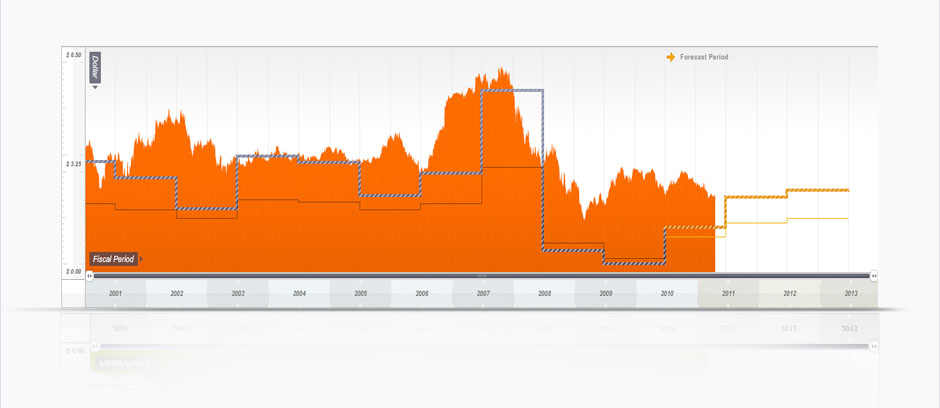
Have a look at the amazing chart below.
(c) Copyright 2011 Roger Montgomery
Its Qantas (ASX:QAN, MQR: B3, MOS-44%): – its my ten-year history of price and intrinsic value (and three year forecast of intrinsic value which updates daily). Now right click on the chart and open it in a new tab. Zoom in. Now stand back from your computer screen. What do you see?
First you will notice two intrinsic values – a range is produced. Next you might notice that there have been short term bouts of both optimism and despondency and this is reflected in the short term share price changes. The final observation you might make and which the charts make most powerfully, is that since 2001, the intrinsic value of Qantas, which is based on its economic performance has, at best, not changed. Look closer and you will notice that the intrinsic value of Qantas today (2011) is lower than it was a decade ago. Even by 2013, intrinsic value is not forecast to be materially different from that of 2002.
Just as Ben Graham predicted, the long-term weighing machine has correctly appraised Qantas’ worth. Unsurprisingly, the share price today of Australia’s most recognised airline, is also lower than it was a decade ago. And unbelievably, the total market capitalisation of Qantas today is less than the money that has been ‘left in’ and ‘put in’ by shareholders over the last ten years!
These charts aren’t just easy or nice to look at, they are incredibly powerful. If you can calculate intrinsic values for every listed company, you can turn the stock market off and simply pay attention to those values. Then, during those times that the market is doing something irrational, you can take advantage of it or ignore it, just as Ben Graham advised.
Unless you can see a reason for a permanent change in the prospects of Qantas, the long-term trend in intrinsic value gives you all the information you need to steer well clear of this B3 business.
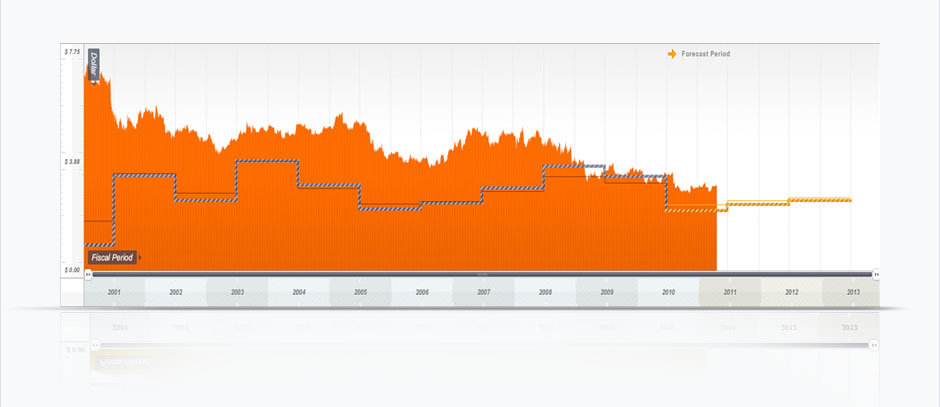
Now have a look at the second chart. What does it tell you?
(c) Copyright 2011 Roger Montgomery
There have been short-term episodes of price buoyancy, but over the long run the weighing machine has done its work. The intrinsic value has not changed in ten years so, over time, the share price has once again reflected the company’s worth and gradually but perpetually fallen until it reaches intrinsic value. This is my ten-year historical price and intrinsic value chart (and three year forecast) for Telstra (ASX:TLS, MQR: B3, MOS:-32%).
What about an extraordinary A1 business?
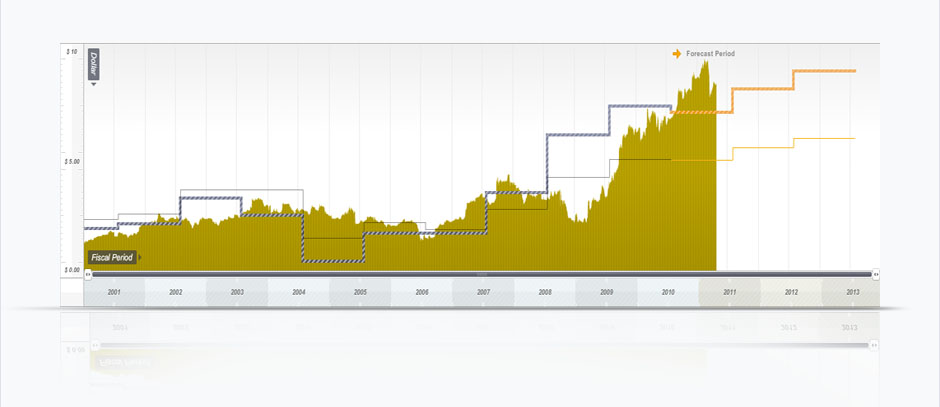
Sally Macdonald joined Oroton (ASX:OTN, MQR: A1, MOS:-17%) as CEO in 2005/06. Observe the strong correlation between price and value since Sally’s appointment.
(c) Copyright 2011 Roger Montgomery
I acknowledge that there are critics of the approach to intrinsic value we Value.able Graduates follow. But like me, you should be delighted there are. Indeed, we should be encouraging departure from this approach!
The critics are necessary. Not only do they help refine your ideas, but without them, how else would we be able to buy Matrix at $3.50, Forge at $2.60, Vocus at $1.60 or Zicom at $0.32! And how else would we be able to navigate around and away from Nufarm or iSoft, and not fall into the trap of buying Telstra at $3.60 because the ‘experts’ said it had an attractive dividend yield? If it was universal agreement I was after, I would just keep writing about airlines.
The Value.able approach works. If you have been visiting the blog for a while, you will know this only too well.
The above charts (automatically updated daily – and I have one for every, single, listed company) confirms what Ben Graham had discovered without the power of modern computing; In the short run the market is indeed a voting machine, and will always reflect what is popular, but in the long run the market is a weighing machine, and price will reflect intrinsic value.
If you concentrate on long-term intrinsic values and avoid the seduction of short-term prices, I cannot see how, over a long period of time, you cannot help but improve your investing.
…And in case you are wondering about the link between Ben Graham and the photograph of Comanche Indian ‘White Wolf’… the photo of White Wolf was taken in 1894 – the year Ben Graham was born.
HOMEWORK RESULTS: I will publish the holiday results homework on Monday. Thank you to all who participated. It is vital what you continue to practice your technique. With repetition you’ll get to the point where you can simply ‘eye-ball’ Value.able intrinsic value.
Posted by Roger Montgomery, author and fund manager, 29 April 2011.
by Roger Montgomery Posted in Companies, Consumer discretionary, Insightful Insights, Investing Education, Technology & Telecommunications, Value.able.
-
10,000 Comments and Counting
Roger Montgomery
April 13, 2011

Early this month we hit a milestone worth celebrating. Thanks to your incredible interest in the value investing approach advocated and discussed here we hit 10,000 comments.
Thank you for your interest, your passion and your generosity. It is amazing and I cannot be more proud of the incredibly diverse directions you have all headed with the new found knowledge from Value.able.
Thank you also for your encouragement and taking the time to share with me just how much you have been impacted by Value.able. My team and I are delighted to hear your amazing stories of investing success.
Speaking of stories, here is one of my recent favourites. It’s from Craig, a Graduate from the Value.able Class of 2010. It’s the story of Eddie and his bike…
Twelve year old Eddie has a paper round.
He bought a bike for $10,000 (its a bloody good bike) and earns $1,000 a year, after all expenses (new tyres, chewing gum) and tax (there’s no tax as the bloke who owns the newsagency pays him cash).
Eddie’s happy, but he wants a new playstation, so he offers a 50% share in his operation to family members.
His brother’s keen but the $10 he gets for mowing the front lawn (the backyard is fake grass) means he doesn’t have the money.
His teenage sister is keen but she’s running up huge mobile phone bills which accounts for all of her pay from McDonald’s.
His old girl’s keen but she just bought a new Apple product, so she’s got no money to spare.
His old man however, has squirreled away $5,000 by doing some overtime at work, and had been shopping around for somewhere to put it to work. ING are offering 8% (this is 2013), so the old man says to Eddie: “Look son, I can get 8% at the bank.”
“You can get 10% with me dad, if you hand over that 5 grand.”
“Yeah but you might want to do something else one day, or your bike could need replacing, or you could – god forbid son – have an accident. With all that risk involved, I wan’t 12.5%, so I’ll give you $4,000 for me half share.”
“Four large? You’re killing me dad. Don’t you know banks can go broke?”
“Not in this country son. I want 12.5%.”“There’ll be another GFC, you wait, but people will still want the paper delivered.”
At that point, the boy’s mother approaches, holding her new iPad.
The husband looks at her, then back to his son: “Make it $2,500… I want 20%.”
What is your funny or amazing Value.able story?
Go ahead, Share, Encourage and Inspire. And thank you for helping so many investors value the best stocks and buy them for less than they are worth!
Did you contribute your photo to the Value.able Graduate Class of 2010? The Class of 2011 is open and accepting Graduates. Email your photo and join Bernie, Martin, Alya and Jim Rogers.
Posted by Roger Montgomery, author and fund manager, 13 April 2011.
by Roger Montgomery Posted in Insightful Insights, Investing Education, Value.able.
-
Is Oroton Australia’s best retailer?
Roger Montgomery
April 12, 2011
Oroton, JB Hi-Fi, The Reject Shop, Woolworths, Nick Scali, Cash Converters. If you have seen me on Sky Business or visited my YouTube channel recently, these names will be familiar. David Jones, Country Road, Harvey Norman, Myer, Super Retail Group (think Super Cheap Auto), Strathfield Group (Strathfield Car Radios), Noni B and Kathmandu also spring to mind, albeit for different reasons.
As a business, retailers are relatively easy to understand. The best managers are easy to spot (think Oroton’s Sally MacDonald) and it is also easy to separate the businesses with earnings power from those without (compare JB Hi-Fi and Harvey Norman).
But generally speaking even the best retailers may not be companies you want to hold forever. Why? Because they quickly reach saturation and so must constantly reinvent themselves.
Barriers to entry are low. There are always new concepts with young, intelligent and energetic entrepreneurs eager to develop a new brand and offering. Big red SALE signs are replacing mannequins as permanent window fixtures in Australian shop fronts, driving down revenue and margins. And for those who choose to defend brand value, sales revenue is also often sacrificed.
Then there’s the twin-speed economy, a string of natural disasters, soaring oil prices, growing personal savings, higher interest rates, Australia’s small population and one that is increasingly adept at shopping online for a getter price. Hands up who wants to be a retailer?
Retailers are attractive businesses – at the right price and the right stage in their life cycle. So, in retailing, who is Australia’s good, bad and just plain ugly?
Remember, these comments are not recommendations. Conduct your own independent research and seek and take professional personal advice.
Harvey Norman
ASX:HVN, MQR: A3, MOS: -19%A decade ago Gerry’s retail giant earned $105 million profit on $484 of equity that we put in and left in the business. That’s a return of around 19 per cent. Fast-forward to 2010 and we’ve put in another $117 million and retained an additional $1.5 billion. Despite this tripling of our commitment, however, profits have little more than doubled to $236 million. Return on equity has fallen by a third and is now about 12%. One decade of operating and the intrinsic value of Harvey Norman has barely changed. HVN is a mature business, but be warned… Harvey Norman is what JB Hi-Fi and The Reject Shop would see if they used a telescope to look forward through time.
OrotonGroup Limited
ASX:ORL, MQR: A1, MOS: -21%Sally MacDonald is a brilliant retailer. I highly recommend watching this interview – click here. Sally took over Oroton in 2006. In just five years she has cut loss making stores and brands, sliced overheads, improved both the quality and diversity of the range. The result? Surging revenues and return on equity in 2010 of circa 85 per cent. Try getting that in a bank account or even a term deposit! Asia offers even brighter prospects for Oroton while their product offering is sufficiently attractive and appealing that the company has the ability to weather the retail storm and protect its brand.
Woolworths Limited
ASX: WOW, MQR: B1, MOS: -17%You don’t get any bigger than Woolworths (its one of the 20 largest retailers on the planet!). It has a utility-like grip on consumers only, with earnings power that would put any utility to shame. The latter can be seen in the near 30% annualised increase in intrinsic value. Competitive position and size means suppliers and customers fund the company’s inventory. Challenges included professed legislative changes to poker machine usage (WOW is the largest owner of poker machines and any drag in revenue will have an exponential impact on profits), and the rollout of a competitor to Bunnings.
David Jones Limited
ASX: DJS, MQR: A2, MOS: -35%A beautiful shop makes not a beautiful business. I remember when David Jones floated. Shoppers who enjoyed the ‘David Jones’ experience and were loyal to the brand bought shares with the same enthusiasm as scouring the shoe department at the Boxing Day sales. Since 2007 DJS has reduced its Net Debt/Equity ratio from 108 per cent to just under 12 per cent. We are yet to see if Paul Zahra can lead DJs with the same stewardship as former CEO Mark McInnes but as far as department stores can possibly be attractive long-term investments, DJs isn’t it.
Myer
ASX: MYR, MQR: B1, MOS: -27%In 2009, following the release of that gleaming My Prospectus, I wrote:
“With all the relevant data to value the business now available and using the pro-forma accounts supplied in the prospectus, I value the company at between $2.67 and $2.78, substantially below the $3.90 to $4.90 being requested [by the vendors]. It appears to me that the float favours existing shareholders rather than new investors.”
My 2011 forecast value for Myer is just over $2. According to My Value.able Calculations, Myer will be worth less in 2013 than the price at which it listed in September 2010. If competitors like David Jones, Just Jeans, Kmart, Target, Big W, JB Hi-Fi, Fantastic Furniture, Captain Snooze, Sleep City, Harvey Norman, Nick Scali and Coco Republic were removed, Myer may just do alright.
Noni B
ASX: NBL, MQR: A2, MOS: -51%Noni B’s intrinsic value is the same as when Alan Kindl floated the company in 2000 (the family retained a 40% shareholding). Return on Equity hasn’t changed either. Shares on issue however have increased 50 per cent yet profits have remained relatively unchanged.
Kathmandu Holdings Limited
ASX: KMD, MQR: A3, MOS: -56%Sixty per cent of Kathmandu’s revenues are generated in the second half of the year. Will weather patterns continue to feed this trend? I sense premature excitement following the implementation of KMD’s newly installed intranet. The system may streamline store-to-store communications, reducing costs and creating inventory-related efficiencies for the 90-store chain, however what’s stopping a competitor replicating the same out-of-the-box system?
Fantastic Furniture
ASX: FAN, MQR: A3, MOS: -24%Al-ways Fan-tas-tic! Once upon a time it was. Low barriers to entry are seeing online retro furniture suppliers like Milan Direct and Matt Blatt are forcing Fantastic and other traditional players to reinvent the way they display, price and stock inventory.
Billabong
ASX: BBG, MQR: A3, MOS: -49%Billabong’s customers are highly fickle, trend conscious and anti-establishment. Like Mambo, as one of my team told me, Billabong is “so 1999 Rog”. Apparently Noosa Longboards t-shirts fall into the “cool” category, now. Groovy!
Eighty per cent of Billabong’s revenues are derived from offshore. Every one-cent rise in the Australian dollar has a half percent negative impact on net profits. Fans of the trader Jim Rogers believe the AUD could rise to USD$1.40! Then there’s the 44 stores affected by Japan’s earthquake (18 remain closed) and another three in the Christchurch earthquake.
Country Road
ASX: CTY, MQR: A3, MOS: -63%).Like the quality of their clothing, Country Road’s MQR has been erratic. So too has its value. Debt is low however cash flow is not attractive. Very expensive.
Cash Convertors
ASX: CCV, MQR: A2, MOS: +26%.Value.able Graduates Manny and Ray H nominated CCV as their A1 stock to watch in 2011. Whilst its not yet an A1, Cash Convertors is a niche business with bight prospects for intrinsic value growth.
Other retailers to watch
I have spoken about JB Hi-Fi, Nick Scali and The Reject Shop many times on Peter Switzer’s Switzer TV and Your Money Your Call on the Sky Business Channel. Go to youtube.com/rogerjmontgomery and type “retail”, “JBH”, “TRS” or “reject” into the Search box to watch the latest videos.
In October 2009 the RBA released the following statistics:
16 million. The number of credit cards in circulation in Australia;
$3,141. The average monthly Australian credit card account balance;
US$56,000. The average mortgage, credit card and personal loan debt of every man, woman and child in Australia;
$1.2 trillion. The total Australian mortgage, credit card and personal loan debt;
$19.189 billion. The amount spent on credit and charge cards in October 2009.Clearly we are all shoppers… what are your experiences? Who do you see as the next king of Australia’s retail landscape?
Posted by Roger Montgomery, author and fund manager, 12 April 2011.
by Roger Montgomery Posted in Companies, Consumer discretionary, Insightful Insights, Investing Education, Value.able.
-
Is that Jim Rogers’ copy of Value.able?
Roger Montgomery
April 8, 2011
I’ve been following and chatting to Jim Rogers for many, many years. And, if your pockets are deep enough to ride out the inevitable bumps (“nothing goes up in a straight line Roger”), his commodity calls have been on the money.
Last night I was delighted to catch up with him again, after being invited by CBA to celebrate the first birthday of their Institutional Equities business (the invitation (picture below) read “If you were smart in 1807 you moved to London, if you were smart in 1907 you moved to New York City, and if you were smart in 2007 you moved to Asia“, Jim Rogers 2007). I was impressed by how many of my friends in the funds management industry have employed the Institutional Equities desk of CBA. They are obviously not restricting their excellent service to me!
Jim arrived and I had the opportunity to catch up before he went on to speak to the audience. For those who missed it, he remains extremely bullish on commodities and in particular Cotton, Sugar, Oil and Gold. The audience were perhaps most in agreement with a bullish view on wheat and while this wasn’t discussed, I can tell you the expansion of deserts in China and the depletion of water reserves there will cause a fundamental step-change in the world’s agricultural markets and the price of food.
But if you really want to get a sense of how bullish Jim is try this on for size: Oil = $200/barrel or more (see my January 2011 Post), Gold $2000/ounce (January 2011 Post) sometime in the next decade and the Aussie dollar? Wait for it…..US$1.40!!!! Jim didin’t say it in so many words, but it was being whispered between the salt and pepper prawns, lime and coconut marshmallows, and for the late night revellers, a 2001 Noble One.
As you can see Jim was delighted to receive a personally dedicated copy of Value.able to read on the flight back to Singapore. I hope that he gets as much out of it as I have from his.

Posted by Roger Montgomery, author and fund manager, 8 April 2011.
by Roger Montgomery Posted in Value.able.
- 96 Comments
- save this article
- POSTED IN Value.able
-

WHITEPAPER
THE PROPERTY RUG PULL
Discover how proposed changes to negative gearing, Capital Gains Tax and holiday home tax rules could reshape property investing, and why investors may consider private credit as property returns become less certain and tax advantages diminish.
READ HERE -
Another warning Roger?
Roger Montgomery
April 8, 2011
 Last night on Peter’s Switzer TV I shared five stocks moving up the Montgomery Quality Ratings (MQR) – B3 to A3, C4 to B3, A4 to A3, C5 to A2 and A4 to A2.
There are about thirty-seven ratios that contribute to the Montgomery Quality Rating. Like the Value.able method for valuing businesses, the MQR is my own unique system of assessing the quality and performance of businesses. Its objective is to weed out those with a high risk of catastrophe and highlight those with a very low risk.
I also spoke about Zicom, a very thinly traded micro-cap that we began buying for the Fund at $0.32, up to $0.42. Yesterday Zicom closed at $0.52 – my estimate of its Value.able intrinsic value.
If you read my ValueLine column for Alan’s Eureka Report on Wednesday evening you will recognise the following warning:
A WARNING FROM ROGER MONTGOMERY: The subject of today’s column is a thinly traded microcap in which I have bought shares because it meets my criteria. It may not meet yours. It is therefore information that is general in nature and NOT a recommendation or a solicitation to deal in any security. The information is provided for educational purposes only and your personal financial circumstances have not been taken into account. That is why you must also seek and take personal professional advice before dealing in any securities. Buying shares in this company without conducting your own research is irresponsible. Buying shares in this company will drive the price up, which will benefit me more than you. The higher the price you pay the lower your return. If the share price rises well beyond my estimate of intrinsic value, I could sell my shares. A share price that rises beyond my estimate of intrinsic value is one of my triggers for selling. I have no ability to predict share prices and despite a margin of safety being estimated, the share price could halve tomorrow or worse. There are serious and significant risks in investing. Be sure to familiarise yourself with these risks before buying or selling any security. Further, my intrinsic value could change tomorrow, if new information comes to light or I simply change my view about the prospects of a company. This could be another trigger for me to sell. Value investing requires patience. You must seek and take personal professional advice and perform your own research.
I reiterated these same concerns last night with Peter (and early last year I wrote a blog post specifically about the problem).
With those warnings in mind, here are the highlights from Peter’s show.
What stocks are on your ‘Improving MQRs’ watchlist? Thank you in advance for sharing your ideas with our Value.able community.
Posted by Roger Montgomery, author and fund manager, 8 April 2010.
by Roger Montgomery Posted in Companies, Insightful Insights, Investing Education, Value.able.
-
Will David beat Goliath?
Roger Montgomery
April 6, 2011
 I am deviating from my regular style of post, handing over the stage to Value.able Graduate Scott T. Scott T has taken up a fight with conventional investing by tracking the performance of a typical and published ‘institutional-style’ portfolio against a portfolio of companies that receive my highest Montgomery Quality Ratings. I reckon in the long run the A1/A2 portfolio will win, but let’s not get ahead of ourselves.
Over to you Scott T…
In December 2010, a large international institution released their “Top 10 stockpicks for 2011”. Click here to read the original story.
I thought it would be interesting to compare the performance of these suggestions against an A1 and A2 Montgomery portfolio.
So I imagined this scenario…
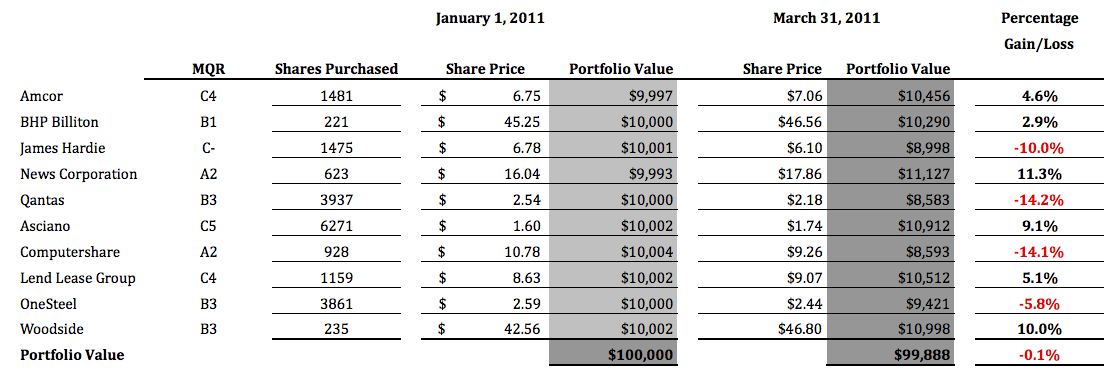
Twin brothers in there 30’s each inherited $100,000 from their parent’s estate. One was a conservative middle manager in the public service; he had little interest in the stock market or super funds and the like, so he decided to go to an internationally renowned, well-credentialed and highly respected firm to gain specific advice. Goldman Sachs advised him of their top ten stocks for 2011, so he decided to achieve diversification by investing $10,000 in each of the ten stocks he had been told about.
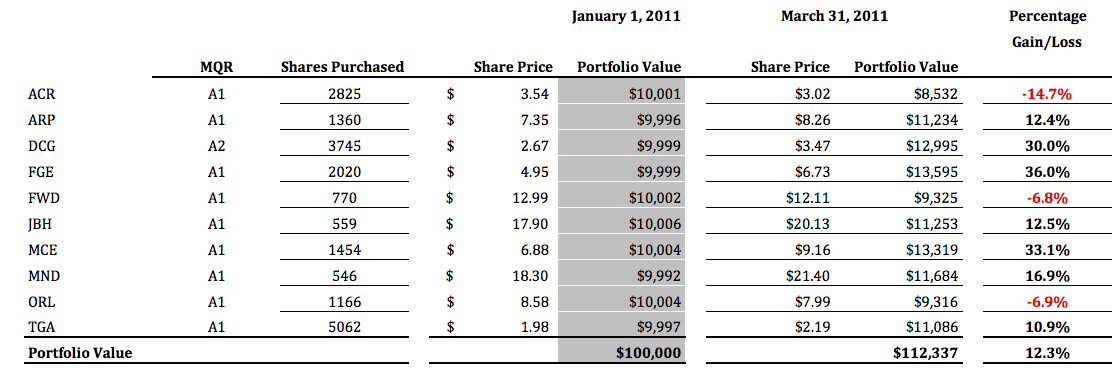
His twin had a small accounting practice in a regional Queensland and was a keen stock market investor. Specifically he was a student of the Value Investing method, and liked to think of himself as a Value.able Graduate. He too thought diversification would be a suitable strategy so decided to invest $10,000 in each of 10 stocks that were A1 or A2 MQR businesses and that were selling for as big a discount to his estimate of Value.able intrinsic value as he could find.
For this 12-month exercise, running for a calendar year, we shall assume that neither brother is able to trade their position. One brother has no inclination to, and his regional twin is fully invested, and more inclined to hold long anyway.
For the companies who have declared dividends in this quarter, most are now trading ex-dividend, but only 2 or 3 have actually paid. Dividends will be picked up in Q2 and Q4 of this study.
Now after just 3 months let’s look at the how the two portfolios have performed…
Institutional Bank Top 10 Picks for 2011
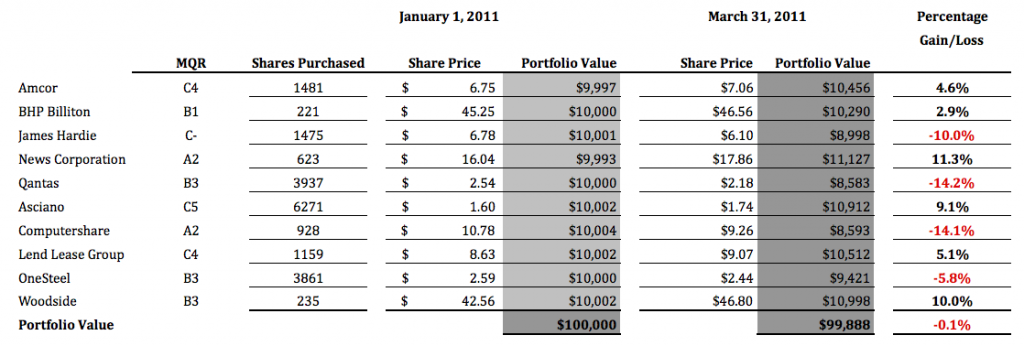
Montgomery Quality Rated (MQR) A1 and A2 Companies

We will visit the brothers again in 3 months on 30/6/2011 to see how they are fairing.
All the best
Scott T
How has your Value.able portfolio performed compared to the ASX 200 All Ords?
Posted by Roger Montgomery, author and fund manager, 6 April 2011.
by Roger Montgomery Posted in Companies, Insightful Insights, Investing Education, Value.able.
-
Why idolise the iPad2?
Roger Montgomery
March 29, 2011
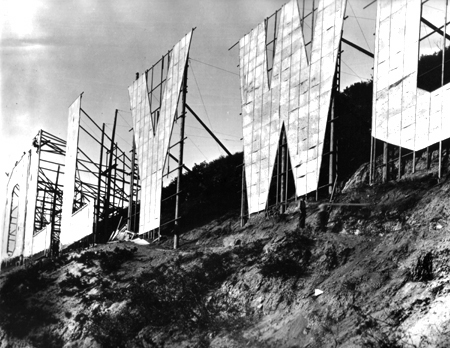 It’s an amazing story… Man creates computer. Man overcomplicates computer. Man strips back computer and creates a brand that has revolutionised the way we are entertained.
Did you know Apple has sold over 300 million iPods and iPhones over the past decade? That’s 300,000,000 products. According to the World Bank, in 2009 the world’s population stood at 6,775,235,741. The World Bank also notes that 80 per cent of the world’s population lives on less than $10 per day. Of the remainder, every 4th man, woman and child has purchased an Apple products in the last decade. Not a bad competitive advantage, (postscript: but perhaps not a sustainable one?)
Apple is also infiltrating the way we work. The Montgomery office is all Mac (and for your information, we have never had to call an IT professional to fix anything). Our iPhones are synced with our iMacs and our MacBooks synced with our iPhones.
You have heard the stories of Apple fans setting up camp on the footpath outside Apple’s flagship store on Sydney’s George Street. Australians don’t do that for coal or iron ore.
And don’t forget the accessories market. There’s no special concessions for development partners. Privately held companies that manufacture the sleeves, cases and connectivity devices that enhance our Apple experience don’t get hold of new devices until we do – on launch day.
Apple has the X-factor. Its product is unique. Its experience is unique and there is an almost religious fervour toward the brand. Competitors don’t stand a chance. The result? High, durable rates of return on equity and a rising Value.able intrinsic valuation – an A1 business.

Return on Equity is just one of dozens of metrics I uses to produce the Montgomery Quality Rating (MQR). Re-read Chapter Eleven, Step C on page 188 of Value.able for the Value.able ROE calculation.
Who is the Aussie equivalent? The Australian market may be much smaller than the US, but there are a handful of extraordinary businesses, A1 businesses. And its worth finding tem. They may not be listed yet. They may not even have launched yet…
Posted by Roger Montgomery, author and fund manager, 29 March 2011.
Postscript: The data used to calculate intrinsic value is available here: https://www.apple.com/investor/
by Roger Montgomery Posted in Companies, Investing Education, Value.able.
-
When to sell? Matrix and other adventures in Value.able Investing
Roger Montgomery
March 18, 2011
In August 2010 Matrix Composites & Engineering, when we first began commenting on the company, was trading around $2.90. Thirty days later the share price was at $4.48. Today MCE is trading at just over $9.00 and has a market capitalisation of more than half a billion dollars. It’s no longer just a little engineering business. Like the Perth industrial precinct of Malaga in which its headquarters are based, MCE is growing rapidly (according to Wikipedia there are currently 2409 businesses with a workforce of over 12,000 people in Malaga. The 2006 census listed only 28 people living in the suburb).
But has MCE’s share price risen beyond what the business is actually worth?
Stock market participants are very good at telling us what we should buy and when. When it comes to selling, it seems silence is the golden rule.
If you receive broker research, take out a report and turn to the very back page – the one beyond the analyst’s financial model. You will often find a table that lists every company covered by that broker’s research department. Now look to the right of each stock listed. What do you notice?
Buy… Buy… Hold… Buy… Buy… Accumulate… Hold…
What about sell?
There aren’t many companies in Australia worthy of a buy-and-hold-forever approach. And if you have invested in a company with a previous BUY recommendation, the luxury of a subsequent Ceasing Coverage announcement by the analyst is not helpful.
So then, when should you sell? It is a question I have been asked, to be honest, I can’t remember how many times. Because I have been asked so many times, it’s a question I answered in Chapter 13 of Value.able – a chapter entitled Getting Out.
Value.able Graduates will recognise a sell opportunity. Yes, it is an opportunity. Fail to sell shares and you could eventually lose money.
Of course, any selling must be conducted with a certain amount of trepidation, particularly when capital gains tax consequences are considered. But not selling simply because of tax consequences is unwise.
We pay tax on our capital gains because we make a gain. Yes, its difficult handing over part of our investment success to the Tax Man for seemingly no contribution, but without success our bank balance would remain stagnant forever.
When then should you sell? In Value.able I advocate five reasons. For now I would like to share with you a possible reason. Based on any of the other reasons I may be selling Matrix so make sure you understand this is a review based on one of five reasons.
Eventually share prices catch up to value. In some cases it can take ten years, but in the case of Matrix, it has taken far less time for the share price to approach intrinsic value.
One signal to sell any share is when the share prices rise well above intrinsic value.
There are no hard and fast rules around this. And don’t believe you can come up with a winning approach with a simple ‘sell when 20% above intrinsic value’ approach either.
What you MUST do is look at the future prospects. In particular, is the intrinsic value rising? I believe it is for Matrix (and I am not the only fund manager who does – you could ask my mate Chris too).
Here’s some of his observations: Risks associated with the timing of getting Matrix’s facility at Henderson up and running are mitigated by keeping Malaga open. And Malaga is producing more units now than it was only a few months ago. Matrix could also produce more units from Henderson than they have suggested (the plant is commissioned to produce 60 units per day) and I believe the cost savings will flow through much sooner than they say. Recall the company has indicated Henderson could save circa $13 million in labour, rent and transport costs (see below analyst comment). Excess build costs are now largely spent and if the company can ramp up to 70 units a day, HY12 revenue could double.
Why do I believe this? Because a recent site visit for analysts suggested it. As one analyst told me: “Production of macrospheres has started from Henderson with 7 of the 22 tumblers in operation. This is a good example of the labour savings to come as it’s now a largely automated process – there were only 3 people working v >20 on this process at Malaga.”
(Post Script: My own visit to WA at the weekend revealed a company capable of producing just over 100 units per day – Henderson + Malaga) Moreover, the sad events unfolding in Japan will force a rethink on Nuclear. If nuclear energy – recently hailed as a green solution to global warming – reverts to being a relic of an old world order, demand for oil will increase. Oil prices will rise. Deep sea drilling will be on everyone’s radar even more so.
And the risks? Well, one is pricing pressure from competitors. This is something that needs to be discussed with management, but preferably with customers!
Some Value.able Graduates may be reluctant to place too much emphasis on future valuations. Indeed I insist on a discount to current valuations. If it is your view that future valuations should be ignored, then you should sell.
Personally I believe one of my most important contributions to the principles of value investing is the idea of future valuations. Nobody was talking about them at the time I started mentioning 2011 and 2012 Value.able valuations and rates of growth. They are important because we want to buy businesses with bright prospects. And a company whose intrinsic value is rising “at a good clip” demonstrates those bright prospects.
If you have more faith and conviction that the business will be more valuable in one, two and three years time, you may be willing to hold on. On the basis of this ONE reason I am currently not rushing to sell Matrix (of course I may sell based on any of the other four reasons), however notwithstanding a change to our view (or one of the other four criteria for selling being met) I do hope for much lower prices (buy shares like you buy groceries…)
I cannot, and will not, tell you to sell or buy Matrix and I might ‘cease coverage’ at any time. As I have said many times here, do not use my comments to buy or sell shares. Do your own research and seek and take personal professional advice.
What I do want to encourage you to do is delve deeply into the company’s history, its management, their capabilities, recent announcements and any other valuable information you can acquire.
And in the spirit demonstrated by so many Value.able Graduates, feel free to share your findings here and build the value for all investors.
When the market values a company much more highly than its performance would warrant, it is time to reconsider your investment. Looking into the prospects for a business and its intrinsic value can help making premature decisions. Premature selling can have a very costly impact on portfolio performance not only because the share price may continue rising for a long time, but also because finding another cheap A1 to replace the one you have sold, is so difficult. At all times remember that my view could change tomorrow and I may not have time to report back here so do your own research and form your own opinions. Also keep in mind that we do not bet the farm on any one stock so even if MCE were to lose money for us (and we will get a few wrong) we won’t lose a lot.
Posted by Roger Montgomery, author and fund manager, 18 March 2011.
by Roger Montgomery Posted in Companies, Energy / Resources, Investing Education, Value.able.
-
How has my Switzer Christmas Stocking Selection performed?
Roger Montgomery
February 10, 2011
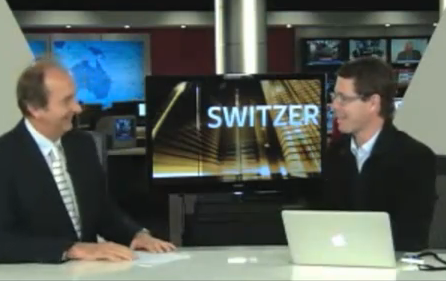 On the last show of 2010, Peter Switzer asked me to list six of my A1 businesses that, at the time, were displaying the largest margins of safety. Tonight Peter has invited me to join him once again to review how those six A1s have performed (and chat about Telstra’s result no doubt). Tune into the Sky Business Channel (602) from 7pm (Sydney time).
Here’s the article/transcript from that appearance.
Click here to watch the latest interview and discover how my A1 picks performed.
A1 stocks are the cream of the crop, but how do you know which stocks measure up? To find out, Roger Montgomery joins Peter Switzer on his Sky News Business Channel program – SWITZER.
Montgomery explains he classes companies from A1 down to C5.
“A1 is a business, I think, that has the absolute lowest probability of what I call a liquidity event – the lowest chance of having to raise capital, the lowest chance of needing to borrow more money, the lowest chance of defaulting on any debt that it has, breaching a banking covenant or a debt covenant, the lowest chance of needing money or going bust,” he says.
Montgomery says he’s interested in consistency of performance – A1s that he think will be A1 in the next 12 months.
“I’m looking for the companies that have been consistently A1s or A2s over a longer period of time,” he says. “They’re the ones that I think are most likely to be next year as well.”
Montgomery stresses that it’s important to diversify and get professional advice.
“Make sure you don’t bet the farm on any one company,” he says. “That’s why you need personal professional advice, because you’ve got to make sure that you’re doing the right thing for you and everybody has different risk tolerances.”
Montgomery’s A1 stocks
Platinum Asset Management – he says this is an “obvious A1 – a great performer, has no need for debt, pays all of its cash out.” The company is trading at about its intrinsic value, so it’s not a bargain, but it’s good quality. The intrinsic value is expected to rise around 14 per cent over three years.
Cochlear – “It’s been an A1 for years,” he says adding that its current share price is not cheap enough. Its intrinsic value is expected to rise around 13 per cent over the next three years.
Blackmores – “Expensive at the moment,” he says. “The intrinsic value is only expected to rise about five per cent over the next three years.”
Real Estate.com – “It’s expensive again – it’s trading at about 15 per cent above its intrinsic value.” The intrinsic value is expected to rise 15 per cent in a year. Its intrinsic value is forecast to rise by about 15 per cent a year. “In a year’s time, its intrinsic value will be its current price.”
M2 Telecommunications – This company is trading at a 10 per cent premium to its intrinsic value, Montgomery says. “It’s not cheap, but its intrinsic value is forecast to rise by eleven and a half per cent.”
Mineral Resources – This is a mining services business and is trading around its intrinsic value. The intrinsic values are forecast to increase by around 30 per cent a year over the next three years – “So that’s not bad.”
DWS Advanced – Montgomery says this IT services business is trading at a three per cent discount to intrinsic value and its intrinsic value is expected to rise by about 13 per cent.
Centrebet – Montgomery explains that people tell him there’s not many competitive advantages with the company because barriers to entry to the industry are low. “The owners of the licenses for these things would say they disagree – barriers to entry are quite high,” he says. Centrebet is at a six per cent discount to intrinsic value and it’s forecast to rise around five per cent a year, Montgomery says.
ARB – “Trading at about 11 per cent discount to its intrinsic value. Forecast intrinsic value is going to rise by about three-and-a-half per cent,” he says.
Oroton – “There’s been some talk about the CEO selling shares. The issue is I’ve bought shares from CEOs and founders who’ve sold shares and the share price has gone up a lot since then. I’ve also seen situations where the CEO has sold and that’s been the best time to have sold.”
Montgomery says there hasn’t been research to show CEOs selling shares indicated anything, but there has been research to suggest CEOs buying shares may indicate something. Oroton is trading at a 13 per cent discount to intrinsic value and is expected to rise 13 per cent per annum.
Companies trading at premiums to their intrinsic value
Reckon
Thorn Group
GUD Holdings
Fleetwood
Wotif
Monadelphous
The intrinsic value on these companies are rising anywhere from six per cent to around 17 per cent per year over the next three years, Montgomery says.
Montgomery says it’s important to do further research on the companies – “you can’t just go out and buy them – some of them, as I’ve pointed out, are expensive, so I wouldn’t be buying them. Some of them are A1s but that doesn’t mean that they’re amazing businesses and they’re the best businesses to buy. They’re the least chance of having a liquidity event.”
Companies trading at discount to intrinsic value
Montgomery explains he isn’t predicting share price; he’s valuing the company.
“Valuing a company is different to predicting where the share price is going to go”.
In descending order – biggest discount to smallest discount:
Matrix
Composite and Engineering
Nick Scali
JB Hi-Fi
Oroton
ARB
Centrebet
DWS
“We’ll come back in the New Year, we’ll have a look at how the index has gone, and we’ll have a look at how that little group of companies has performed.”
Important information: This content has been prepared by www.switzer.com.au without taking account of the objectives, financial situation or needs of any particular individual. It does not constitute formal advice. For this reason, any individual should, before acting, consider the appropriateness of the information, having regard to the individual’s objectives, financial situation and needs and, if necessary, seek and take appropriate professional advice.
Posted by Roger Montgomery, author and fund manager, 10 February 2010.
by Roger Montgomery Posted in Insightful Insights, Investing Education, Value.able.