

A crisis of quality – What’s wrong with active management?
When I wrote Value.able in 2010, ‘Quality’ as an investing factor was gospel, a foundational truth: buying fundamentally superior businesses at reasonable prices and holding them over the long run was the surest path to wealth creation.
Individuals like Warren Buffett, Charlie Munger, Mohnish Pabrai, Seth Klarman, Howard Marks and Terry Smith proved, over decades, that Quality rules. Superior Return on Capital Employed (ROCE) or Return on Equity (ROE), high gross margins, and consistent Free Cash Flow (FCF) conversion inevitably compounded a company’s equity, and ultimately produced outsized returns for investors in those businesses.
But as I reflect on the last five years’ returns from various investors, quality-based active investing appears to be weathering a prolonged storm. Over the past five years, for example, funds like Terry Smith’s Fundsmith Equity Fund – which has delivered a 13.1 per cent annualised return since its 2010 inception – have meaningfully trailed the returns of market indices like the MSCI World.
Why are quality-oriented fundamental metrics underperforming? Has the discipline of quality-and-value lost its edge temporarily or are we witnessing a structural distortion in how capital is priced?
Passive capital and momentum
To understand why quality strategies have struggled, it’s helpful to examine the market’s structure. Unless you’ve had your head in the sand, you will have noted the equity market is no longer driven primarily by stock pickers evaluating balance sheets, half-yearly and annual reports, or company outlooks. Increasingly, the market has become influenced by passive flows – investments into index funds – and momentum.
That observation is backed by data. According to data from CBOE Global Markets, active fund managers accounted for roughly 80 per cent of total trading volume in the 1990s. Today, active managers represent a mere 10 per cent of total trades. Meanwhile, passive index funds and ETFs, in the U.S. for example, now control over 60 per cent of total Assets Under Management (AUM).
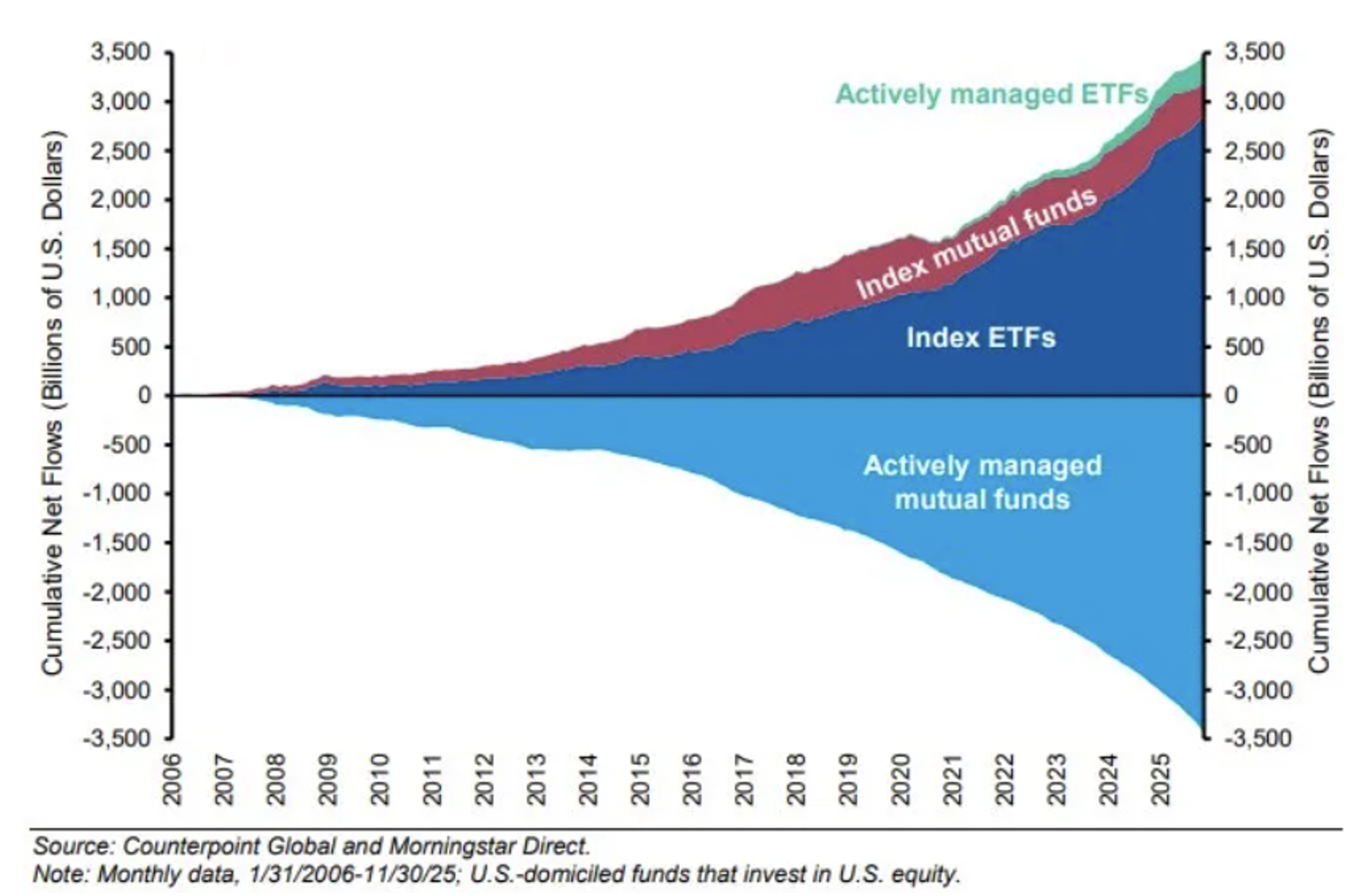
The result is that capital flowing into index funds and ETFs becomes the consensus, and the weight of money drives the biggest stocks higher irrespective of valuation. The result is that passive funds outperform, driving even more money into passive funds at the expense of active funds. It becomes a self-fuelling flywheel.
Figure 1. Cumulative Net Flows for U.S. Mutual Funds and ETFs, 2006-2025
Source: Counterpoint Global and Morningstar Direct
At the same time, the dynamic has pushed price-insensitive momentum to a 30-year high. In fact, market behaviour has reached levels of fundamental detachment reminiscent of late 1999 or 1963’s “It’s a Mad, Mad, Mad, Mad World” market.
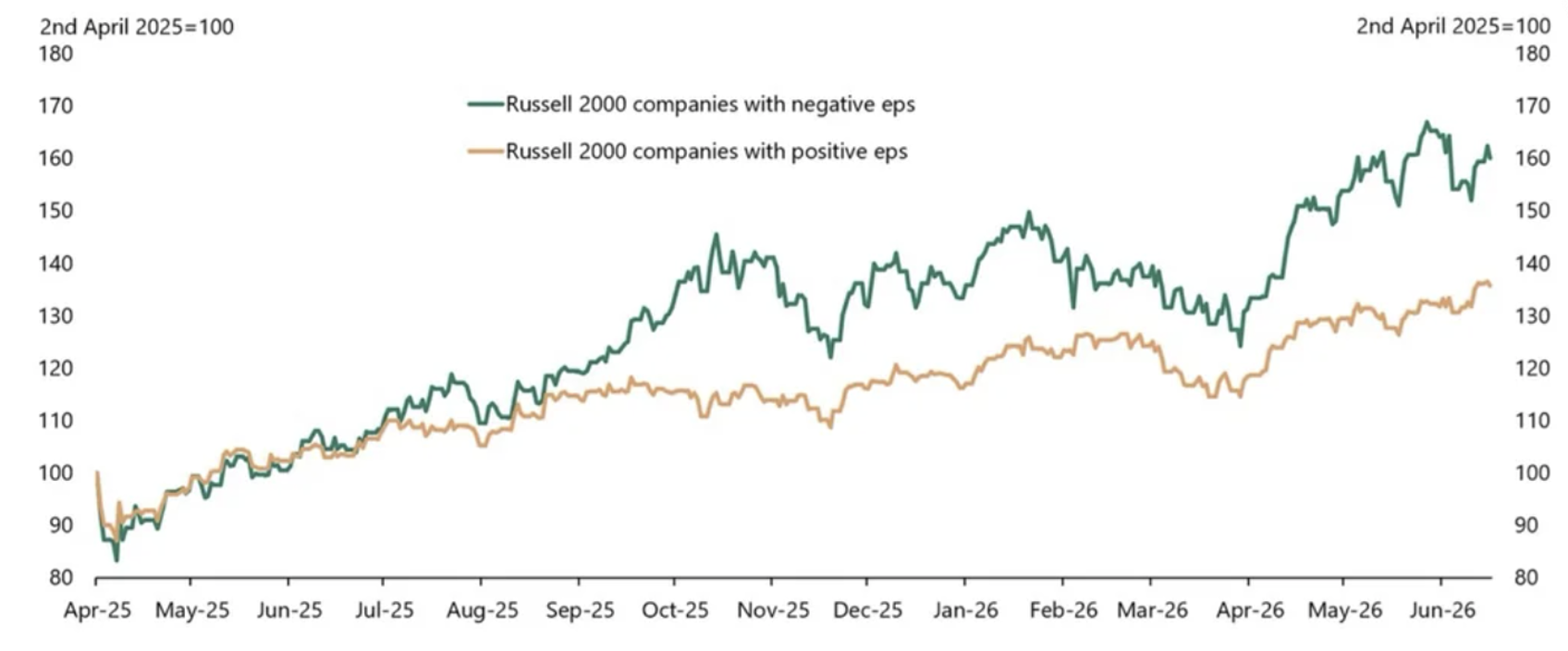
Consider the recent performance of unprofitable Russell 2000 Index companies versus those with positive earnings-per-share (EPS). Unprofitable companies (negative EPS) have systematically outperformed profitable ones.
Figure 2. Companies with Negative Earnings Outperform
Source: Bloomberg, Apollo Chief Economist
As one observer noted, “The market rewarding money-losing companies more than profitable ones is such a weird dynamic to watch persist this long, you’d think it would’ve corrected by now.”
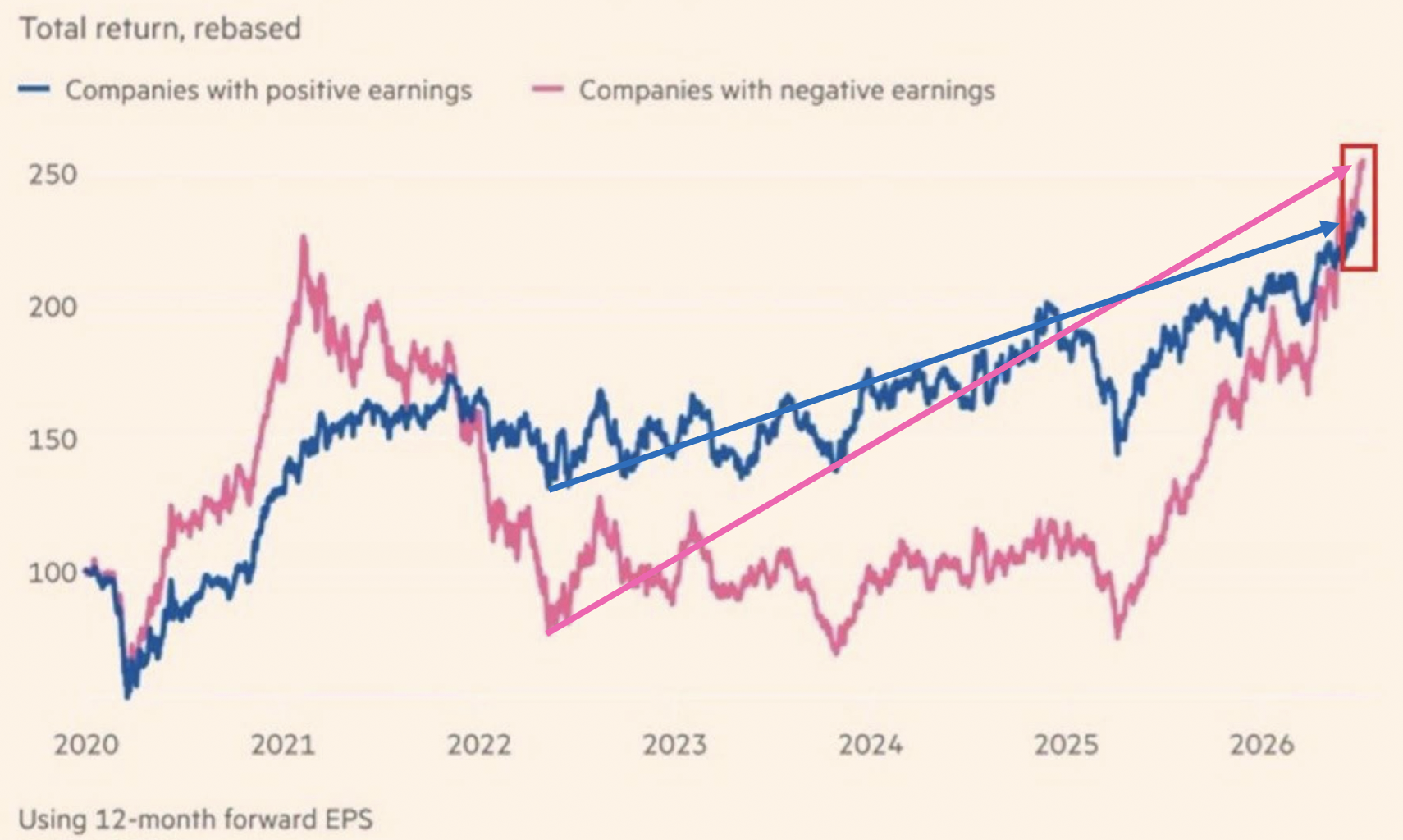
Indeed, the dynamic has persisted for some time. As Figure 3., reveals, the outperformance of unprofitable businesses in the U.S. small cap space has been ongoing since 2022.
Figure 3. Loss makers outperforming.
Source: HSBC
The active dilemma
Warren Buffett has, over the decades, frequently advocated doing nothing after buying an extraordinary business at an ordinary price. In his 1990 Letter to Berkshire Hathaway shareholders, Buffett emphasised the power of buy-and-hold investing and the dangers of unnecessary trading, stating, “Lethargy bordering on sloth remains the cornerstone of our investment style.” In 1996 he told investors, “Inactivity strikes us as intelligent behavior.” The core message has always been that allowing high-quality investments to compound over time is a winning long-term strategy.
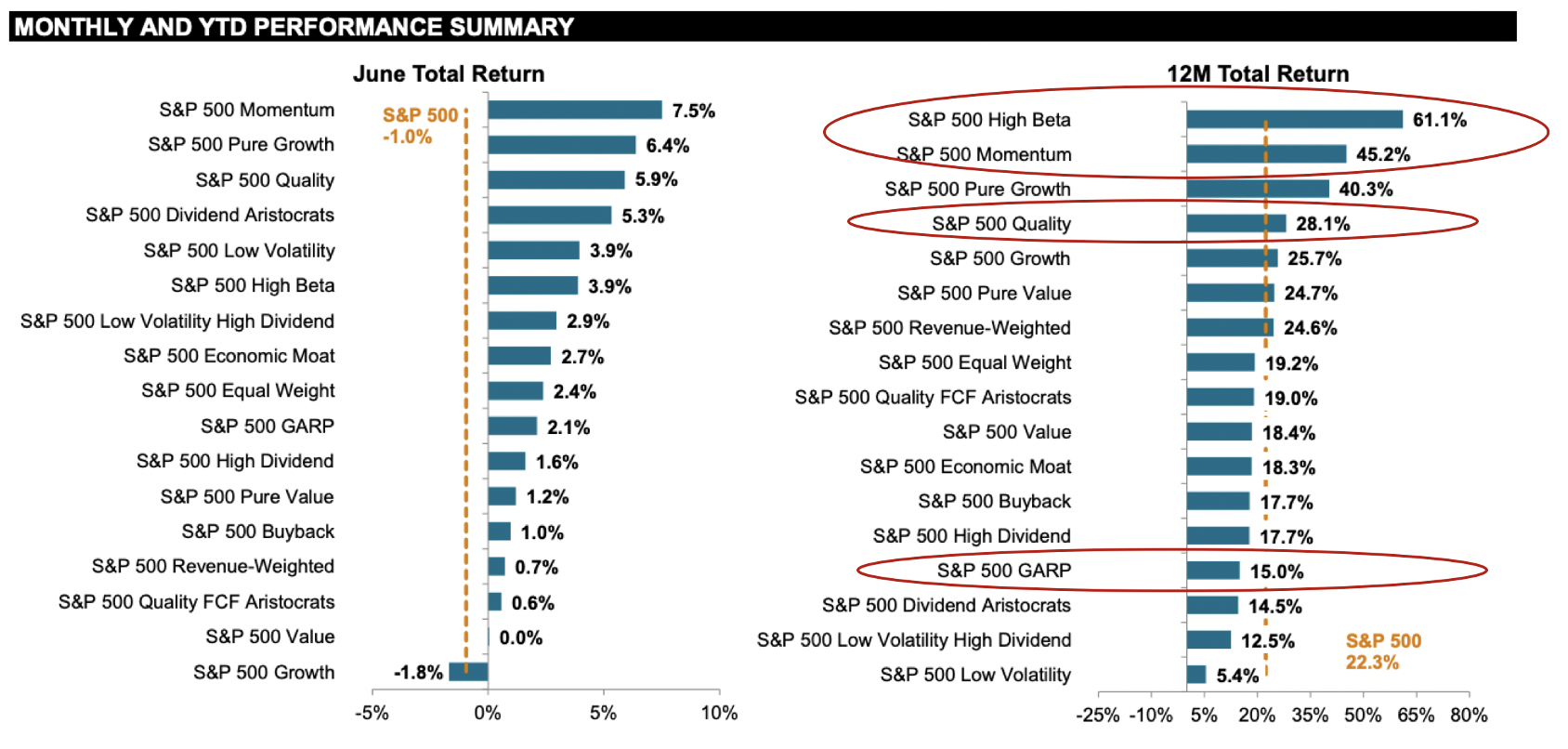
Figure 4. S&P500 Factor Indices Performance Monthly and YTD June 2026
Source: https://www.spglobal.com/spdji/en/documents/performance-reports/dashboard-sp-500-factor.pdf
As the ranking provided by S&P Global in Figure 4., reveals, one of the bottom five year-to-date strategies has been Growth at a Reasonable Price (GARP). Investors would have generated much better returns had they switched from quality/value growers to momentum or high beta. And yet again, the table also demonstrates the persistence of momentum and high beta stocks over quality as a factor.
Importantly, the differentials have become more acute recently, spurring many investors to contemplate a switch from the fuddy-duddiness of quality profitable companies, to the returns available from investing in the latest greatest technology.
One manager to make this switch is UK-based Terry Smith. In his mid-2026 letter to shareholders, Terry Smith highlighted the paradox modern quality managers face. Fundsmith’s core philosophy – 1. Buy good companies, 2. Don’t overpay, 3. Do nothing – relies on market efficiency, over time, to reward fundamental quality.
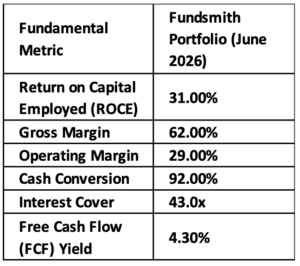
Table 1. Fundsmith portfolio metrics:
Source: Fundsmith Semi-Annual Letter, June 30, 2026
Despite holding companies with an average ROCE of 31 per cent and an FCF yield of 4.3 per cent (more than double the S&P 500 average, which has been squeezed by massive AI capital spending), as shown in Table 1., Quality-based funds face persistent headwinds as investors redeem for cheaper and (currently) better-performing index funds or momentum strategies.
In open-ended funds, like Fundsmith, managers are subject to client redemptions. When, for example, a high-quality company suffers a temporary operational issue, momentum-driven automated selling exaggerates the stock’s downside, turning minor pullbacks into sharp selloffs. It’s one of the reasons we frequently see extreme intraday moves on the back of often modest earnings surprises.
Traditional quality investing taught managers to buy these dips. Two widely-cited examples include Warren Buffett buying American Express during the 1960s salad oil scandal, and the Washington Post in 1973 when high inflation, economic stagnation, and political turmoil surrounding Watergate saw panic selling hit media stocks and particularly the newspaper industry. Others include John Templeton buying penny stocks at the outbreak of World War II, David Tepper buying U.S. banks in 2009 and making US$7 bilion, and Peter Lynch making 15 to 20 times for his clients buying American automaker Chrysler in 1982 when it appeared to be on the brink of bankruptcy.
But in today’s market, buying into downward momentum is, as Smith described, like trying to “catch a falling knife”.
This dynamic forced Fundsmith to increase portfolio turnover to 51.8 per cent in the first half of 2026, rotating out of lagging businesses (such as LVMH, Coloplast, and Zoetis) into companies with stronger price and operational momentum (such as TSMC, AppLovin, and GE Vernova).
But not every quality-based investor is throwing in the towel. Buffett, the GOAT (Greatest Of All Time) of quality-based value investing, is sticking to his guns, amassing US$400 billion in cash according to the most recent disclosures and apparently completely eschewing the AI thematic.
The hope: Quality and Value will reassert their dominance
While momentum can dominate in the medium term, market history demonstrates that trees don’t grow upwards indefinitely. We can see that current momentum is being fuelled by an influx of passive flows, and we can surmise that speculative fervour around artificial intelligence is also contributing to the underperformance of more traditional quality issues.
But passive flows, at least, are a double-edged sword.
Consider what happens when market momentum reverses. Just as passive buying has driven prices higher without regard to value or quality, passive redemptions, when they occur, will force index trackers to sell indiscriminately. In a market where active liquidity providers represent only 10 per cent of volume, sudden sell-offs can cause severe drawdowns. Single-day swings such as Sandisk’s 11 per cent move, Micron’s 12 per cent swing, and Western Digital’s 11.5 per cent spike in June as well as Dell’s 32 per cent intraday move in May and Snowflake’s near 40 per cent move on May 28, are potentially clear warnings of the underlying fragility in the structure of today’s market.
And consider that historically there have been a multitude of swings from active to passive, from quality to momentum and from value to growth and back again.
These cycles begin with a fundamental disconnect, where passive buying inflates momentum and quality fundamentals are ignored. That produces extreme concentration in the biggest stocks in the index with market valuations unsupported by fundamentals or valuation. Eventually, the growth fails to match the hype, and as passive flows reverse rapidly, the valuation mismatch corrects. Finally, with portfolio allocations forced to remain in equities a rotation or flight to quality occurs and investors return to cash-generative, high-ROE businesses.
Well, for quality or value-based investors, that’s the hope anyway.
For faithful quality-based investors
For believers in quality and value, current underperformance is hard to stomach and even harder to endure, but the question is whether it is a permanent sign that fundamental analysis is obsolete.
Despite nearly five years of underperformance, I am not convinced that quality-based fundamental investing is dead. And with US$400 billion in cash, it seems Warren Buffett isn’t convinced either.
It’s worth keeping in mind (some of you will remember) that during the height of the dot-com boom between 1998 to Easter 2000, Berkshire Hathaway significantly underperformed the rapidly rising market.
While the Nasdaq soared 145 per cent between June 1998 and February 2000, Berkshire’s stock price fell roughly 44 per cent, and its per-share book value dropped 0.5 per cent in 1999. The divergence was driven by Warren Buffett strictly avoiding technology stocks (as Berkshire is doing now with AI stocks), as well as slumping value stocks (but highly profitable companies) – such as Coca-Cola and American Express – as investors broadly liquidated them to chase soaring internet and dot-com startups.
So material was the underperformance that in late 1999, Barron’s magazine published an article entitled “What’s Wrong, Warren?”, questioning whether Buffett’s conservative, value-based approach had become obsolete.
In his 1999 Berkshire Hathaway Annual Letter to Shareholders, Buffett openly addressed this historic relative underperformance, defending his refusal to speculate on hyped tech stocks. As many now know, that discipline paid off when the dot-com bubble burst in March 2000. As the tech-heavy market crashed over the next two years, Berkshire’s portfolio surged in value and the rest, as they say, is history.
Table 2. Berkshire versus, Nasdaq, S&P500 and Magnificent Seven 2023-2026 YTD
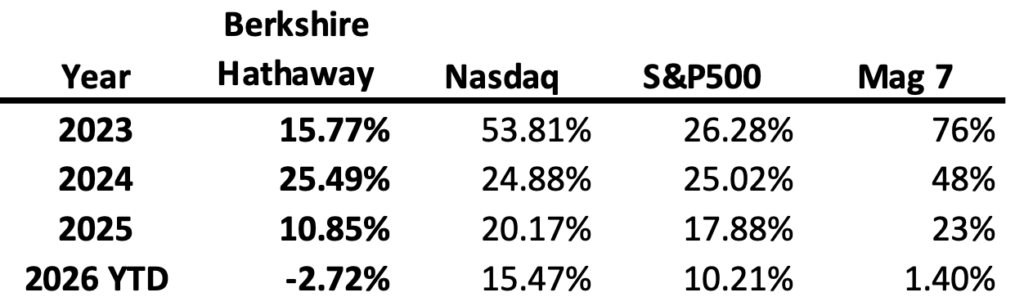
Today, it’s AI stocks and index mechanics that have skewed price signals, so it’s worth remembering that portfolios generating greater than four per cent free cash flow yields backed by +30 per cent returns on equity and capital employed offer structural protection that debt-laden, unprofitable and capital hungry AI growth stocks can’t match.
Finally, it’s worth contemplating the original rationale for passive index funds: They exist to capture average market returns at low cost – not to beat active management by 30 per cent via concentrated technology sector bets.
‘When’ the passive investing flywheel slows or reverses, business quality will once again prove to be the ultimate margin of safety.

Roger Montgomery is the Founder and Chairman of Montgomery Investment Management. Roger has over three decades of experience in funds management and related activities, including equities analysis, equity and derivatives strategy, trading and stockbroking. Prior to establishing Montgomery, Roger held positions at Ord Minnett Jardine Fleming, BT (Australia) Limited and Merrill Lynch.
He is also author of best-selling investment guide-book for the stock market, Value.able – how to value the best stocks and buy them for less than they are worth.
Roger appears regularly on television and radio, and in the press, including ABC radio and TV, The Australian and Ausbiz. View upcoming media appearances.
This post was contributed by a representative of Montgomery Investment Management Pty Limited (AFSL No. 354564). The principal purpose of this post is to provide factual information and not provide financial product advice. Additionally, the information provided is not intended to provide any recommendation or opinion about any financial product. Any commentary and statements of opinion however may contain general advice only that is prepared without taking into account your personal objectives, financial circumstances or needs. Because of this, before acting on any of the information provided, you should always consider its appropriateness in light of your personal objectives, financial circumstances and needs and should consider seeking independent advice from a financial advisor if necessary before making any decisions. This post specifically excludes personal advice.


