

The cost of a housing downturn – who pays the price?
Australia’s housing market is under growing pressure, and further declines in property values could affect more than just homeowners. The consequences could extend across household finances, consumer confidence and state government budgets.
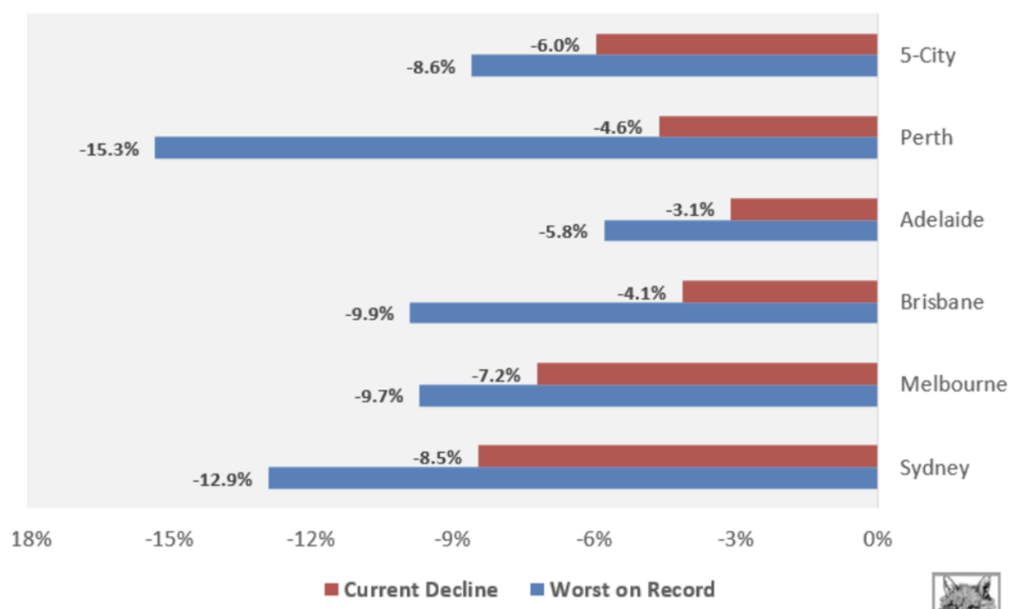
If the value of Australia’s 11 million dwellings decline by an average 15.5 per cent from its A$12.8 trillion peak, then up to A$2.0 trillion in paper wealth could be wiped out over the 2026-2027 period. Based on averages, a dwelling worth $1.16 million at its peak could fall below $1.0 million. This fall in value would equate to a decline of $70,000 per Australian in housing wealth.
Current losses vs worst on record
Source: www.macrobusiness.com.au
The significant issues I see will likely include; pressure on many mortgagee’s balance sheets, poor consumer confidence levels, and required austerity from State governments.
1.Pressure on mortgage holders
Of the 3.25 million Australians who have a mortgage, their debt to residential property value ratio will increase, putting additional pressure on their household budget.
Recent purchases, particularly by many first home buyers with a relatively small deposit ratio, will record negative equity on the said purchase. Given the borrowing laws in Australia, this is a tough position to be in – unlike some Western World countries where borrowers can generally elect to walk away from a negative equity position.
2. Consumer confidence under pressure
Consumer confidence reflects the collective sentiment and spending decisions of Australians and can be an important indicator of the country’s economic outlook.
Together with the four cash rate increases from the Reserve Bank of Australia (RBA) in 2026, Australia’s poor productivity record of recent years, and the negative real Gross Domestic Product (GDP) per capita in the majority of the past 16 quarters, it seems likely that consumer confidence will remain at close to historic lows for some time.
For example, the 4-week moving average for the ANZ-Roy Morgan Australian Consumer Confidence Index has bounced from a multi-decade record low in mid-April 2026 of 62 to the current 72 – well below the 36-year average of 108.5.
3. Pressure on state government budgets
With the Stamp Duty received by most Australian State governments typically accounting for 16 per cent of general government revenue, each Treasurer must be contemplating at least a 4 per cent reduction in this component of their revenue, assuming the average decline in residential property price is accompanied by declining volumes of transactions.
This will place many States’ credit ratings under pressure, and austerity programs will be required.
Disagreements between various State Premiers and the Prime Minister’s office will likely increase. In NSW, for example, Premier Minns appears increasingly frustrated given the $0.82 GST return per $1.00 per head of population relative to Victoria’s $1.06 GST return per $1.00 per head of population.
So, who really pays the price?
A further decline in property values could have significant flow-on effects across the Australian economy. With households already facing higher borrowing costs, the consequences may be felt by consumers and governments alike.

Chief Executive Officer of Montgomery Investment Management, David Buckland has over 40 years of industry experience.
David is a deeply knowledgeable and highly experienced financial services executive. Prior to joining Montgomery in 2012, David was CEO and Executive Director of Hunter Hall for 11 years, as well as a Director at JP Morgan in Sydney and London for eight years.
This post was contributed by a representative of Montgomery Investment Management Pty Limited (AFSL No. 354564). The principal purpose of this post is to provide factual information and not provide financial product advice. Additionally, the information provided is not intended to provide any recommendation or opinion about any financial product. Any commentary and statements of opinion however may contain general advice only that is prepared without taking into account your personal objectives, financial circumstances or needs. Because of this, before acting on any of the information provided, you should always consider its appropriateness in light of your personal objectives, financial circumstances and needs and should consider seeking independent advice from a financial advisor if necessary before making any decisions. This post specifically excludes personal advice.


