
Has the great AI unwind begun?
Investor concerns about the sustainability of artificial intelligence (AI) infrastructure spending have been building and threatening the stock market for months, and Jensen Huang’s reinstatement as Nvidia’s CEO doesn’t appear to have assuaged them. Indeed, the brief fillip the market enjoyed following the announcement of his return already appears to be fading.
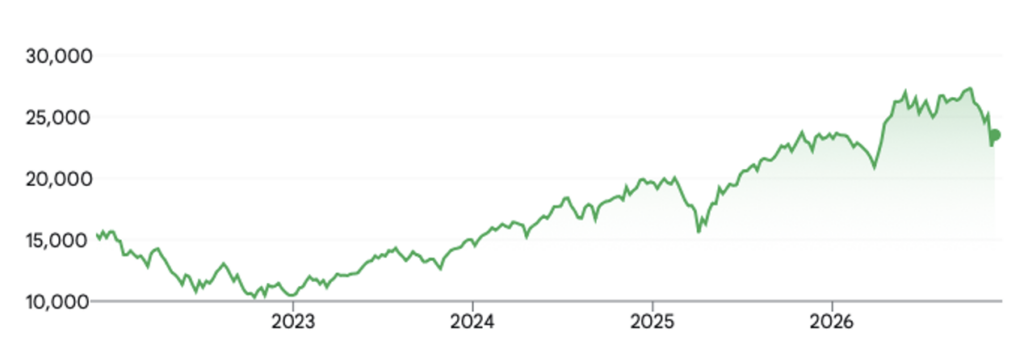
Heading into the U.S. Thanksgiving holiday, and despite a strong domestic economy, AI stocks remain beaten down.
Since 2022, Wall Street enjoyed an AI-inspired hype cycle, pricing the latest General Purpose Technology (GPT) as if any amount of money thrown at it would earn a spectacular return. It’s worth noting, however, that throughout history, every GPT has inspired the same hype cycle.
Figure 1. NASDAQ
Source: Google Finance
But last week, a single-day drop of over five per cent pushed the NASDAQ into correction territory, dragging both commodities and broader equities down with it.
No oracles here
And it’s fair to say the sell-off wasn’t just routine profit-taking; it looked like a wave of panic. Then, just two minutes after Friday’s market close, database giant Oracle – a fixture of the tech sector since the 1970s – issued an unprompted statement on X insisting it had secured every dollar needed to fulfil its OpenAI contracts.
In corporate finance, an unsolicited declaration of solvency when nobody asked, and while your stock sits at a 52-week low and your credit default swaps go parabolic, is odd.
Tech versus finance
To understand why the market suddenly snapped, you have to separate the underlying technology from the financial engineering built on top of it. Statistical inference models may well prove transformative over the coming decades just as commercial flight, the radio, the telephone, railways and the internet were. That doesn’t mean investors win. In fact, history shows that the real winners from the new technology are almost always and exclusively the consumer.
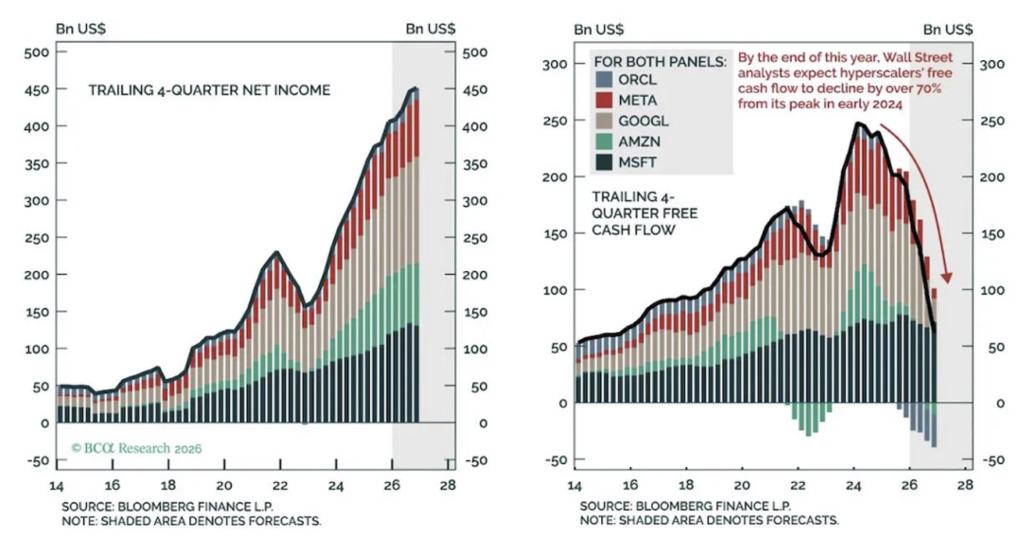
Today, the corporate entities housing AI models have been operating on an unsustainable cash-burn model. Tech giants and data centre operators have poured hundreds of billions into chips, land, electricity, and water without generating the cash flow required to service their massive debt loads.
Figure 2. Hyperscaler reported profits boom but cash flows collapse
Source: Bloomberg Finance L.P.
For years, cheap money papered over the gap. That era ended as 10-year Treasury yields surged over 30 per cent from February lows to touch 5.27 per cent (4.86 per cent at the time of writing), driven by persistent inflation, sovereign debt issuance, data centre borrowing, and geopolitical conflict in Iran.
As has always been the case, when the price of money jumps, leveraged speculation has to ease.
This boom was built on significant leverage. Following the 2023 Silicon Valley Bank bailout – which signalled to Wall Street that aggressive risk-taking enjoyed downside protection – major hedge funds levered up to levels unseen since 2013. According to Federal Reserve stability data, the hedge fund sector accumulated roughly US$13 trillion in gross assets against just US$4 trillion in net assets, leaving at least US$9 trillion in excess leverage.
According to reports, at the top tier, funds were borrowing US$11 from major banks like JPMorgan, Goldman Sachs, and Morgan Stanley for every dollar they managed. As borrowing costs climbed, margin calls followed, forcing major funds like the US$45 billion AI-focused Situational Awareness to liquidate positions over the summer.
Circular finance
And then there’s the circular financing web, with Nvidia at the centre.
For years, Nvidia acted as both a hardware monopolist and a de facto shadow bank – extending off-balance-sheet financing to specialised cloud providers (“neoclouds” like CoreWeave and Nebius) so they could buy more Nvidia Graphic Processing Units (GPUs), while investing US$10 billion directly in major end customers like Anthropic.
When revelations of CEO Jensen Huang’s triple adultery triggered his resignation earlier this month, the headlines focused on his affair with an alleged Chinese spy and illegal chip smuggling through Singapore to Chinese entities like Megaspeed.
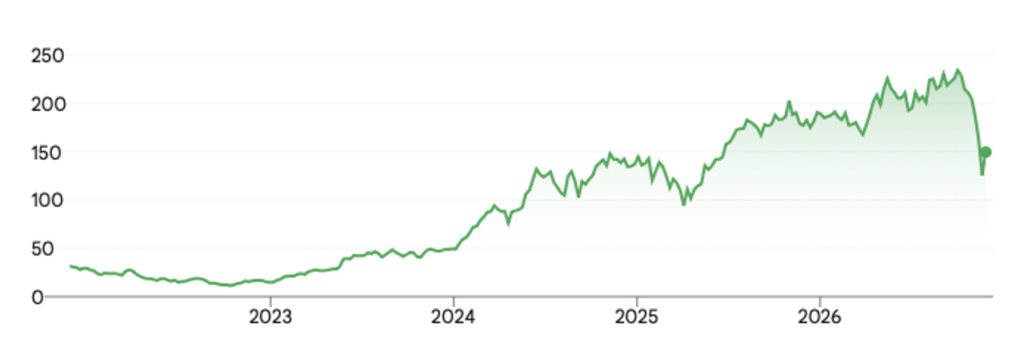
Figure 3. Nvidia share price
Source: Google Finance
But the real fear was accounting scrutiny from the Treasury and Securities and Exchange Commission (SEC). Indeed, even with Huang’s reinstatement days later, Nvidia remains nearly 40 per cent below its highs and has shed nearly US$3 trillion in market value. Meanwhile, its neocloud partners have seen their stock prices halve while their debt trades at junk status.
As an aside the local Australian Neocloud, Firmus, has raised roughly US$3.05 billion to US$4.7 billion in equity alongside US$10 billion in debt facilities, which brings its total financing to over US$13 billion–$16.3 billion depending on the database. It may not survive.
Meanwhile, the supposed saviour of the AI trade – Anthropic, the maker of the Claude Large Language Model (LLM) – saw its Initial Public Offering (IPO) stumble right out of the gate. Wall Street hoped a blockbuster debut would reignite market euphoria. Instead, Anthropic’s staggering cash burn and nearly US$1 trillion in long-term data centre commitments weighed heavily on sentiment.
Shares opened at US$115 before collapsing back to US$82 at the time of writing and below its US$83 IPO price.
Problems pile up
The entire AI ecosystem appears to be caught in an interconnected vice.
Oracle is carrying roughly US$465 billion in debt and obligations while burning US$16 billion in negative cash flow annually, betting its future on a handful of clients led by OpenAI.
But OpenAI recently fell far short of its US$30 billion private fundraising target – bringing in just US$11 billion – and its path to a public listing looks effectively closed after Anthropic’s questionable debut.
If OpenAI can’t raise capital, Oracle won’t get paid, and heavily indebted backers like SoftBank will have to write-down their investment.
And then there’s the Semiconductors. These companies were hit by news last week that the U.S. government is tightening export controls on semiconductors in response to allegations that Nvidia and other U.S. chip companies were indirectly selling their AI chips to China or providing chips to other Asian data centres that the Chinese accessed remotely.
Tighter export controls would lower the demand for chips and depress their prices. If so, then the drop in the industry’s valuation multiple will soon be followed by a slowdown in earnings growth or even negative earnings.
History is a guide
History suggests this unwind won’t happen overnight. Bear markets rarely end in a single dramatic crash; they grind investors down over months or years through deceptive “bear market bounces” that trap dip-buyers before resuming their descent.
It’s worth remembering the dot-com bust took the NASDAQ two and a half years to bottom out, while dragging the broader economy into recession a full year after tech stocks peaked.
It’s also worth noting that a 20 per cent – 30 per cent decline in the S&P 500 is meaningful enough to be considered a systemic event impacting the economy, rather than a normal isolated correction.
That’s because government tax receipts fall when capital gains and corporate profits shrink. Then unemployment rises as companies reduce hiring and cut staff. And finally, banks that hold equities, loans to equity-sensitive borrowers, and related securities see both mark-to-market losses and higher loan delinquencies.
The result is a broader economic slowdown.
Summary
While Nvidia appears permanently injured and Anthropic’s IPO looks like a fail and the U.S. Federal Reserve’s voting committee remains hawkish, there is one crucial difference between today’s market and that of 2007, just before the Global Financial Crisis (GFC). And that is ordinary American households are not sitting on US$14 trillion in toxic mortgage leverage.
This crash may just be confined to those over-leveraged hedge funds, private equity investors, and Silicon Valley monopolies. Indeed, as some observers have noted – that could explain why political appetite for a Wall Street bailout appears non-existent.
Of course, all investors will be impacted to some extent. As capital gains evaporate, pension funds and university endowments take losses, tax revenues in states like California and New York shrink, and foreign investors pull back from U.S. assets, the wealth effect will inevitably spill into the real economy.
The AI party and associated bubble will end even though the technology keeps working. Bubbles pop because financial gravity always wins.

Roger Montgomery is the Founder and Chairman of Montgomery Investment Management. Roger has over three decades of experience in funds management and related activities, including equities analysis, equity and derivatives strategy, trading and stockbroking. Prior to establishing Montgomery, Roger held positions at Ord Minnett Jardine Fleming, BT (Australia) Limited and Merrill Lynch.
He is also author of best-selling investment guide-book for the stock market, Value.able – how to value the best stocks and buy them for less than they are worth.
Roger appears regularly on television and radio, and in the press, including ABC radio and TV, The Australian and Ausbiz. View upcoming media appearances.
This post was contributed by a representative of Montgomery Investment Management Pty Limited (AFSL No. 354564). The principal purpose of this post is to provide factual information and not provide financial product advice. Additionally, the information provided is not intended to provide any recommendation or opinion about any financial product. Any commentary and statements of opinion however may contain general advice only that is prepared without taking into account your personal objectives, financial circumstances or needs. Because of this, before acting on any of the information provided, you should always consider its appropriateness in light of your personal objectives, financial circumstances and needs and should consider seeking independent advice from a financial advisor if necessary before making any decisions. This post specifically excludes personal advice.


