

Hyperscaler cash flow mirage
It may initially seem a stretch to claim the financial quality of your retirement beyond 2026 might depend on the outcome of some heroic assumptions about Hyperscaler artificial intelligence (AI) cash flows.
But is it?
Equity markets, and especially investors in U.S. stocks – of which there is a record number investing a record amount – are ignoring a litany of concerns.
Figure 1. Foreign investors have now bought US$942 billion of U.S. stocks over the last 12 months, the most in history
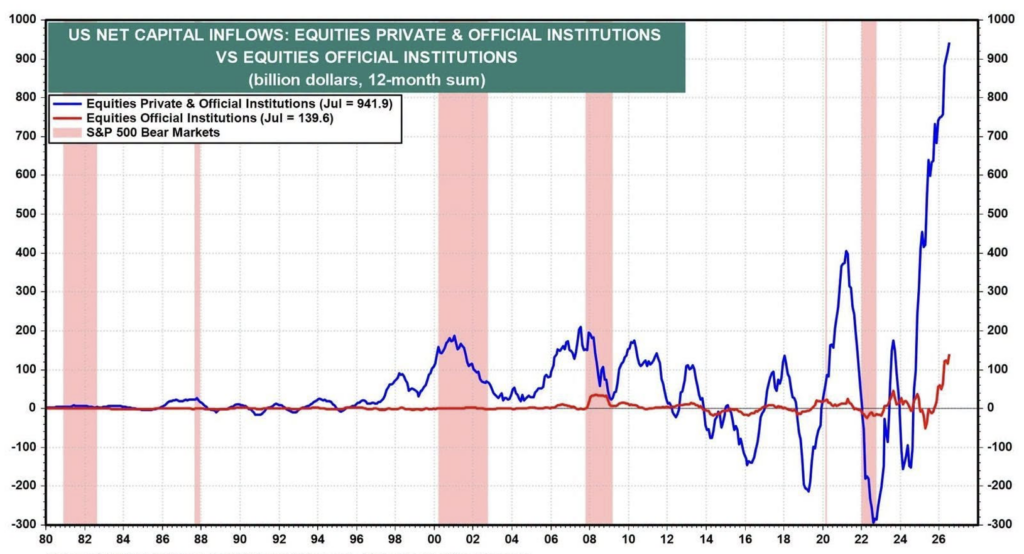
Source: LSEG Datastream and Yardeni Research. Department of the Treasury
Those concerns include historically stretched valuations, extreme concentration in mega-cap stocks, weak market breadth, persistent inflation, high and rising short and long-term interest rates, geopolitical fragility, ballooning U.S. debt, and the need for unconventional monetary intervention.
Balancing those concerns are rising earnings, an assumed soft landing, and an accommodative Federal Reserve (the Fed). But the most controversial offset – the one on which your retirement may depend – is the assumptions associated with AI.
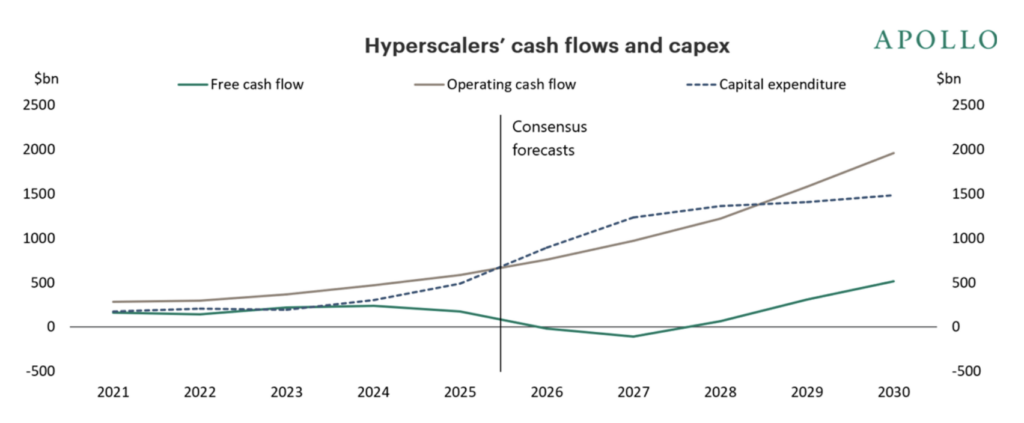
Recently, Torsten Slok from Apollo Global graphed the assumptions upon which the entire AI trade may rest.
Figure 2. Assuming 27 per cent growth in operating cash flows
Source: Apollo
Big Tech is betting the house, including their economic moats, on AI.
Driven by massive data centre expansions, specialised silicon, and generative AI infrastructure, the aggregate spending from hyperscalers, which includes Microsoft, Alphabet, Amazon, Meta, and Oracle, has reached astronomical levels.
And justifying these infrastructure commitments is an expectation aggregate hyperscaler operating cash flows will scale from approximately US$600 billion in 2025 to US$2.0 trillion by 2030.
That target represents a 27.2 per cent Compound Annual Growth Rate (CAGR) across five consecutive years – a pace with no historical precedent for an asset base already generating well over US$1.5 trillion in collective revenue. While Big Tech will undoubtedly expand its cash generation over the coming years, a sober assessment of the underlying financial drivers suggests the US$2.0 trillion target is probably a bridge too far.
The maths behind US$2 trillion
To understand why the target is unlikely, have a look at what needs to go right for hyperscalers to reach it.
Aggregate Operating Cash Flow (OCF) measures cash generated from business operations:

To achieve US$2.0 trillion in OCF, hyperscalers must:
Continue growing their digital advertising (Alphabet, Meta), e-commerce (Amazon), and core enterprise software (Microsoft, Oracle) revenues at 8 per cent – 12 per cent per year, to supply their high-margin cash base.
Grow combined cloud infrastructure revenues (AWS, Azure, Google Cloud, OCI) by 18 per cent – 25 per cent per year until 2030 to drive platform revenues toward US$800 billion–US$1.0 trillion.
And finally, high-margin AI software revenues, such as those from Copilot licences, model application programming interface (API) consumption, and vertical AI agents, have to grow more than 10x, in revenue terms, from roughly US$25 billion – $35 billion in 2025 to over US$350 billion –$450 billion annually.
Underpinning all of this is another requirement to be able to rapidly monetise the new assets. Hyperscalers are pouring US$600 billion+ annually into data centre capacity. High asset monetisation means turning those server clusters into high-margin cash quickly –maintaining estimated 80 per cent + utilisation rates, transitioning capacity from model training to recurring token inference, and achieving full capital payback within 12 to 24 months before hardware depreciation and obsolescence forces the next upgrade cycle.
And that’s probably where the thesis becomes hopeful.
Pushing barrows uphill
Several structural frictions make achieving this US$2.0 trillion OCF outcome improbable.
While capital expenditure (capex) sits on the balance sheet rather than being deducted directly from operating cash flow, the operational expenses required to support the infrastructure are immense. Rising energy costs and lease payments, along with cooling, facility maintenance, and the rapid depreciation cycles for servers and graphic processing units (GPUs), will drag on operating cash margins.
For most investors and analysts, the highest cash margins in tech come from pure software as a service (SaaS). Expanding this revenue model to AI would be a masterstroke, but it’s unlikely. That’s because enterprise buyers are already demonstrating caution. Rather than expanding their IT budgets to accommodate new AI tools, many enterprises are simply reallocating existing software budgets.
Consequently, the AI-driven software layer revenue is projected to reach US$200 billion –$300 billion by 2030. It’s a solid number, but it’s a long way from the high-margin revenues needed to see cash flows reach US$2.0 trillion.
Moreover, as competition intensifies among foundation and frontier model providers, the unit economics of AI inference is experiencing rapid downward price pressure. Hardware efficiency gains and open-source alternative models are driving token costs down by over 50 per cent year over year.
The optimist will note lower costs boost adoption volumes (more customers), but the counter is that severe price erosion prevents compute hosting (Infrastructure as a Service (IaaS) – where a vendor provides on-demand access to essential computing infrastructure –such as physical or virtual servers, storage, and networking – over the internet on a pay-as-you-go basis) from earning the high margins needed.
Finally, VC-funded AI labs and foundation model startups generate a meaningful share of current revenue for cloud providers. Those AI labs are burning cash at unsustainable rates. If they face a funding bottleneck before achieving self-sustaining profitability, cloud providers will witness the impact of reduced compute consumption. Of course, the bulls will remind investors Uber was unprofitable and funded for 14 years after being founded in 2009 before posting its first full-year net profit and operating profit in 2023. It’s worth keeping in mind, however, that Uber has sustained three drawdowns of between 20 and 64 per cent since listing in 2019.
The realistic horizon
Hyperscalers aren’t headed for a terminal crash because their core businesses remain among the most potent profit engines in corporate history. Their high-profitability digital advertising, e-commerce and enterprise software monopolies will continue to provide huge cash flows.
But those engines and their underlying monopoly status are being compromised by the race to maintain AI relevance. And they’re now borrowing billions above those cash flows in the race to win. Expecting aggregate operating cash flow to more than triple to US$2.0 trillion by 2030 requires very optimistic assumptions across every layer of the technology stack.
A more plausible trajectory might posit aggregate operating cash flows between US$1.1 trillion and US$1.4 trillion by 2030 (circa 12–15 per cent CAGR). That outcome still represents an extraordinary period of wealth creation – just without the hyper-accelerated monetisation required to meet the market’s most aggressive expectations.
If the Hyperscalers get there a year or two later, it might not worry anyone. But how the market reacts to being disappointed will determine the impact on that part of your retirement savings that’s exposed to the AI trade.

Roger Montgomery is the Founder and Chairman of Montgomery Investment Management. Roger has over three decades of experience in funds management and related activities, including equities analysis, equity and derivatives strategy, trading and stockbroking. Prior to establishing Montgomery, Roger held positions at Ord Minnett Jardine Fleming, BT (Australia) Limited and Merrill Lynch.
He is also author of best-selling investment guide-book for the stock market, Value.able – how to value the best stocks and buy them for less than they are worth.
Roger appears regularly on television and radio, and in the press, including ABC radio and TV, The Australian and Ausbiz. View upcoming media appearances.
This post was contributed by a representative of Montgomery Investment Management Pty Limited (AFSL No. 354564). The principal purpose of this post is to provide factual information and not provide financial product advice. Additionally, the information provided is not intended to provide any recommendation or opinion about any financial product. Any commentary and statements of opinion however may contain general advice only that is prepared without taking into account your personal objectives, financial circumstances or needs. Because of this, before acting on any of the information provided, you should always consider its appropriateness in light of your personal objectives, financial circumstances and needs and should consider seeking independent advice from a financial advisor if necessary before making any decisions. This post specifically excludes personal advice.


