

The great Treasury swap (and why it matters)
If you follow financial news, like I do, you might have recently heard market commentator Trevor Hall summarise Treasury Secretary Scott Bessent’s latest move in a single eye-opener:
“He’s buying back bonds with 1 per cent interest rates at 50 cents on the dollar and replacing them with short-term debt that currently yields 3 and ¾ per cent.”
It sounds like a paradox. Why would the U.S. government buy back debt that costs them almost nothing (1 per cent interest rates) and swap it for debt that costs almost four times as much (3.75 per cent)?
Making sense of Bessent’s manoeuvring (who, it should be remembered, spent decades affiliated with George Soros’s family office and Quantum Fund) reveals helpful insights into where interest rates, the stock market, and the U.S. economy may be heading.
To understand what’s happening, picture a bond as a fixed-rate loan.
Back in 2020–2021, when interest rates were near zero, the U.S. government issued 30-year bonds paying around 1 per cent to 2 per cent interest.
The problem today is that as inflation rose and the Federal Reserve hiked interest rates, newly issued long-term bonds began paying 5 per cent or more. Because bond prices fall when rates rise, the older 1 per cent 30-year bonds plummeted in market value –trading at roughly Hall’s “50 cents on the dollar.”
Now, Bessent and the Treasury step in and use cash to buy back those old US$100 bonds for just US$50. In accounting terms, the government erases US$100 in liability (the face value of the debt) while paying only half the price.
To create the cash for that purchase, Treasury issues new short-term debt (Treasury bills) that mature in a few months to a couple of years. However, because short-term market rates are higher today, those new T-bills carry an interest rate around 3.75 per cent.
So, in essence, the government slashes its total principal debt load on paper, but it trades a locked-in, dirt-cheap interest rate over 20+ years for a higher interest rate that must be paid right now.
Why is the treasury doing this?
This strategy – often referred to as a “Treasury Twist” – is actually less about immediate savings and more about managing market panic.
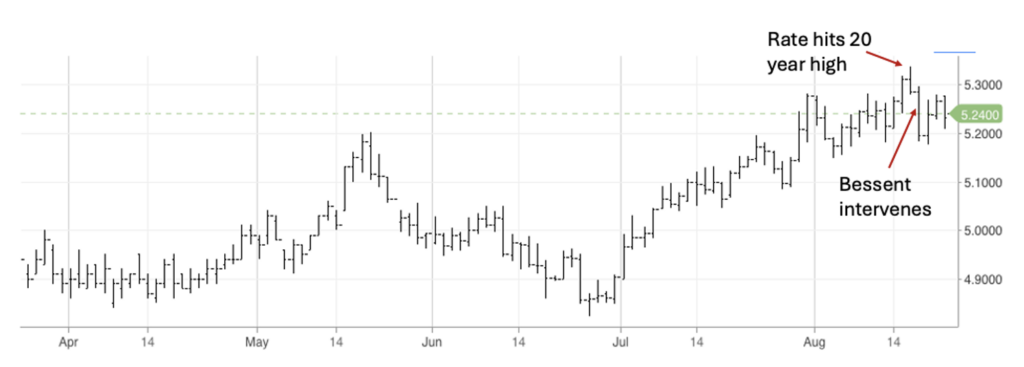
When 10-year and 30-year Treasury yields spike toward 20-year highs, as they have recently, it drives up borrowing costs across the economy – including corporate loans, mortgage rates, and auto loans. By stepping in as a guaranteed buyer for long-dated bonds, the U.S. Treasury creates demand, artificially boosting bond prices and pulling long-term yields back down.
Of course, by issuing short-term debt at 3.75 per cent, Secretary Bessent is taking a calculated bet. If the Fed cuts interest rates over the next year or two, the Treasury can repeatedly refinance that short-term debt at lower and lower rates – eventually shrinking both the principal and the interest burden.
What it means for investors and the economy
For stock markets, especially high-growth tech and AI infrastructure stocks that despise high long-term interest rates, any move by the Treasury to cap long-term yields serves as an unofficial safety net (now dubbed the Bessent Put).
Meanwhile, higher yields make future corporate profits less valuable today and increase the cost of capital.
Wall Street is sceptical about whether financial engineering can override basic supply and demand. If investors believe the government is simply shifting debt around rather than fixing fiscal spending, bond yields will fail to fall and could bounce again, triggering stock market volatility.
Figure 1. U.S. 30 year treasury yields
Mortgage rates & consumers
30-year fixed mortgage rates move in lockstep with the 30-year Treasury yield. If this strategy succeeds in keeping long-term yields down, it could prevent mortgage rates from pushing toward 7 per cent or 8 per cent, offering needed relief to a squeezed housing market.
Futility & risk
With total U.S. public debt exceeding US$40 trillion, interest on government debt is absorbing an increasing share of the federal budget. Shifting more national debt into short-term T-bills means the U.S. government becomes far more sensitive to Federal Reserve policy.
If Bessent’s bet goes awry and inflation remains sticky, meaning the Fed is forced to keep rates elevated, paying 3.75 per cent + on trillions in short-term debt will become very expensive, very fast.
Some suggest the futility of Bessent’s Treasury intervention lies in attempting to solve a crisis of supply and fiscal overreach with liquidity manoeuvres.By ramping up buybacks of long-dated bonds while issuing massive quantities of short-term debt, the Treasury is merely rearranging deck chairs on a US$40 trillion debt burden.
Historical examples – from the Fed’s 1961 Operation Twist to the Bank of Japan’s yield curve control – demonstrate that balance sheet trickery can’t artificially depress long-term yields when underlying monetary and fiscal policies remain wildly expansionary.
Because the bond market’s sell-off is fundamentally driven by sticky inflation expectations, runaway deficit spending, and competition for corporate debt from the AI boom, an additional US$4 billion in official buybacks per operation is a drop in the ocean that fails to address the reason for investor flight.
And that probably explains why the stock market hasn’t rallied since Bessent’s intervention, nor have Treasury bond yields fallen materially.
The broader financial risks of the strategy are serious, if not severe, as it directly exposes the global financial system to a catastrophic loss of confidence in core U.S. assets.
When a government’s bond yields surge alongside a plummeting currency – a dynamic typically seen in emerging market (EM) economies – it signals that global markets no longer view Treasury debt as a risk-free safe haven. And, by intentionally drawing ‘line-in-the-sand’ yield targets near five per cent, Bessent has effectively invited aggressive macro hedge funds and bond vigilantes to continuously test the Treasury’s resolve.
One would expect Bessent to know this, given his work with Soros in 1992, attacking the British Pound after which it was pulled from the European Exchange Rate Mechanism (ERM).
Every time market forces breach these arbitrary thresholds, the Treasury will be forced to double down with increasingly uncoordinated and erratic announcements, destroying the methodical predictability that historically anchored global faith in U.S. sovereign debt.
Ultimately, this intervention risks backfiring by exacerbating the very borrowing costs it attempts to suppress.
Shifting national liabilities into short-term debt transforms the U.S. government into a fragile, ‘rollover’ borrower, heavily vulnerable to persistently high interest rates set by Federal Reserve Chair Kevin Warsh.As the Treasury absorbs higher short-term financing costs to temporarily prop up long bonds, the market’s realisation that the national deficit is expanding even faster could force 30-year yields higher anyway.The resulting spillover – from skyrocketing mortgage rates and depressed housing activity to elevated corporate borrowing – threatens to choke off economic expansion, leaving the U.S. trapped in a stagflationary cycle fueled by self-inflicted fiscal chaos.
The takeaway
Treasury Secretary Bessent is essentially running a high-stakes bet with the U.S. balance sheet, while sacrificing low-cost long-term stability to reduce immediate debt totals and attempt to suppress long-term interest rates.
The U.S. Treasury Department is actively trying to keep long-term borrowing costs down. But as Singapore’s Business Times reported, “Bossing the bond market around never works.”
Keep an eye on bond yields and Federal Reserve rate decisions over the coming months – they’ll likely determine whether Bessent’s trick proves a stroke of financial genius or a temporary band-aid leading to an even bigger fiscal challenge.

Roger Montgomery is the Founder and Chairman of Montgomery Investment Management. Roger has over three decades of experience in funds management and related activities, including equities analysis, equity and derivatives strategy, trading and stockbroking. Prior to establishing Montgomery, Roger held positions at Ord Minnett Jardine Fleming, BT (Australia) Limited and Merrill Lynch.
He is also author of best-selling investment guide-book for the stock market, Value.able – how to value the best stocks and buy them for less than they are worth.
Roger appears regularly on television and radio, and in the press, including ABC radio and TV, The Australian and Ausbiz. View upcoming media appearances.
This post was contributed by a representative of Montgomery Investment Management Pty Limited (AFSL No. 354564). The principal purpose of this post is to provide factual information and not provide financial product advice. Additionally, the information provided is not intended to provide any recommendation or opinion about any financial product. Any commentary and statements of opinion however may contain general advice only that is prepared without taking into account your personal objectives, financial circumstances or needs. Because of this, before acting on any of the information provided, you should always consider its appropriateness in light of your personal objectives, financial circumstances and needs and should consider seeking independent advice from a financial advisor if necessary before making any decisions. This post specifically excludes personal advice.


