

What did Coles bring to the checkout in FY26?
Supermarket giant Coles Group released its FY26 full-year earnings this week, delivering metrics that were modestly ahead of market expectations.
Despite persistent cost-of-living pressures facing Australian households, the company reported solid execution, robust supermarket growth, and strong efficiency measures.
Initial market excitement, however, is being tempered by an elevated capital expenditure outlook and a softer-than-expected early trading update for FY27.
Consequently, investors will weigh the solid historical performance against near-term cash-flow headwinds and competitive threats.
Figure 1. Coles Share Price (August 25, 2026)
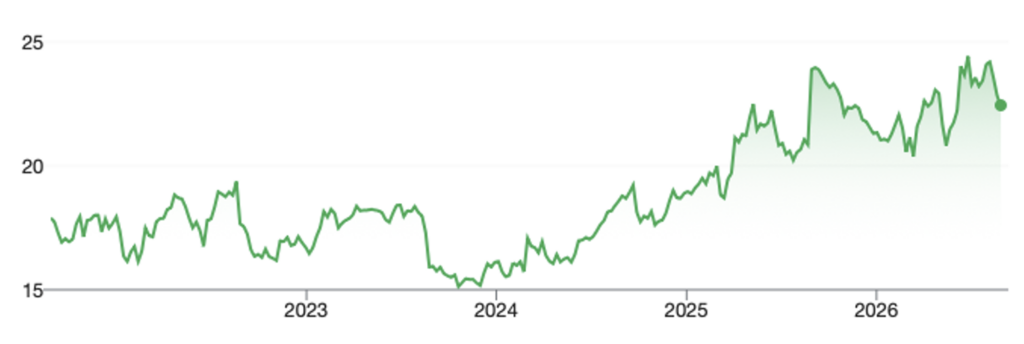
Source: Google Finance
Key financial & operational highlights
For FY26, Coles delivered resilient top-line momentum. Looking closer, several key takeaways emerged:
- Supermarket Sales Growth: In the fourth quarter (4Q26), supermarket sales grew by +3.2 per cent, slightly behind broker estimates of +3.9 per cent.
- A standout story for the group was the acceleration of its productivity initiatives. The Smarter Selling program delivered $311 million in benefits for FY26, comfortably outperforming company guidance of >$250 million. This efficiency gain proved critical in offsetting ongoing supply chain inflation and store labour cost headwinds.
- Coles closed FY26 with net debt of $1.232 billion. This outcome sits comfortably below some broker expectations ($1.312 billion), though it landed slightly above the broad market consensus ($1.095 billion).
Looking Ahead
While FY26 focused on underlying cost control, management’s outlook calls for significant reinvestment.
Coles announced $190 million in one-off strategic investments planned for FY27. This expenditure is slated to cover a broad organisational change program, dual-running operational costs as new fulfilment infrastructure comes online, and associated redundancy expenses.
Management projects this program will yield a run-rate benefit of >$100 million annually by the end of FY29.
To support these technology and supply chain transformations, Coles issued FY27 capital expenditure guidance of $1.55 billion. This is a step up from analyst expectations, exceeding both broker estimates of $1.30 billion and wider market consensus of $1.35 billion.
A soft start to FY27
The most scrutinised section of the release remains the early FY27 trading update. While underlying momentum was strong early on, market share dynamics have disrupted the trajectory.
Sales growth in the opening weeks of FY27 surged to +3.7 per cent, accelerating nicely relative to 4Q26 (+3.2 per cent).
Growth temporarily moderated through late July and early August, coinciding with Woolworths’ high-profile “Ooshies” promotional campaign.
Following the peak of competitor activity, sales recovered back to the 4Q26 run-rate of +3.2 per cent.
On a positive note, liquor sales trajectory showed tangible improvement in 1Q27 relative to a softer 4Q26 performance.
Despite the post-Woolworths-campaign recovery, market sentiment around the update remains cautious. Given that tobacco sales are expected to serve as a statutory revenue tailwind following July 1, consensus had been pencilling in +4.7 per cent sales growth for 1H27. Against those heightened targets, the current run-rate leaves early FY27 performance a little soft.
Market takeaway
Coles delivered a solid FY26 performance marked by excellent cost management and robust earnings execution. Of course, markets are forward-looking. Between a higher capital expenditure (capex) hurdle rate for FY27, near-term restructuring costs, and early sales momentum running slightly behind the optimistic 1H27 consensus, investors are taking a cautious approach.
On balance, it’s probably reasonable to expect the higher capital intensity and soft start to weigh on the share price in the near term, particularly as the market digests the medium-term tradeoffs.

Roger Montgomery is the Founder and Chairman of Montgomery Investment Management. Roger has over three decades of experience in funds management and related activities, including equities analysis, equity and derivatives strategy, trading and stockbroking. Prior to establishing Montgomery, Roger held positions at Ord Minnett Jardine Fleming, BT (Australia) Limited and Merrill Lynch.
He is also author of best-selling investment guide-book for the stock market, Value.able – how to value the best stocks and buy them for less than they are worth.
Roger appears regularly on television and radio, and in the press, including ABC radio and TV, The Australian and Ausbiz. View upcoming media appearances.
This post was contributed by a representative of Montgomery Investment Management Pty Limited (AFSL No. 354564). The principal purpose of this post is to provide factual information and not provide financial product advice. Additionally, the information provided is not intended to provide any recommendation or opinion about any financial product. Any commentary and statements of opinion however may contain general advice only that is prepared without taking into account your personal objectives, financial circumstances or needs. Because of this, before acting on any of the information provided, you should always consider its appropriateness in light of your personal objectives, financial circumstances and needs and should consider seeking independent advice from a financial advisor if necessary before making any decisions. This post specifically excludes personal advice.


