

Negative equity trap: Post Labor budget house price drops are wiping out buyers’ life savings
Since Labor’s 2026 federal budget changes were handed down, Australia’s property market – particularly suburbs across Sydney and Melbourne – has experienced sharp price corrections.
While property commentators spent early 2026 tracking a largely flat, sideways trend in capital city housing (hovering around the $1.81M to $1.83M median mark in Sydney), the post-budget landscape has delivered a rude shock.
For homeowners who, for years, sacrificed and scrimped to save a 10 to 20 per cent deposit and then purchased or refinanced during 2025 or early 2026, these price falls are no longer just abstract paper losses – they represent a devastating hit to their wealth and equity. Indeed, all they’ve saved has been wiped out in a matter of months.
Deposits completely wiped out
Equity is the difference between what your home is worth and what you owe the bank. You have equity when the market value of your property is higher than what you owe. When prices fall, however, 100 per cent of the loss comes directly out of the buyer’s equity, while the bank’s loan balance remains completely unchanged.
And if you take into stamp duty and other ‘frictional’ or ‘transaction’ costs into account it’s very likely that you are already up to 6.5 per cent behind when you take the keys.
The mechanics of this drawdown are unforgiving:
1. 20 per cent price drop and the 80 per cent loan-to-value ratio (LVR) borrower
If a suburb’s median price falls by 20 per cent, anyone who bought with a standard 20 per ecnt deposit (borrowed 80 per cent) has seen their entire saved deposit wiped out. The result is zero equity remaining. Their entire deposit has vanished. Of course, a 20 per cent drop is even worse for anyone who borrowed more than 20 per cent.
2. Beyond 20 per cent drop = deep negative equity (underwater)
For an 80 per cent LVR borrower, if the property’s market value falls further than 20 per cent, the home becomes worth less than the outstanding mortgage balance. Equity turns negative. Not only has the deposit been wiped out, but the borrower owes more than they can sell the property for.
3. 11 per cent price drop = negative equity for high-LVR Buyers (89 per cent + LVR)
Even a modest 11 per cent to 12 per cent drop wipes out the entire deposit for buyers who utilised First Home Buyer support schemes or First Home Guarantee programs (often purchasing with 5 per cent to 10 per cent deposits / 90 per cent –95 per cent LVRs.
On paper it all sounds theoretical, and Labor might like it to be. The rude reality is that thousands of Australians have saved for years for a 10 per cent deposit. And if you’ve purchased in the last 9-12 months in a suburb now displaying price falls of 10 per cent, all of those savings have vapourised. And if prices have declined by more than 10 per cent, you can’t even pay off the loan if you sold today. That’s the reality under Labor for many thousands of Australians today.
Table 1. Prices smashed since Budget Day
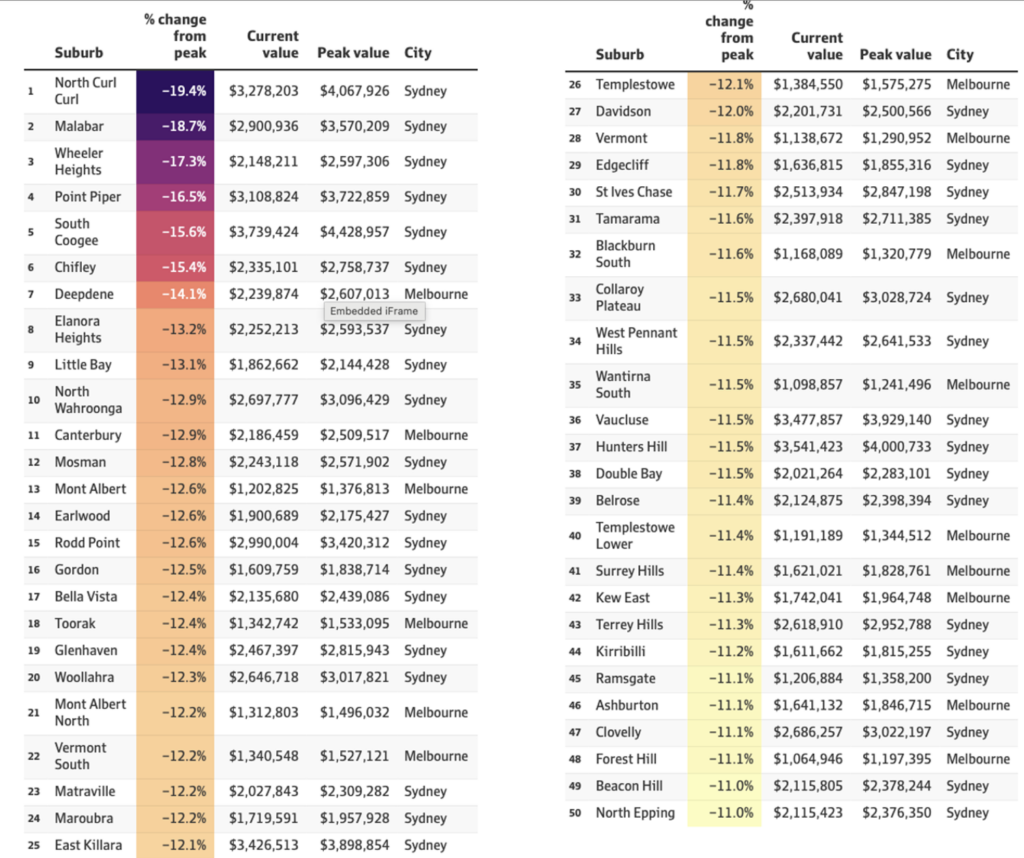
Source: Michael Read AFR, Cotality
In North Curl Curl, on Sydney’s Northern Beaches, median prices dropped 19.4 per cent, cutting median wealth by $789,723. A buyer who bought at or near the peak over the last 6-9 months, with an 80 per cent LVR mortgage has virtually $0 equity. And if they borrowed more than 80 per cent, they’ve lost their entire deposit and can’t even pay the loan back if they sell their property today.
Suburbs in Sydney’s Eastern Suburbs and Coastal South like Malabar (-18.7 per cent) and South Coogee (-15.6 per cent) have seen median losses approaching or exceeding $650,000 to $690,000.
Meanwhile, in Melbourne, Deepdene (-14.1 per cent), Canterbury (-12.9 per cent), and Toorak (-12.4 per cent) lead the Victorian capital’s declines, with average capital losses across the top 15 Melbourne suburbs exceeding $198,000.
Across all 50 suburbs in the dataset, every single suburb registered a decline of at least 11.0 per cent. This means that in every single one of these 50 suburbs, any recent buyer who put down less than an 11 per cent deposit is now officially in negative equity.
What does negative equity mean for borrowers?
First, borrowers underwater can’t switch lenders to seek better interest rates, as banks won’t refinance a property that doesn’t cover the loan balance without requiring fresh cash injections.
Further, if a homeowner faces a life change, like a job loss, a partner’s job loss or interest rate pressure and must sell, the proceeds of the sale won’t clear the debt. That potentially leaves them owing hundreds of thousands to the bank after losing their home. For many, if not for their ability to continue paying the mortgage, they’d be bankrupt.
Finally, as families feel significantly poorer after watching six-figure equity buffers disappear in months, the negative wealth effect results in a broad contraction in household spending, which has serious consequences for the economy.
What do experts think house prices will do next?
The consensus among economic forecasters and property analysts points to further price falls through 2026 and into early 2027.
There are several reasons for the dour forecasts. First, the full drag of post-budget fiscal tightening and tax policy shifts is still flowing through buyer sentiment and borrowing capacity.
Second, sticky service inflation is holding terminal cash rates elevated, which means buyer borrowing power remains suppressed by around 30 per cent relative to 2021 levels. This, in turn, means the pool of potential buyers to rescue owners underwater has shrunk significantly.
Finally, as fixed-rate mortgages roll-off and investor tax adjustments begin to bite, inventory is expected to climb into the spring selling season, putting further downward pressure on prices.
Two-thirds of Australia’s households either own their home or are paying it off, and now all of them are losing money. This will flow through to the economy.

Roger Montgomery is the Founder and Chairman of Montgomery Investment Management. Roger has over three decades of experience in funds management and related activities, including equities analysis, equity and derivatives strategy, trading and stockbroking. Prior to establishing Montgomery, Roger held positions at Ord Minnett Jardine Fleming, BT (Australia) Limited and Merrill Lynch.
He is also author of best-selling investment guide-book for the stock market, Value.able – how to value the best stocks and buy them for less than they are worth.
Roger appears regularly on television and radio, and in the press, including ABC radio and TV, The Australian and Ausbiz. View upcoming media appearances.
This post was contributed by a representative of Montgomery Investment Management Pty Limited (AFSL No. 354564). The principal purpose of this post is to provide factual information and not provide financial product advice. Additionally, the information provided is not intended to provide any recommendation or opinion about any financial product. Any commentary and statements of opinion however may contain general advice only that is prepared without taking into account your personal objectives, financial circumstances or needs. Because of this, before acting on any of the information provided, you should always consider its appropriateness in light of your personal objectives, financial circumstances and needs and should consider seeking independent advice from a financial advisor if necessary before making any decisions. This post specifically excludes personal advice.


