
Is AI making Meta a winner?
If you hold units in a broad global index fund, shares in a global index ETF, or have global exposure in your Australian super fund, chances are you own a piece of both Meta Platforms and Alphabet (Google). Indeed, these two tech giants have long been dominant positions in most global portfolios.
A structural shift is now taking place behind the scenes, and it directly affects their relative revenue trajectories and market valuations.
For nearly two decades, Google Search was the undisputed champion of digital advertising revenue. Three years ago, Meta’s advertising revenue sat at roughly 70 per cent of Google Search’s volume. Fast forward to this year’s September quarter results and Meta recorded US$63.1 billion in advertising revenue while Google Search earned US$63.4 billion over the same period.
The gap has effectively vanished – shrinking to less than $300 million – and Meta’s ad machine is expanding at double the speed of Google’s: 26 per cent year-over-year (YoY) compared to Google Search’s 12 per cent.
Figure 1. Quarterly Meta advertising revenue versus Google Search revenue (US$billion)
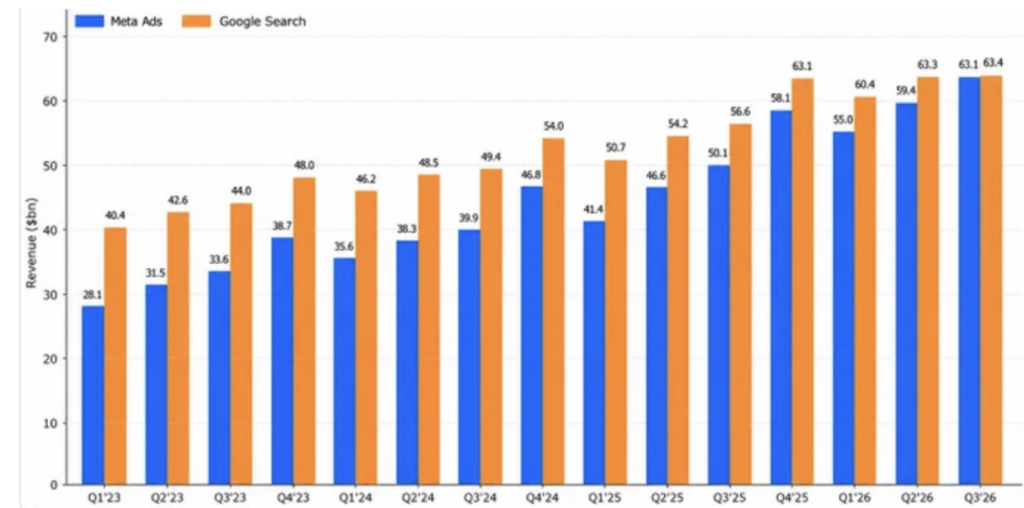
Source: Meta Platforms, and Alphabet company filings
The AI engine: personalisation vs. cannibalisation
Artificial intelligence (AI) is the driving force behind this convergence.
For Meta, AI acts as an accelerator on owned territory. Meta sells user attention inside its walled ecosystems (Facebook, Instagram and WhatsApp). Upgrading its AI recommendation and ad-ranking models doesn’t disrupt its monetisation but enhances it.
In the most recent quarter, Meta saw the total number of ads served jump 10 per cent, while the average price paid per ad also rose, by 14 per cent. When AI helps ads to be more successfully targeted, they yield higher conversion rates, and advertisers are happy to pay the premium.
Specific enhancements support this.
Meta upgraded the AI algorithms that evaluate thousands of potential ads in real time and rank them to predict which one a user is most likely to interact with, and this upgrade made those ads significantly more effective at convincing people to download apps.
Meta’s updated ranking models lifted app-install conversions by 9.6 per cent, and advertisers who implemented recommendations from Meta’s AI assistant secured nearly 5 per cent more conversions at the same cost per conversion.
Google, by contrast, faces a classic innovator’s dilemma. Its core search engine operates on a direct, 25-year-old economic contract: a user types a query, Google presents a search engine results page (SERP) packed with sponsored links, and the user clicks.
Enter generative AI and “AI Mode” summaries. When a user asks an AI assistant or AI-powered search tool for a synthesised answer, they receive a direct response rather than a page of links. The rapid adoption of AI Mode queries inherently exerts downward pressure on search monetisation. An AI agent that performs a task or provides a direct answer skips the results page where Google generates its cash flow from clicked-on links.
The effects extend beyond Google. Digital publishers and platforms built on search traffic are experiencing downturns. Reddit, for example, reported losing over a million search referrals per week in October, cautioning that daily active users could drop by double digits. When AI provides answers directly, people don’t feel the need to search further.
Wall Street & the Whitehouse
Curiously, superior advertising metrics didn’t insulate Meta’s stock price from market gravity. Despite its standout operational quarter, Meta’s shares retreated alongside Alphabet’s.
That’s because investors are increasingly focused on the immense capital expenditure (Capex) required to build out the AI infrastructure – data centres, compute clusters, and power supply – needed to run these next-generation models. Because capital spending is destroying free cash flow today, investors want proof that decent returns will arrive tomorrow. And they’re not getting that.
Following the Democratic clean sweep in the U.S. midterms, Meta’s future also faces political and regulatory scrutiny. Bipartisan momentum in the U.S. continues to target social media algorithms, particularly regarding youth engagement and safety. Proposed legislation to restrict access or cap screen time for younger users could weigh on overall engagement, a vital metric for Meta’s impression-driven ad model.
And then there’s the AI buildout itself. Democrat Gina Hinojosa flipped Texas blue by tapping directly into public frustration over grid reliability and resource allocation. She has promised to freeze data centre approvals until the state legislature codifies strict protections including the mandatory use of American union labour for construction, enforceable guarantees that residential electricity and water rates will not rise to subsidise data centres and that tech companies will build their own dedicated power plants rather than drawing off the public grid.
The bottom line
On the one hand, AI is helping Meta win share from Google. So, if you assumed web search would forever hold the digital advertising lead, the latest earnings reports signal a changing of the guard.
Meta’s targeting engine has nearly closed the revenue gap with Google Search, proving that AI-driven attention management can monetise just as effectively as traditional intent-driven search.
But this could just be the first shot across the bow. If everyone has an AI agent on their device, using private models (that’s the next development, by the way), will they even want or need to see an ad?
And then there’s the AI buildout itself that is turning the hyperscalers from asset-light monopolists into capital-intensive competitors and free cash flow destroyers.
There may be some enthusiasm for Meta today, but we are just in the first innings of a game that has many evolutions to go.

Roger Montgomery is the Founder and Chairman of Montgomery Investment Management. Roger has over three decades of experience in funds management and related activities, including equities analysis, equity and derivatives strategy, trading and stockbroking. Prior to establishing Montgomery, Roger held positions at Ord Minnett Jardine Fleming, BT (Australia) Limited and Merrill Lynch.
He is also author of best-selling investment guide-book for the stock market, Value.able – how to value the best stocks and buy them for less than they are worth.
Roger appears regularly on television and radio, and in the press, including ABC radio and TV, The Australian and Ausbiz. View upcoming media appearances.
This post was contributed by a representative of Montgomery Investment Management Pty Limited (AFSL No. 354564). The principal purpose of this post is to provide factual information and not provide financial product advice. Additionally, the information provided is not intended to provide any recommendation or opinion about any financial product. Any commentary and statements of opinion however may contain general advice only that is prepared without taking into account your personal objectives, financial circumstances or needs. Because of this, before acting on any of the information provided, you should always consider its appropriateness in light of your personal objectives, financial circumstances and needs and should consider seeking independent advice from a financial advisor if necessary before making any decisions. This post specifically excludes personal advice.


