

Australia’s non-market labour productivity – down 9 per cent in 5 years
According to the Australian Bureau of Statistics (ABS), our federal government employees received an average 7.2 per cent increase in the cash component of the wages bill to $43.8 billion, in Fiscal 2026.
Over the four years to June 2026, the cash salaries for our federal government employees have increased by 35.2 per cent, or a compound annual 7.8 per cent. Meanwhile, the annual change in employee numbers has increased by 14.7 per cent, or a compound annual 3.5 per cent.
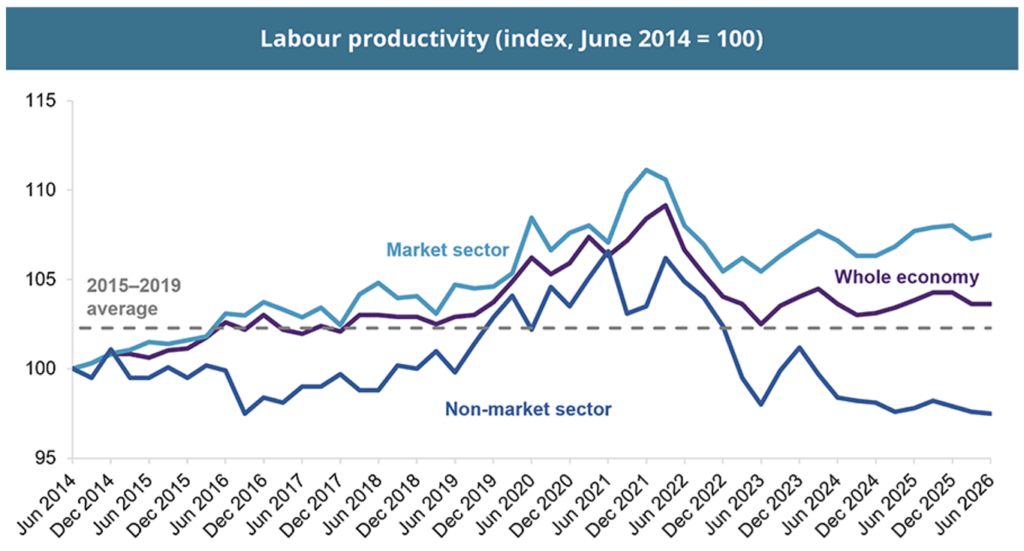
It’s an uncomplicated picture. Grow your staff numbers by 3.5 per cent per annum and increase their cash wages by 7.8 per cent per annum. If this was a strong growing business, it would be acceptable. But it is not. Worse still, the wage bill (plus other benefits) is paid by Aussie taxpayers, and the (overall) non-market labour productivity, according to the Productivity Commission, has been declining at 1.8 per cent per annum over the past five years. As illustrated below, that means non-market labour productivity is currently nine per cent below the level recorded in 2021.
This places the non-market sector productivity level which is below that achieved in March 2007, according to the Productivity Commission, and Australia’s overall labour productivity is barely one per cent above the 2015-2019 average level of productivity.
Graph 1: Labour productivity
 Source: Productivity Commission

Chief Executive Officer of Montgomery Investment Management, David Buckland has over 40 years of industry experience.
David is a deeply knowledgeable and highly experienced financial services executive. Prior to joining Montgomery in 2012, David was CEO and Executive Director of Hunter Hall for 11 years, as well as a Director at JP Morgan in Sydney and London for eight years.
This post was contributed by a representative of Montgomery Investment Management Pty Limited (AFSL No. 354564). The principal purpose of this post is to provide factual information and not provide financial product advice. Additionally, the information provided is not intended to provide any recommendation or opinion about any financial product. Any commentary and statements of opinion however may contain general advice only that is prepared without taking into account your personal objectives, financial circumstances or needs. Because of this, before acting on any of the information provided, you should always consider its appropriateness in light of your personal objectives, financial circumstances and needs and should consider seeking independent advice from a financial advisor if necessary before making any decisions. This post specifically excludes personal advice.


