Value.able
-
Where else has Value.able been?
Roger Montgomery
December 1, 2010



It has been a month or so since I last shared with you photographs from Value.able Graduates. These pics are from Gary, who has been travelling through Europe. He wrote “Read the book while traveling through Europe. Have attached some shots you may be able to use in your where in the world has Value.able been? One at the Louvre and the other at a little coffee with the Eiffel tower behind. Enjoyed the book, hoping to pay for the trip with the knowledge, Gary“.
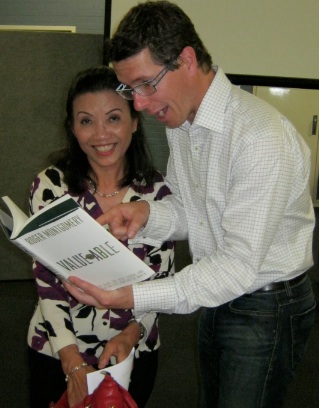 I was in Perth last month to speak for the ASX and Australian Investors’ Association. This picture is from Dan (with his Mum).
Dear Roger,
I just wanted to give a big Thank You for your presentation at the Wembley Tennis Club in Perth recently! I wasn’t able to attend because I live 450km North of Perth and have been busy with work, but I told my parents to attend and they said they had a fantastic night! Also, a huge thank you for signing my copy of your book and for taking the time to have a photo with Mum! We all love the book and have benefited greatly from your wisdom. I’m relatively new to the stock market (I’m 26 years old) but I feel as though I have learnt a great deal during the last year. I started getting interested in the stock market approximately 5 years ago, and back then I had the desire to own things that were (are still) considered to be “Blue Chip”, e.g. Incitec Pivot, Westfield, Santos, Babcock and Brown, Virgin Blue, etc. Now I have a far greater sense of how to approach investing in a more rational way, and how to identify companies that are actually of high quality. Now I spend my spare time on focusing only on quality businesses and have done really well using your solid and sensible approach. Thank you for the Value.able education! Maybe one day I’ll have the courage to post a comment on your blog (which is fantastic). I hope to see you when you’re next in Perth for a presentation so that I can thank you in person. All the best, Dan
And whilst Mark didn’t include photos of his Value.able journey, he has certainly impressed me with his enthusiasm.
“Hi Roger, Loved your book. You may be distressed or impressed but I have underlined highlighted and read separate chapters often. Dog eared sections etc. etc. I feel like I’m back in school and I’m 53. Seriously tremendous. Well done. Congrats, Mark”
A little ‘off topic’ was this email from Ken. Thanks Ken…
Roger,
Half the battle, getting started with any sort of analysis is being confident that one is not wasting one’s time going about things the wrong way. You have indeed given me a ‘leg-up’ with a range of aspects of my investing and thank you. My early career (and still a component of my work) involved collecting field data to calibrate and validate a pasture model (I’m still collecting validation data each year – 25 years since starting and training people, although engaged in quite different work now). I have spent years working with this model and with the scientist who built the model. There was never, in the early days, a definitive manual – just a mutual sharing of insights, late hours, passion and pain.
The modelling is now second nature and I’m more concerned with the flaws with the model than anything. But there was a huge barrier to entry – no manual could ever replace that research and effort that I put in to become confident and eventually proficient with what I was doing. It helped though, to have a more experienced person there for guidance – often just pointing out a reference to read etc. In turn I try to help people with their efforts where I can but it is up to the individual to get their own hands dirty, begin their own journey but, in our case, now as part of a ‘college’ of users. You are right in your approach – offering us a generous ‘leg up’ with your book and a means to share insights (your blog). By putting things into practice for ourselves, the keen will learn both the art and the science and, hopefully, slowly, become better investors and more value.able to both you and fellow bloggers. In many respects, this is how our team at work has operated for so long. As a team, we have become well respected both nationally and internationally – the college itself knows no institutional boundary.
In the preface to your book, Simon Hoyle notes:
“By helping to equip investors with the right set of skills, Roger is, either consciously or unconciously, waging a war against those who would seek to profit from the naivety or misplaced trust of others”.
Along the same lines, Alan Kohler, in “Why I started EUREKAreport” states:
“But it’s important to understand that investing is work. It is not gambling, or wishing and hoping, or trying to get the inside dope: it is work; a second job. Nevertheless with the right kind of support, you can do it and you can beat the pros. Eureka Report is the beginning of an attempt to provide that support and to redress the balance – to give ordinary people the tools and the knowledge to become independent and reclaim the control – and the money! – that is rightfully theirs.”
Roger, you are indeed forming an ‘investment college’ and it is good to be a part of it. I look forward to your latest blog and happy for you to reference anything.
Cheers
Ken
Thank you to everyone who has gone to so much trouble to demonstrate just how profound an effect my book has been having on your travel plans – if not your investing plans. I am genuinely encouraged and humbled at the same time by your support. Thank you again.
Posted by Roger Montgomery, 1 December 2010
by Roger Montgomery Posted in Insightful Insights, Value.able.
-
How many of your Chips are Blue?
Roger Montgomery
November 26, 2010
 If you are new to the stock market, I believe it is possible that you have been lulled into a false sense of security. I say this because I regularly hear well-meaning advice that goes something like this; “just buy a portfolio of blue chips and hold for the long term”
But what is a blue chip? Here are some of the definitions I have found around the place:
“a common stock of a nationally-known company whose value and dividends are reliable; typically have high price and low yield; blue chips are usually safe investments”
“A blue chip stock is the stock of a well-established company having stable earnings and no extensive liabilities. Blue chip stocks pay regular dividends, even when business is faring worse than usual. …”
“A large company. Blue chip shares are generally lower risk. FTSE 100 constituents are generally considered blue chips”
“Shares of companies that are considered to be particularly solid and with a high capitalisation level. Their purchase is presumably associated with minor risk when the Stock Exchange falls”
And my new favourite definition;
“Blue Chip is the third album by Acoustic Alchemy, released under the MCA Master Series label in 1989, and again under GRP in 1996.”
Clearly there is only rough consensus around what a ‘blue chip’ actually is, but I get the distinct impression that a lack of understanding about what truly constitutes ‘high quality’ has meant the resultant definitions are clumsy at best. And if advisors can’t define quality/blue chip with some consensus, then its quite possible new investors are plunging into a blind-leading-the-blind situation.
Here at my Insights blog, I don’t talk about blue chips. Why? Because they don’t exist. There is no such thing.
I define quality through my A1-C5 Montgomery Quality Ratings (the MQRs) using a raft of measures and scenarios, combined with measures of the financial relationship a company has articulated over the years with its shareholders and its competitive position.
Warren Buffett once observed that time is the friend of the wonderful business but the enemy of a poor one. You don’t want to put the shares of a bad business, even if it’s a big one, in the bottom drawer and forget about them. Long term buy-and-hold investing then should only apply to the truly high quality companies – A1 companies.
To that end I would like to share with you an early Christmas gift (until Value.able arrives under your Christmas tree).
One of the definitions noted above and a commonly held one is that blue chips have to be large companies. Companies that inhabit the S&P/ASX 50, for example, may be considered Blue Chips. Putting aside for a moment the fact that there are plenty of large companies that have gone to the wall, it is possible to re-rank the so called Blue Chips – the large capitalisation companies – and find out if any are more blue than the rest.
So in the pursuit of ‘blueness’, below you will find all companies with a current market capitalisation of more than $10 billion sorted by my MQR (followed by Safety Margin for good measure). I have also included my current expected (annual) rate of change in Value.able Intrinsic Value over the next three years and thrown in dividend yields because I know how adored they are.
Of course, all of this is purely didactic and not intended as advice. YOU MUST SEEK AND TAKE PERSONAL PROFESSIONAL ADVICE. Also remember that I do not know what share prices are going to do, they could all halve or double and my MQRs andValue.able Intrinsic Values could all change tomorrow, possibly by a lot. They could go up or down and I am under no obligation to keep you updated. So please DO NOT RELY ON THE INFORMATION PROVIDED.
Having made that clear, and I am not joking about such serious matters, here is the list:
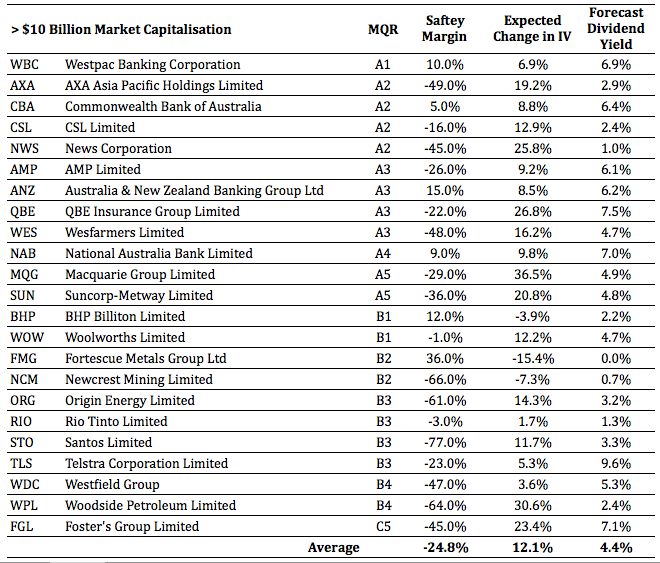
So its seems not all blue chips are entirely blue. As one of my friends – who likes to occasionally catch the amber light – says, “there’s still a bit of green left!”
Lumping all large companies into the ‘Blue Chip’ camp may not lead you to secure returns. Indeed, it could more likely see you merely lurch from one crisis to the next. If that is an experience you would like to change or avoid, then understanding the factors that indicate good quality is vital.
Value.able Graduates would have read the chapters about identifying extraordinary businesses in my book. If you haven’t yet secured your copy of Value.able you can do so at my website, www.rogermontgomery.com.
Posted by Roger Montgomery, 26 November 2010.
by Roger Montgomery Posted in Companies, Insightful Insights, Value.able.
-
Is that the Second Edition of Value.able?
Roger Montgomery
November 19, 2010
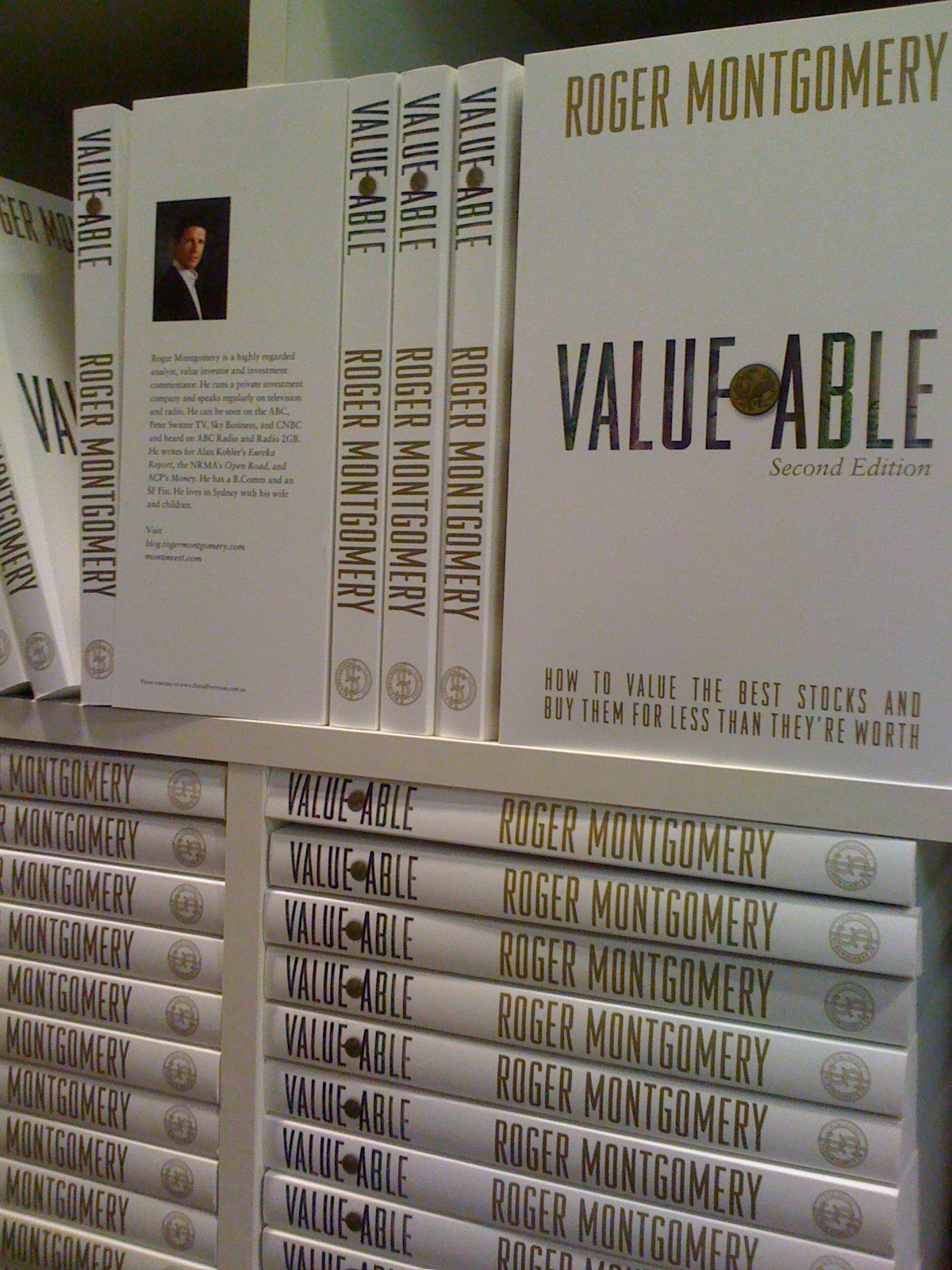
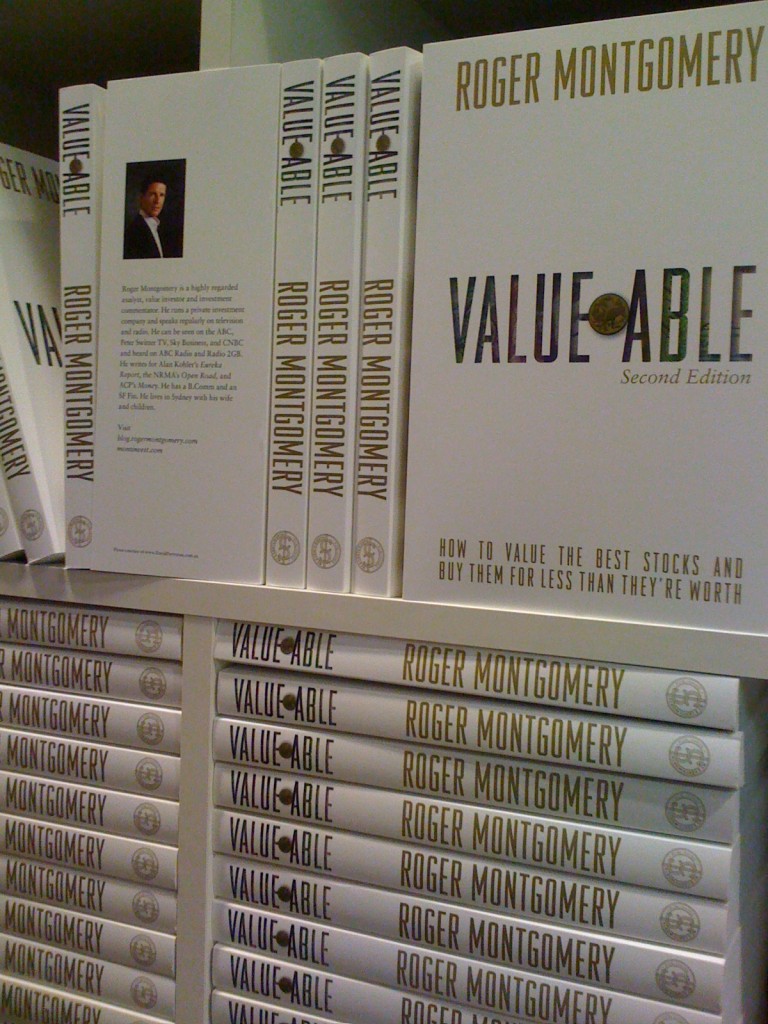 Walking into the stores of some of my ‘A1’ MQR companies lately, it is clear that Christmas is just around the corner. Here at Montgomery Inc, Value.able Second Edition has just arrived.
At under $50, Value.able is not only easy to wrap, it’s the gift that keeps on giving all year round (and you don’t have to brave the local shopping centre)!
Many First Edition Graduates have asked me the question “what’s new in the Second Edition?” Aside from an added Appendix, the Second Edition contains all the information of the First Edition that had such a positive impact on people like Graham, who wrote;
“I’m somewhat of a minimalist and love it when I get a book where it makes me feel like I can throw away all the other books I have on a subject – this is such a book!!”
Value.able Second Edition is $49.95. The price includes GST and postage to anywhere in Australia (allow 7 business days). You may be able to claim a tax deduction, although you’ll probably want to check.
Visit my website to purchase your copy. And after reading it, please share your thoughts about Value.able, at Leave a Comment here at the blog.
Posted by Roger Montgomery, 19 November 2010
by Roger Montgomery Posted in Companies, Investing Education, Value.able.
-
Have you been getting your daily dose?
Roger Montgomery
November 9, 2010
 If only it worked that well all the time!
Last Thursday evening (4 November) on Peter’s Switzer TV I listed, amongst other companies, Credit Corp and Forge Group as two I would have in the hypothetical Self Managed Super Fund Peter challenged me to set up that day.
Why did I nominate CCP and FGE? Both receive my A1 or A2 MQR and both have been trading at a discount to their intrinsic value.
If you are a regular reader of my blog you would have read my insights for some months on these companies. And if you saw today’s announcements, you can imagine why I am a little happier than usual.
Credit Corp’s previous 2011 NPAT guidance was $16-$18 million. Today the company announced FY11 would likely produce an NPAT result of $18-$20 million.
Forge Group’s announcement states “The Board wishes to advise that the company forecasts net profit before tax for the half year ending 31st December 2010 to be in the range of $25-$27 million. This represents an improvement on the previous corresponding period (pcp $19.04m) of up to 42%.”
As I fly to Perth for a presentation and company visit, I am encouraged that several of the companies Value.able graduates mentioned in our lists are also hitting new 52-week highs. In a rising market that lifts all boats, it is perhaps unsurprising, but nevertheless it should be an encouragement to Value.able graduates and value investors that companies like FLT, DCG, MIN, FWD, FGE, CCP, NCK, DTL, MCE, MTU and TGA have all hit year highs – some of them yesterday. More importantly those prices are perhaps justified by their intrinsic values.
Of course I am not here to predict where those prices will go next, because I simply don’t know. Short-term prices are largely a function of popularity and the market could begin a QE2-inspired correction, an Indian infrastructure-inspired bubble or a China liquidity-inspired bubble tomorrow. I have no way of telling and instead, I focus on intrinsic values and only pay cursory attention to share prices.
So, as I always say, seek and take personal professional advice before taking any action and remember that 1) I don’t know where the share price is going 2) I am under no obligation to keep you up-to-date with my thoughts about these or any company, my Montgomery Quality Ratings or my valuations and I might change my views, values and MQRs at any time so don’t rely on them and 3) I may buy or sell shares in any company mentioned here at any time without informing you.
And so I remind you one more time. Please seek and take personal professional advice and always conduct your own research.
Posted by Roger Montgomery, 9 November 2011.
by Roger Montgomery Posted in Companies, Insightful Insights, Investing Education, Value.able.
-
Are you drowning in a sea of complexity?
Roger Montgomery
November 3, 2010
 I don’t know if you have noticed but some of my recent posts and comments have been getting a little technical. I am sorry about that, I get a bit carried away sometimes.
Of course on this blog, I am not alone. Joab’s brilliant heads-up on the forthcoming changes to the treatment of leases and the impact on the financial statements is exactly the sort of thing that excites those of us who make investing a full time occupation.
In this field it’s easy to want to prove how much detail one can accumulate about a company or what one knows about valuations or credit analysis. Then of course debates and polite but pointed arguments begin about whose mousetrap is better.
Yet for most of us, it’s a storm in a tea cup, and meanwhile someone has made a million dollars quietly accumulating a few shares in the recently listed company XYZ Ltd.
In most cases there is one pearl that counts and the rest is noise. Our job is to find the pearls. Of course with so much rubbish to sift through it can be challenging to pluck up the enthusiasm to even start searching. For many investors, time is of the essence and short cuts are needed.
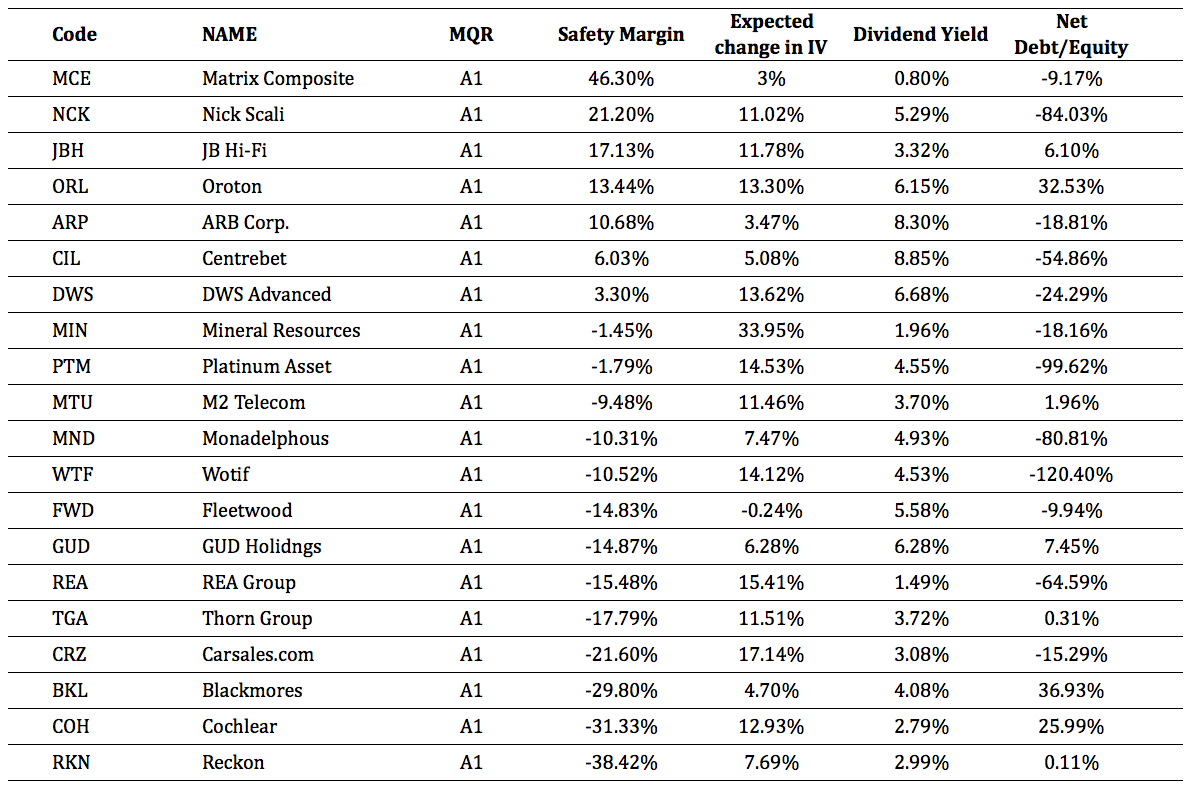
Well, I am here to deliver. But this not a post about buying the next hot uranium or gold explorer – tips I do receive and some I even regret missing sometimes. Today’s post is about a shortlist of A1 companies, their proximity to intrinsic value, my expected change in those intrinsic values and the associated net debt to equity ratios.
Why? It’s about getting back to basics.
Investing is simple. Not easy, but simple. Much work went into the classification process to come up with my A1, A2, C5, etc Montgomery Quality Ratings using, for example, industry specific KPI’s to ensure that future sweat was reduced.
And recently one Value.able Graduate Ken, reinforced my resolve to keep it all very simple. Ken D wrote:
Hi again Roger,
Out of curiosity, last week I constructed 2 hypothetical portfolios: 1) with your A1 stocks in equal proportion; and 2) the same with your A2 stocks. I have attached some numbers. I was impressed by the average past performance (i.e. investment performance) from both portfolios and also noted quite a difference between the A1 and A2 portfolios (attached). I doubt whether the result is fortuitous. Without asking you to outline your ranking process, I was wondering whether the strong past performance might be expected as a direct result of criteria used in the A1, A2 classification process – e.g. reference to historical earnings growth for instance, or perhaps more interestingly, a product of the inherent quality of the business as measured by current performance measures.
Ken
In answer to Ken’s question and for everyone’s benefit, remember Ben Graham’s quote about short-term voting machines and long-term weighing machine? Over longer periods of time, price follows intrinsic value and because my Value.able method of calculating intrinsic value is related to the performance of the business, one should expect price to follow performance. Over time A1 businesses should do better and a portfolio filled with just A1s purchased at big discounts to intrinsic value, should, in theory, do best.
Ken looked at all the A1s that I had mentioned on the blog and went backwards (I’ll ignore survivor bias for now) to have a look at the annual returns a portfolio of A1s would have produced.
While there is more refinement required, the early results are impressive. Over the last ten years Ken’s portfolio of 16 A1 company stocks returned 24 per cent, per annum. The same 24 per cent per annum result was produced with a portfolio of 23 stocks over five years and there were 31 A1 stocks in the last year that combined, returned 31 per cent.
Thanks for putting in the time Ken.
With all that in mind, here is my latest list of A1 companies, their proximities to intrinsic values and a few other salient stats.

What I would like to see as comments here are your thoughts or insights about any of these companies. Go right ahead and share whatever you know or think. But only about the companies in the list. Keep the comments to the topic set and we will build a useful library of insights. Just click the Leave a Comment link below.
Posted by Roger Montgomery, 3 November 2010.
by Roger Montgomery Posted in Companies, Investing Education, Value.able.
-

WHITEPAPER
WHY I'M DOUBLING DOWN ON THE CALL TO INVEST IN PRIVATE CREDIT AND DIGITAL INCOME
Discover how private credit and market-neutral digital income strategies may enhance portfolio diversification in an environment where the traditional 60/40 approach is proving less effective.
READ HERE -
Where will Value.able appear next?
Roger Montgomery
October 11, 2010
We have seen Value.able being applied on an offshore oil rig, in a deck chair on one young man’s private island and also a plunge pool in Bali. Here are two more stories from Graduates showing how they are applying Value.able in practice.
Roger,
I was recently in Galle, Sri Lanka, and was able to share some of your insights with a local spice trader, Yasiru. He was particularly interested in your comments on quality businesses and was happy to say that he maintained a competitive edge by controlling costs – he grinds and mixes the spices himself. I can report that his product is excellent and sells at bargain prices (I have no shares or other interest in his business).
Justin
And from Michael…

I felt compelled to shine light the legion of your followers that are not simply reading Value.able while sitting in lazy pacific island deck-chairs, exotic pools-with-a-view or even far reaching oil rigs. I give you the Montgomery Aussie Battler: An 8am-6pm, 5-day-week worker, traveling to and from work via a crammed and smelly public transport system (namely Brisbane’s CityCat). Who smiles to themselves knowing ‘the final salvation’ is possible – an early retirement thanks to Value.able, intrinsic value, margin of safety and high ROE to name a few. Thanks for starting a revolution!
Michael
P.S. Note the studious working scribbles underneath Value.able.
Please keep sharing your Value.able adventures with our community. We are enjoying the journey.
Posted by Roger Montgomery, 11 October 2010.
UPDATE: 13 October 2010
Here is another pic from Matt I received today… ‘Operating Value.Able’

Hi Roger, I don’t have a tropical or relaxing environment from which to share my experience of Value.Able – I send you this picture from the Trauma theatre at 2am after an emergency operation on a car accident victim. Not a place normally associated with relaxing thoughts. However, you may not know how good an operating theatre can be for reading. After all, it has the two most important ingredients: very good lighting and plenty of fresh air (via the ultra clean ventilation systems of course). Your book has been an excellent addition to my investing education and I look forward to meeting you at one of your upcoming presentations.Cheers, Matt
P.S. the patient is doing just fine
UPDATE: 14 October 2010
 Hi Roger,
I was just reading up on the “formula” when some of the guys were curious. Then, just before the game started I was trying to explain to my team mates the difference between a company’s yeild, PE and ROE. Told them to just get the book.
Cheers….Rad
by Roger Montgomery Posted in Insightful Insights, Investing Education, Value.able.
-
No more Value.able Roger?
Roger Montgomery
October 7, 2010
 The First Edition of Value.able has sold out.
Thank you. Thank you for purchasing copies for your family and friends. And thank you for allowing me to share my way of investing with you.
If you haven’t yet purchased your copy, don’t worry. I plan to release a Second Edition paperback in November. The manuscript is with the designers and will soon be on the printing press.
You can pre-order and secure your copy at my website, www.rogermontgomery.com. Or if you haven’t yet done so, join up to my mailing list and I will let you know when then Second Edition is available.
I have received a few emails from investors who purchased their First Edition copies in early September and are patiently waiting for them to arrive. The books are delivered by Australia Post. If no one is home at the time of delivery, a parcel reminder will be left at your front door or in your letterbox and your book will be taken to your local post office. Unfortunately I have heard of occasions where no reminder note was left.
If you haven’t yet done so, please check with you local post office and if you don’t have any luck, please let me know.
Posted by Roger Montgomery, 7 October 2010.
by Roger Montgomery Posted in Insightful Insights, Investing Education, Value.able.
-
Carsales.com.au is an A1 business, but is it cheap?
Roger Montgomery
October 7, 2010
 Each Wednesday I write my ValueLine column for Alan Kohler’s Eureka Report. Usually I post a link to my article the following day here at the blog. This week Alan has generously allowed me to republish my insights. Visit the Eureka Report website, www.eurekareport.com for more details about Alan’s newsletter.
ValueLine: Carsales.com
Ever noticed that the biggest and best online businesses are lists? Lists of websites, lists of houses, lists of flights, lists of jobs, lists of hotel rooms … even lists of people!
The business of curating and providing lists can be an extremely lucrative one because there is no need for a warehouse or a manufacturing plant. Nor is there a need for inventory and there is potentially very little maintenance spending required.
But because anyone with access to a server and knowledge of a programming language can imitate the business model, what is needed to be successful is a sustainable competitive advantage. More about that in a moment.
Last year nearly one million cars were sold in Australia; this year the figure is expected to be even higher. Of Australia’s adult population of 19.3 million, 5.3% buy a new car every year. Excluding January sales (when everyone is on holidays) and June sales (with end of financial year run-outs) about 85,000 new cars are sold each month.
That’s a lot of new cars being bought, and one suspects that just as many second hand-cars being sold too. One company leveraged to this industry without having to buy stock, lease a showroom or pay the wages of mechanics is Carsales.com (CRZ).
After a decade of business under private ownership, Carsales.com was floated at $3.50 a share in September 2009 in one of the most highly anticipated listings of the year. As is often the case with such floats, very few retail investors were able to get an allocation.
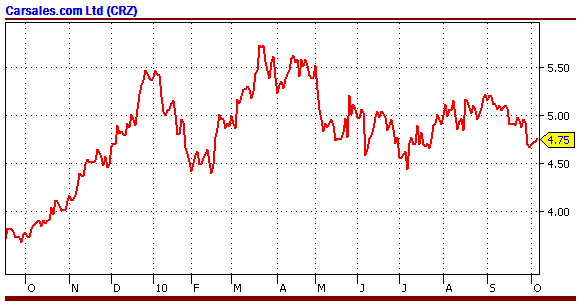
Today Carsales (CRZ) is Australia’s largest online list of cars, with about 205,000 units available for sale as of June this year.
For the year to June 2010, Carsales reported a profit of $43.2 million, which was $16.8 million less than listed car dealership Automotive Holdings (AHE). Automotive Holdings reported a profit of $60 million but required $1 billion of assets and $376 million of equity to produce it.
By way of comparison, Carsales required just $114 million of assets and $89 million of equity. Automotive Holdings generated a return on assets of 6.5%; Carsales’ figure was 39%.
If they were your assets, which return would you prefer?
For every dollar of sales, Automotive Holdings generates earnings before interest, tax, depreciation and amortisation (EBITDA) of 3.8¢. Carsales generates EBITDA of 52¢ from every dollar of sales.
If you could own one of these businesses, which would you prefer?
Carsales dominates Australia’s online lists of cars, capturing roughly half the market. Its next nearest competitor is the Newscorp-owned Carsguide with 93,000 cars for sale at mid-August, followed by the Trading Post with 69,000 cars.
For the full year to June 2010, Carsales’ revenues increased by 28%, with operating costs rising by less than 12% and net profits increasing by over 41%.
One of the keys to sustaining this kind of performance is a competitive advantage and while many conventional reports cite brands and systems as sources of competitive advantage, Carsales’s advantage comes from what is known as the network effect.
This is arguably one of the strongest sources of competitive advantage and it is evident when the value of a service increases for both new and current users as more people begin to use that good or service.
Think about it like this.
As more people list their cars/jobs/properties on a website, more people visit that website because it has the more cars listed. As more people visit the website, it justifies more people listing their cars there and this virtuous circle continues to work in favour of the dominant site, until an unbridgeable moat exists between Carsales.com and the other brands.
In an effort to break the cycle, one of Carsales’ competitors offered vendors the opportunity to list their cars for free but even that failed to put a dent the growth trajectory of Australia’s leading car classifieds website.
Carsales enjoys the same benefits of the network effect as Seek (SEK) does in job ads, REA Group (REA) does in real estate and Wotif (WTF) does in accommodation. This network effect is as visible and obvious as it is entrenched for Carsales.com and investors looking to buy a wonderful business would be hard-pressed to find many more attractive (for more of Roger’s thoughts on web-based businesses, click here).
Now the reality is that Carsales’ largest shareholder, PBL Media, owns 49% of the company and at some point that stake will be sold. But investors fearing the overhang should be less concerned by who buys and sells the shares and more concerned with whether the intrinsic value of the company is rising or not.
Carsales’ intrinsic value is rising. My forecasts suggest intrinsic value will rise 19% for each of the next three years and, let me assure you, there are few companies that can even promise that.
But a rising intrinsic value is just one of the characteristics the ValueLine portfolio seeks. The other is a discount to today’s intrinsic value. And that is the only test that Carsales.com. does not pass.
Carsales.com is an A1 business with a strong competitive advantage that is generating excellent returns on assets but, according to my calculations, its intrinsic value is $3.77. If we compare this to yesterday’s closing price of $4.72, it is approximately 25% overvalued.
In 2012, my estimated intrinsic value for Carsales rises to $4.65 and in 2012 to $5.24, but disciplined value investors need to make sure that everything lines up perfectly to pursue a successful investment strategy.
Carsales is not currently trading at a discount but it is a great business to keep in mind, should the market temporarily change its mind.
Posted by Roger Montgomery, 7 October 2010
by Roger Montgomery Posted in Companies, Value.able.
- 48 Comments
- save this article
- POSTED IN Companies, Value.able
-
Value.able review by Student2trader.com
Roger Montgomery
October 1, 2010
Very few books get me this excited.
The anticipation I had when opening my package upon receiving Roger’s book was huge! Boy was I not let down!
Roger’s book literally reignited my interest toward fundamental valuation of firms. Investors should rejoice, finally a logical approach to valuing ANY company that literally ANY investor can use. I have put many friends and family on to this book! I have no doubt that Value.able is going to take the nation, possibly the world, by storm.
I really enjoy Roger’s simple approach to valuing companies and the way he explains his concepts in the book are commendable. Some of his best concepts involve seeking both qualitative and quantitative margins of safety when using his simple yet very effective valuation method.
Roger gives a lot of value to his readers in this book. I personally never accept anything I read unless I completely understand exactly what is happening, how the concept works and how the assumptions affect the outcome. Subsequently, Value.able was a fantastic read for those reasons; Roger leaves nothing to the imagination, makes no unjustifiable assumptions, and bases his methods on proven and simple logic. Best of all, you don’t need a degree in finance to understand his book.
I honestly recommend you read Value.able. Many people are already looking forward to the second edition of the book, which will no doubt add further value for readers, based on the feedback Roger received from the first release.
If you are an investor, a student, a simple person wanting an easier logical way to make your decisions or even if you are academically challenged, you will understand Roger’s approach.
Well done Roger, I look forward to reading your future books!
Co-founder of Student2Ttrader.com.
by Roger Montgomery Posted in Value.able.
- 4 Comments
- save this article
- POSTED IN Value.able
-
How do Value.able graduates calculate forecast valuations?
Roger Montgomery
October 1, 2010
 I know of no other book in the world that discusses the concept of calculating future intrinsic values. You may think that is a bold statement, but its true. I have seen many books that claim to reveal Warren Buffett’s intrinsic value formula, but not one that lays out, step-by-step, what investors need to look at to determine whether intrinsic value is rising at a satisfactory rate in the future.
I confess to chuckling recently when one investor told me that they were finding it a little difficult to source the data they needed to calculate future intrinsic values. They also believed that my book lacked an explanation for how to calculate future intrinsic values.
So I asked whether or not they had even thought about future intrinsic values before having read Value.able? Sheepishly, the investor accepted that my book was much more valuable than they had initially concluded and subsequently told other people.
I have not found any other book in the world that has taken that little Buffett quote about finding businesses growing intrinsic value at a “satisfactory rate” and making it part of a clearly explained and defined investing process.
And for those of you who are looking for a reference to forecast equity per share in Value.able…. see Page 188, Step A.
The missing worked example for future equity. It’s easy!
How can you estimate future equity if you don’t have a forecast number such as those readily available in analyst research notes? It’s easy. Take the last known equity per share figure, add the estimated profits, subtract the estimated dividends, add any capital raised through new shares issued and subtract any equity paid back to shareholders through buybacks and you have it.
Here’s an example: In the 2010 annual report for The Reject Shop, equity at 30 June 2010 was $51.543 million (click here to see) and there were 26.034 million shares on issue. Dividing the 2010 ending equity by the shares on issue ($51.543/26.034) equals equity of $1.98 on a per share basis.
According to Commsec (click here to see), consensus analyst estimates for 2011 earnings per share and dividends per share are $1.028 and $0.744 respectively.
Starting with the 2010 equity per share of $1.98, add the earnings per share of $1.028 and subtract the dividends per share of $0.744 to arrive at an estimated ending equity for 2011 of $2.26. (If you are aware of any shares issued since the end of the financial year, you may want to take the amount raised and divide it by the number of shares issued and then add that result to the $2.26)
Now that you have seen it done, how easy is that?
A global movement begins!
I couldn’t be happier that a small group of passionate Australian value investors are even contemplating future intrinsic values! Nobody in the world is presenting you with estimates for intrinsic values, two, three or four years out and I have never seen any investor ever do it. I know of nobody else in Australia doing that, nobody has written about it before and I haven’t ever come across anyone else in the international business media discussing it either.
And now you are all doing it! It has become part of your vocabulary.
Think about that for a minute… after reading Value.able, investors are now estimating future intrinsic values, posting their estimates at my blog and Facebook page,and chatting about them online in forums and in boardrooms where previously nobody was.
If before reading Value.able you weren’t discussing future intrinsic values and now you are, then my book has had a positive impact and I am delighted. And all for just $49.95!
Consider how you are now subconsciously framing your investing decisions with future intrinsic values in mind.
Warning!
Don’t blindly combine numbers with Value.able’s valuation tables to produce intrinsic values. As I say in my book, you MUST understand the business and its prospects. I devoted an entire chapter to cash flow and its calculations. Don’t ignore it. I also devoted an entire chapter to competitive advantages. Don’t ignore that either.
Recently, Buffett sold down his holding in Moody’s because it had lost some of its competitive advantage. He isn’t selling because he has recalculated intrinsic value. It’s the competitive advantage that drives the intrinsic value.
Be careful you aren’t so focused on the intrinsic value number that you ignore all the other important factors.
Its one of the reasons I have my Montgomery Quality Ratings (MQRs). They are my own filter to help narrow the universe of companies to conduct further research on.
I put a lot of effort into writing my book and making an investment plan out of the best of what the world’s most successful investors have revealed, published and taught. And I am delighted that you have allowed me to share that with you. Thank you.
Where do I get the raw data Roger?
I have previously posted a document called ‘Source Data’, where Value.able graduates contributed their solutions to obtaining the data. Because I am receiving so many requests for help finding the data, I thought it useful to republish it. Click here or click the Value.able Source Data button to the right.
I was saddened to hear that one Value.able reader thought getting the data was all too hard and gave up. That’s like knowing there’s silver and gold a metre under your feet but saying that grabbing a shovel and digging is just too hard. If you don’t want to do the work that’s fine, but please don’t blame the guy who gave you the map, the pick and the shovel.
Using the information in my Source Data document, you should now be in a rock solid position to start estimating future intrinsic Value.able values.
Take a look at the Source Data document and you will see that the raw data is freely available. Indeed every single number you need to estimate the current intrinsic value is also available in a company’s annual report, and its all free at ASX.com.au.
With sources like Commsec and the formula I have given you for future equity, you can now freely estimate the forecast intrinsic value as well. Just go to ASX.com.au, click on the announcements link, select the company code and the year you need and voila! All the information is there in the annual report.
Value.able outlines the way I invest. I don’t have a green button that I press each day that automatically goes and buys the best opportunities. Value investing requires research and analysis. We can build devices that give us some short cuts, but they don’t replace the need to understand the business and the risks.
Why are my valuations different to Roger’s?
If everyone uses exactly the same inputs, our Value.able valuations will all be identical. Any differences therefore are due to different data. Some examples of sources of variation are:
- Online brokers’ ROE numbers are calculated differently to the way I suggest in Value.able. They use ending equity and I suggest average equity.
- Generic net profit after tax figures available on various online summary lists may or may not remove abnormal/significant or non-recurring items. Intrinsic values should be based on recurring profits, revenues and expenses. (Yes there is some subjectivity in this).
- I have noticed many of you using 10% discount rates for all companies. As I suggest in Value.able, this may be too low in some cases.
There are a variety of reasons and your Value.able valuations are different to mine.
Recently on TV I indicated that my valuation of Telstra was closer to $2.30-$2.50, but one Value.able graduate produced $3.68. I suspect that the difference is simply the choice of discount rate. Many investors will use a low discount rate because TLS such a big company with plenty of liquidity and very low risk of significant change. I however might use a higher rate because I want compensation for the fact that its future prospects are opaque and its profits haven’t grown a dollar in a decade.
Thinking about differing results, I am encouraged that many Value.able graduates were able to replicate my results exactly, or within a couple of cents.
Value.able will stand the test of time because it is based on a method of investing that works. It is a method of investing that requires time to demonstrate its value. And in time I look forward to hearing many more of your success stories.
Only a few First Edition hardback copies of Value.able remain. So if you haven’t purchased your reserved copy yet, now is not the time to ponder.
There was only one print run of the First Edition hardback. The paperback Second Edition will be available in mid November.
Posted by Roger Montgomery, 1 October 2010.
by Roger Montgomery Posted in Companies, Insightful Insights, Investing Education, Value.able.