

AI’s next test
July and August 2026 have delivered a useful reminder that even the strongest investment narratives eventually collide with economics.
According to The Wall Street Journal, US momentum stocks suffered one of their worst stretches in decades. Bank of America noted July 2026 was one of the worst months for momentum trading in nearly forty years.
As artificial intelligence (AI)-related equities suffered their violent reversal, some of the market’s most popular semiconductor and memory names fell extraordinarily quickly.
Table 1. Not so fast!
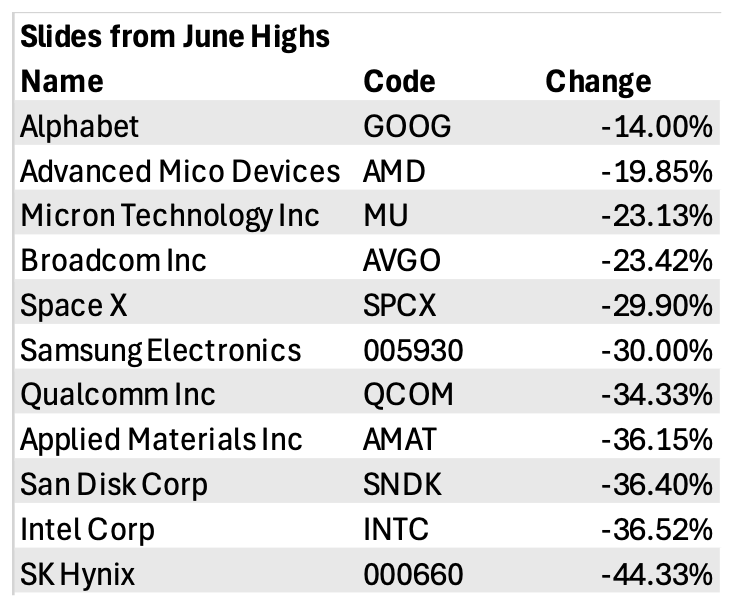
Source: Montgomery Investment Management, as at 1 September 2026
Part of the explanation was mechanical rather than fundamental. Years of strong returns had attracted momentum traders who leveraged into an increasingly crowded trade, and when prices turned, forced selling amplified the decline.
The difficulties experienced by former OpenAI researcher, Leopold Aschenbrenner’s highly publicised Situational Awareness fund became the most visible example, but similar leveraged positioning had accumulated elsewhere, including across Asian markets.
Bubble popping?
The episode matters because it coincides with, or reflects, a question we posited last year: what economic return will ultimately justify the extraordinary amount of capital being invested in AI?
In this blog post, entitled How Much!?!?, we examined the revenue and profit estimates required to justify the AI build-out.
There is little doubt the technology itself is improving. The harder question is whether each new generation is improving enough.
Training frontier models is becoming enormously expensive, while the incremental gains between generations appear progressively less transformative. One fund manager rhetorically asked, “how many additional enterprises signed because version 5.5 is so much better than 5.0?”
A model can be demonstrably superior on benchmarks without producing an equivalent improvement in corporate profitability. The distinction is critical. Investors ultimately require productivity, not benchmark scores.
That productivity revolution remains more prospective than proven.
Most large corporations have now experimented extensively with generative AI. Many report considerable potential, yet widespread measurable productivity gains remain elusive.
For a corporation to implement AI successfully, it will need to redesign workflows, adjust incentives, and eliminate redundant processes. Simply giving employees an AI assistant creates another software subscription without a genuine productivity dividend.
That is why the ultimate measure of AI adoption may not be how many companies use it, but whether companies can produce materially more output with fewer resources.
And we’ve yet to see that occur broadly.
Software engineering should provide an early test. Existing models are already capable coders, and software companies were among AI’s earliest adopters. Yet, aside from a meaningful initial round of industry retrenchment, there has been little evidence of sustained labour substitution across the sector.
If the trillions being committed to AI infrastructure are to earn attractive returns, that eventually needs to change.
The commoditisation problem
In the meantime, there’s another challenge, and that’s the improving quality of open-weight models.
If cheaper Chinese and American models become ‘good enough’ for most corporate applications, the economics of frontier AI become considerably more difficult. Frontier providers may spend billions producing the world’s most capable models only to discover that customers can accomplish most of the everyday tasks they need covered with substantially cheaper alternatives.
Uber provides an interesting example. AI-agent usage within the company reportedly increased more than ninefold between February and August, yet overall AI costs remained broadly flat from April, as the company became more efficient in deploying models, including through greater use of open-weight alternatives.
As we have seen many times throughout history, the development of this ‘new-fangled’ technology is wonderful for users. And, as history has also shown, it is less obviously wonderful for companies expecting exceptional returns from developing increasingly expensive frontier models.
Regulation introduces another complication. Anthropic’s powerful Fable 5 and Mythos 5 models were temporarily restricted by the US government in June because of national-security concerns before access was subsequently restored. Mythos remains available only on a limited basis. The episode demonstrates that as models become more capable – particularly in areas such as cybersecurity – the very capabilities that increase their economic value may also attract greater regulatory attention.
None of this means AI will fail. It is reasonable to assume AI is likely to become one of the defining technologies of this era. What it does mean, however, is that investors must apply greater discrimination about where to invest.
AI is becoming a funding question too
The scale of AI investment also intersects with another major concern: the growing competition for capital.
As I have written about here, and here, America is already running exceptionally large fiscal deficits. The Congressional Budget Office expects the federal deficit to reach approximately US$1.9 trillion, or 5.8 per cent of GDP, in 2026, while debt held by the public stands at roughly 101 per cent of GDP.
Then add AI. J.P. Morgan estimates hyperscaler capital expenditure alone could reach US$700 billion in 2026. Financing requirements have already exhausted the cash flows of the hyperscalers, pushing them into corporate bonds, project finance and other debt structures.
Government borrowing and AI infrastructure are therefore competing for an enormous pool of global capital at precisely the time some traditional Treasury buyers have become less reliable.
Something eventually has to adjust, and that adjustment may be higher yields, causing the US Treasury to intervene.
The Treasury has already doubled the maximum size of certain long-dated bond buybacks from US$2 billion to at least US$4 billion per operation, explicitly seeking to improve liquidity in the long end of the market. But against the magnitude of America’s prospective funding requirements, such interventions remain modest.
Moreover, by drawing a line in the sand, for example at 5.00 per cent, Treasury also invites hedge funds to test its resolve by betting on higher rates.
Higher bond yields matter beyond bonds. If investors can obtain increasingly attractive returns from fixed income, the hurdle rate applied to equities, infrastructure and other long-duration assets must rise as well. Interest rates act, on financial assets, as gravity does on Earth.
That argues for relatively subdued aggregate equity returns and considerably greater dispersion between winners and losers. In such an environment, owning the market may become less rewarding than identifying businesses undergoing genuine structural improvement.
Conclusion
AI and US bonds initially appear unrelated, but each ultimately comes down to capital allocation. Questions like how much capital is available, what return investors demand in exchange for providing it, and where that capital earns the highest return will increasingly determine market outcomes.
After years in which abundant liquidity has rewarded powerful narratives, the coming environment may be more demanding.
The promise of technology is still important, but the rules of economics and finance may matter more.

Roger Montgomery is the Founder and Chairman of Montgomery Investment Management. Roger has over three decades of experience in funds management and related activities, including equities analysis, equity and derivatives strategy, trading and stockbroking. Prior to establishing Montgomery, Roger held positions at Ord Minnett Jardine Fleming, BT (Australia) Limited and Merrill Lynch.
He is also author of best-selling investment guide-book for the stock market, Value.able – how to value the best stocks and buy them for less than they are worth.
Roger appears regularly on television and radio, and in the press, including ABC radio and TV, The Australian and Ausbiz. View upcoming media appearances.
This post was contributed by a representative of Montgomery Investment Management Pty Limited (AFSL No. 354564). The principal purpose of this post is to provide factual information and not provide financial product advice. Additionally, the information provided is not intended to provide any recommendation or opinion about any financial product. Any commentary and statements of opinion however may contain general advice only that is prepared without taking into account your personal objectives, financial circumstances or needs. Because of this, before acting on any of the information provided, you should always consider its appropriateness in light of your personal objectives, financial circumstances and needs and should consider seeking independent advice from a financial advisor if necessary before making any decisions. This post specifically excludes personal advice.


