

Many major economies under stress from relatively high inflation AND unemployment
After cutting their cash rates in the latter part of 2024 and 2025, the Central Banks of Australia, the U.S., Europe and New Zealand have recently reversed tack. This is coming at a tricky time for many economies with inflationary expectations and cost of living issues putting additional pressure on consumers, and this is often accompanied by relatively high unemployment in the UK (5.0 per cent), Europe (6.4 per cent), Canada (6.4 per cent) and New Zealand (5.6 per cent).
|
Australia |
Cash Rate (%) |
|
Prior peak |
4.35 |
|
February 2025 |
4.10 |
|
May 2025 |
3.85 |
|
August 2025 |
3.60 |
|
February 2026 |
3.85 |
|
March 2026 |
4.10 |
|
May 2026 |
4.35 |
|
August 2026 |
4.35 |
|
September 2026 |
4.60 |
|
Move from February 2024 peak |
+0.25% |
Reserve Bank of Australia (RBA) Governor, Michele Bullock, has overseen four 0.25 percentage point increases since February 2026 from 3.60 per cent to the current 4.60 per cent. The productivity problem in the non-market sector, like education, health and public administration is unhelpful, given Australia’s trimmed mean rate of inflation is growing at 3.6 per cent for the year to July 2026.
The big question is whether Australia’s unemployment rate jumps significantly from the current 4.6 per cent?
Graph 1. Advanced economy central bank policy rates (%)
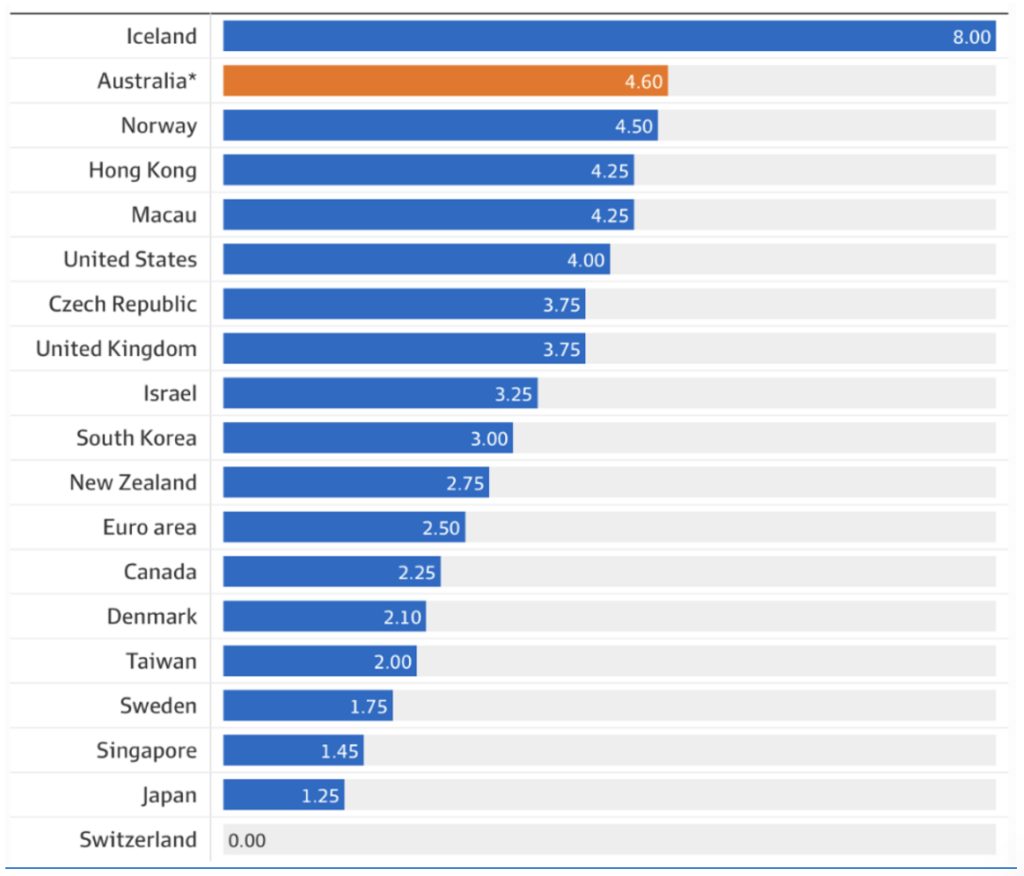
Source: Michael Read, AFR, Trading economics
|
USA |
Cash Rate (%) |
|
Prior peak |
5.50 |
|
September 2024 |
5.00 |
|
November 2024 |
4.75 |
|
December 2024 |
4.50 |
|
September 2025 |
4.25 |
|
October 2025 |
4.00 |
|
December 2025 |
3.75 |
|
September 2026 |
4.00 |
|
Move from August 2024 peak |
-1.50% |
After cutting the U.S. cash rate on six occasions from 5.50 per cent to 3.75 per cent between August 2024 to December 2025, recently appointed Chairman of the U.S. Federal Reserve reversed course in September by increasing the cash rate by 0.25 percent to 4.00 percent.
With U.S. annual rate of inflation sitting at 3.4 percent in August 2026, up from the mid two per cent area before the U.S./Iran war, another interest rate increase in the near-term is possible.
|
UK |
Cash Rate (%) |
|
Prior peak |
5.25 |
|
August 2024 |
5.00 |
|
November 2024 |
4.75 |
|
February 2025 |
4.50 |
|
May 2025 |
4.25 |
|
August 2025 |
4.00 |
|
December 2025 |
3.75 |
|
Move from July 2024 peak |
-1.50% |
The UK rate of inflation is running at 3.1 per cent in the 12 months to August 2026, however the Bank of England (BoE) is in a bind with the unemployment rate averaging 5.0 per cent over the past year.
|
Europe |
Cash Rate (%) |
|
Prior peak |
4.50 |
|
June 2024 |
4.25 |
|
September 2024 |
3.65 |
|
October 2024 |
3.40 |
|
December 2024 |
3.15 |
|
January 2025 |
2.90 |
|
March 2025 |
2.65 |
|
April 2025 |
2.40 |
|
June 2025 |
2.15 |
|
June 2026 |
2.40 |
|
September 2026 |
2.65 |
|
Move from May 2024 peak |
-1.85% |
With the annual rate of headline inflation at 3.2 per cent, the European Central Bank is also in a bind with the unemployment rate averaging 6.4 per cent over the past couple of years. The eight interest rate cuts over the year to June 2025 had no obvious assistance, and parts of Europe seem to be under a lot of financial stress.
|
Canada |
Cash Rate (%) |
|
Prior peak |
5.00 |
|
June 2024 |
4.75 |
|
July 2024 |
4.50 |
|
September 2024 |
4.25 |
|
November 2024 |
3.75 |
|
December 2024 |
3.25 |
|
February 2025 |
3.00 |
|
March 2025 |
2.75 |
|
September 2025 |
2.50 |
|
October 2025 |
2.25 |
|
Move from May 2024 peak |
-2.75% |
Similarly to Europe, Canada’s headline rate of inflation for the year to July is 3.0 per cent, whilst the unemployment rate is 6.4 per cent. The nine cuts to the cash rate from 5.0 per cent to 2.25 per cent over the 17 months to October 2025 also indicates an economy under stress.
|
New Zealand |
Cash Rate (%) |
|
Prior peak |
5.50 |
|
August 2024 |
5.25 |
|
October 2024 |
4.75 |
|
November 2024 |
4.25 |
|
February 2025 |
3.75 |
|
April 2025 |
3.50 |
|
August 2025 |
3.00 |
|
October 2025 |
2.50 |
|
November 2025 |
2.25 |
|
July 2026 |
2.50 |
|
September 2025 |
2.75 |
|
Move from July 2024 peak |
-2.75% |
New Zealand’s rate of inflation accelerated to 4.1 per cent in the year to the June 2026 Quarter, whilst the unemployment rate stands at 5.6 per cent.
Conclusion
With the RBA’s latest increase, central banks face an increasingly difficult balance. Inflation remains a concern, but higher interest rates could place further pressure on households and employment. How far can they raise rates before the economic cost becomes too high?

Chief Executive Officer of Montgomery Investment Management, David Buckland has over 40 years of industry experience.
David is a deeply knowledgeable and highly experienced financial services executive. Prior to joining Montgomery in 2012, David was CEO and Executive Director of Hunter Hall for 11 years, as well as a Director at JP Morgan in Sydney and London for eight years.
This post was contributed by a representative of Montgomery Investment Management Pty Limited (AFSL No. 354564). The principal purpose of this post is to provide factual information and not provide financial product advice. Additionally, the information provided is not intended to provide any recommendation or opinion about any financial product. Any commentary and statements of opinion however may contain general advice only that is prepared without taking into account your personal objectives, financial circumstances or needs. Because of this, before acting on any of the information provided, you should always consider its appropriateness in light of your personal objectives, financial circumstances and needs and should consider seeking independent advice from a financial advisor if necessary before making any decisions. This post specifically excludes personal advice.


