

Market state of play – and what to do
Well into the penultimate quarter of the calendar year, institutional and private investors face the paradox that record infrastructure capital expenditure, particularly by AI hyperscalers, coexists with heightened geopolitical risk, sticky inflation, and an apparent structural shift to the relationship between equities and bonds.
And if institutions are changing their asset allocations to reflect these shifts, should private investors do the same?
Key macro drivers & systemic trends
Global markets are simultaneously buoyed by and caught between the aggressive artificial intelligence (AI) infrastructure buildout – which demands unprecedented data centre capacity, specialised compute, and power infrastructure – and lingering geopolitical vulnerabilities in the Middle East.
Both dynamics act as structural inflationary drivers on raw materials and energy supply chains. And given stocks markets tend to do better when economic growth is accompanied by disinflation, rather than inflation, one starts to wonder how long the bull market can remain supported.
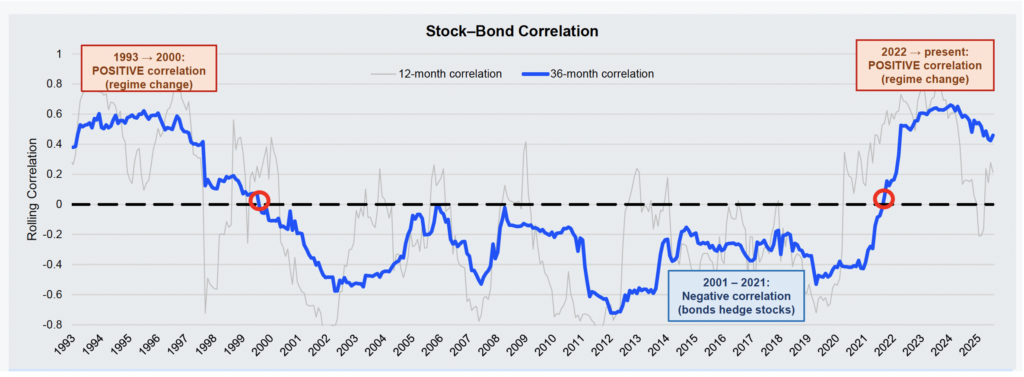
After 20 years of negative correlation, rolling 12- and 36-month stock-bond correlations have returned to positive territory. When market stress stems from monetary policy tightening, fiscal policy profligacy, persistent inflation, or high valuation multiples rather than growth shocks, equities and sovereign bonds tend to fall in tandem.
That’s significant because previously investors were advised to on simple 60/40 fixed-income duration to buffer equity drawdowns. Relying on the negative correlation is no longer the shortcut to adequate diversification it once was. Other solutions are necessary.
Figure 1. Positive equity/bond correlation erodes defensive role of fixed income
Source: Perpetual, FactSet, S&P 500 TR and Bloomberg US Treasury TR indices
With inflation likely to hold more influence over economies and markets in the foreseeable future, simply having 40 per cent of a portfolio in bonds won’t provide the protection required.
“Genuine diversification means deliberately spreading risk across exposures that actually behave differently when it matters, rather than holdings that may be exposed to the same underlying factors.” Perpetual Private, August 2026
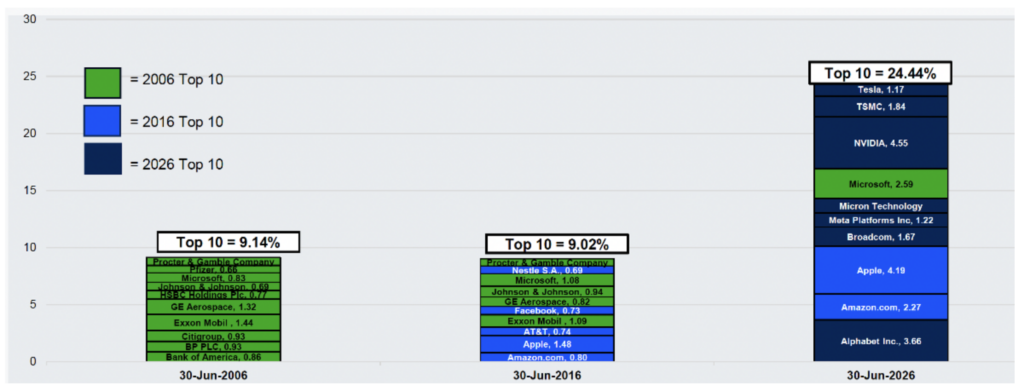
Another key driver of markets is market concentration, which has reached multi-decade highs. The top 10 constituents of the MSCI ACWI account for nearly a quarter of the total global index market capitalisation.
Again, this appears to be structural. Automated inflows to passive index funds continue to channel capital disproportionately into the mega-caps. And while this perpetuates the index’s outperformance relative to, for example, quality-based active fund managers, it’s also amplifying index-level volatility and single-factor risk.
Figure 2. Increasing global equity concentration. MSCI ACWI Top 10
Source: Perpetual, FactSet, As at 30 June 2026
- Focus on earnings quality over narrative
Focusing on quality as a factor for stock selection has resulted in significant underperformance since the AI thematic gained momentum. The resultant outperformance of the major indices has, for example, even led to Berkshire Hathaway underperforming the S&P 500 over the last five years.
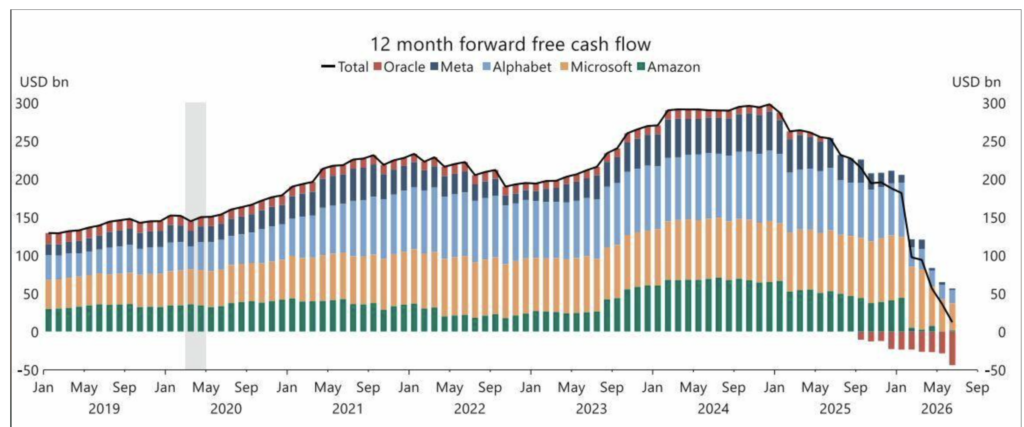
Now, the AI theme is transitioning from broad multiple expansion to capital discipline, as hyperscaler free cash flow yields plunge amid capital expenditure outpacing short-term earnings growth.
Figure 3. Plunging free cash flows
Source: Bloomberg, Macrobond, Apollo Chief Economist
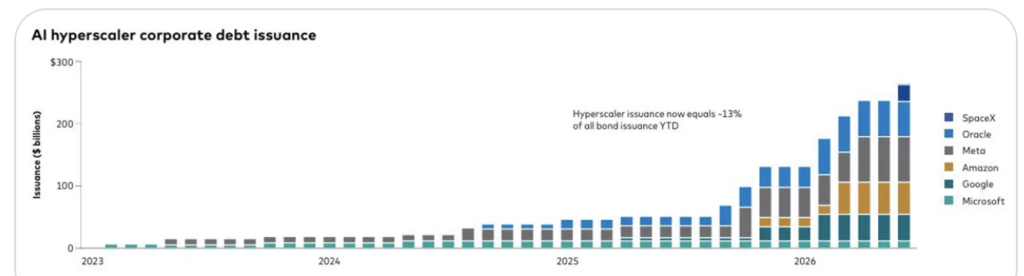
As Figure 4., reveals, the drop in free cash flows means the hyperscalers are forced to borrow to stay in the AI arms race.
Figure 4. Plunging free cash flows leads to rising debt
Source: Bloomberg, as of June 30, 2026
And while equity investors celebrate and cheer the epochal spending on AI infrastructure, irrespective of whether it is cash or debt-funded, credit default swap traders might be harbouring a different view.
Figure 5. Plunging free cash flows and rising debt, makes insurance traders nervous
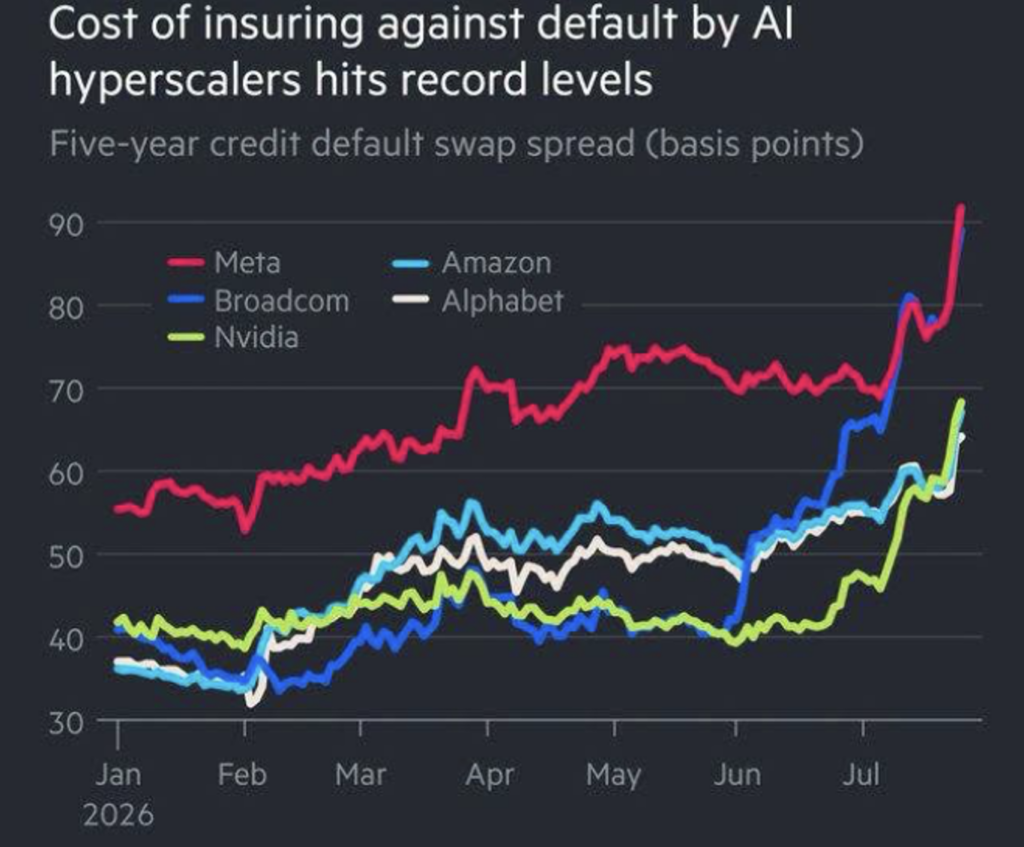
Source: Bloomberg, financial times
The strategy of burning infinite amounts of cash and debt to stay in the AI race represents an ‘all-in’ bet that AI tools for individual consumers and enterprise customers will be sold at highly profitable volumes and prices – neither of which is certain.
There is, therefore, wisdom now in taking some profits from the AI winners, and refocusing on companies demonstrating tangible return on invested capital (ROIC) rather than pure cash burn.
And let’s not forget the disparity between tech sub-sectors is expanding. Capital markets are rewarding hardware infrastructure – semiconductors, specialised memory, power, and data centres – while software platforms face uncertainty about their monetisation timelines, and even whether they will be able to monetise at all amid the commoditisation of their tools.
- Seek true uncorrelated diversification
With stock-bond correlations positive and equity indices heavily concentrated, portfolios require deliberate allocation to uncorrelated risk factors. Exposure to high-quality, for example – AA-rated, private credit funds, or energy infrastructure funds and assets, and relative-value, uncorrelated hedge funds such as arbitrage funds offers yield and diversification unlinked to traditional macro and market forces.
- Maintain dry powder for volatility
While underlying economic growth remains resilient, market concentration, delays or setbacks to AI monetisation, geopolitical tensions and shifting central bank reaction functions create room for market dislocations. Maintaining liquidity (cash or near-cash investments) allows investors to capitalise on short-term mispricings when market valuations decouple from underlying corporate fundamentals, which, eventually, they will.
Learn more about private credit.
Alternatively, you can speak with David Buckland or Rhodri Taylor here at Montgomery on (02) 8046 5000.
Disclaimer:
You should read the relevant Product Disclosure Statement (PDS) or Information Memorandum (IM) before deciding to acquire any investment products.
Past performance is not a reliable indicator of future performance. Returns are not guaranteed and so the value of an investment may rise or fall.
This information is provided by Montgomery Investment Management Pty Ltd (ACN 139 161 701 | AFSL 354564) (Montgomery) as authorised distributor of the Aura Core Income Fund (ARSN 658 462 652) (Fund). As authorised distributor, Montgomery is entitled to earn distribution fees paid by the investment manager and may be issued equity in the investment manager or entities associated with the investment manager.
The Aura Core Income Fund (ARSN 658 462 652)(Fund) is issued by One Managed Investment Funds Limited (ACN 117 400 987 | AFSL 297042) (OMIFL) as responsible entity for the Fund. Aura Credit Holdings Pty Ltd (ACN 656 261 200) (ACH) is the investment manager of the Fund and operates as a Corporate Authorised Representative (CAR 1297296) of Aura Capital Pty Ltd (ACN 143 700 887 | AFSL 366230).
You should obtain and carefully consider the Product Disclosure Statement (PDS) and Target Market Determination (TMD) for the Aura Core Income Fund before making any decision about whether to acquire or continue to hold an interest in the Fund. Applications for units in the Fund can only be made through the online application form that accompanies the PDS. The PDS, TMD, continuous disclosure notices and relevant application form may be obtained from www.oneinvestment.com.au/auracoreincomefund or from Montgomery.
The Aura Private Credit Income Fund is an unregistered managed investment scheme for wholesale clients only and is issued under an Information Memorandum by Aura Funds Management Pty Ltd (ABN 96 607 158 814, Authorised Representative No. 1233893 of Aura Capital Pty Ltd AFSL No. 366 230, ABN 48 143 700 887).
Any financial product advice given is of a general nature only. The information has been provided without taking into account the investment objectives, financial situation or needs of any particular investor. Therefore, before acting on the information contained in this report you should seek professional advice and consider whether the information is appropriate in light of your objectives, financial situation and needs.
Montgomery, ACH and OMIFL do not guarantee the performance of the Fund, the repayment of any capital or any rate of return. Investing in any financial product is subject to investment risk including possible loss. Past performance is not a reliable indicator of future performance. Information in this report may be based on information provided by third parties that may not have been verified.

Roger Montgomery is the Founder and Chairman of Montgomery Investment Management. Roger has over three decades of experience in funds management and related activities, including equities analysis, equity and derivatives strategy, trading and stockbroking. Prior to establishing Montgomery, Roger held positions at Ord Minnett Jardine Fleming, BT (Australia) Limited and Merrill Lynch.
He is also author of best-selling investment guide-book for the stock market, Value.able – how to value the best stocks and buy them for less than they are worth.
Roger appears regularly on television and radio, and in the press, including ABC radio and TV, The Australian and Ausbiz. View upcoming media appearances.
This post was contributed by a representative of Montgomery Investment Management Pty Limited (AFSL No. 354564). The principal purpose of this post is to provide factual information and not provide financial product advice. Additionally, the information provided is not intended to provide any recommendation or opinion about any financial product. Any commentary and statements of opinion however may contain general advice only that is prepared without taking into account your personal objectives, financial circumstances or needs. Because of this, before acting on any of the information provided, you should always consider its appropriateness in light of your personal objectives, financial circumstances and needs and should consider seeking independent advice from a financial advisor if necessary before making any decisions. This post specifically excludes personal advice.


