

The source of the next crisis: winner takes all
I have spent the better part of the last 18 months warning investors the pattern of past returns from investing in new technology – what we refer to as General Purpose Technologies (GPT) – are likely to apply to the latest GPT- artificial intelligence (AI).
Quite simply, there’s a point in every technology investment boom when the technology stops being the most important question, and the money takes over.
The recent sell-off in semiconductor stocks suggests the AI bubble has been pierced and is now leaking. The AI boom may therefore be at the point where investors demand to “show me the money.”
Table 1. Leaking bubble
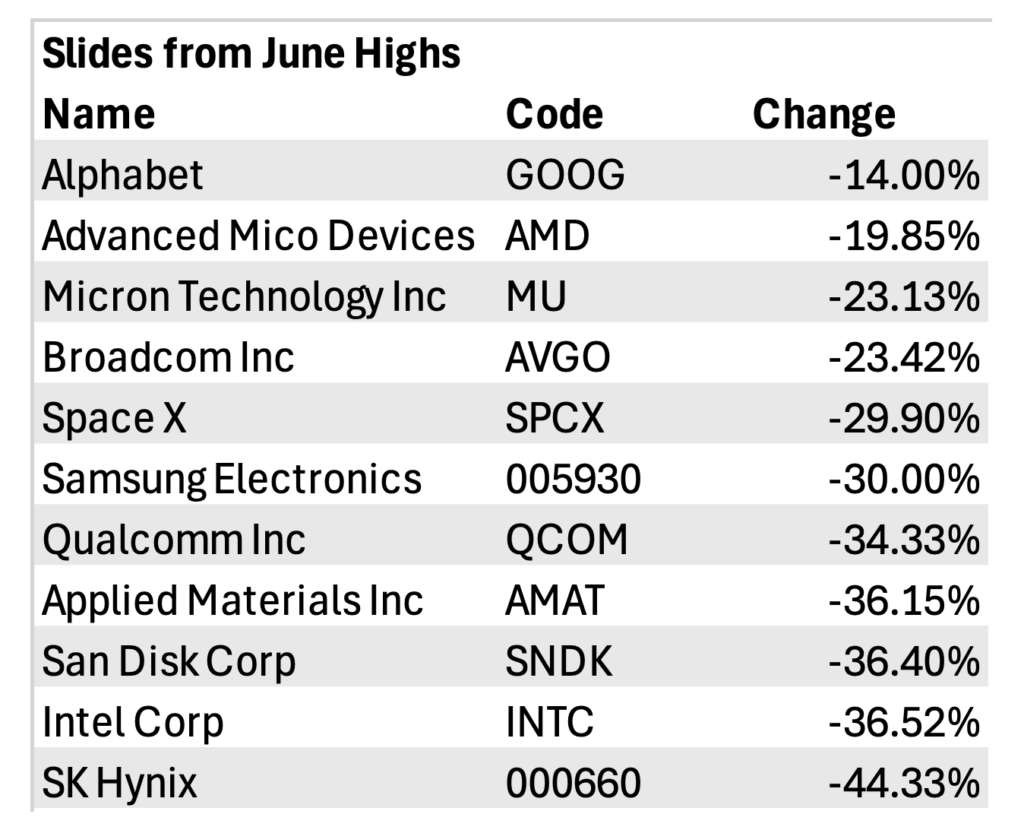
Source: Montgomery, 31 August 2026
As is the case historically with the invention of every GPT, the excitement surrounding AI was largely centred on what the technology might eventually achieve: automate knowledge work, write software, cure cancer, put people on Mars, solve democracy, discover drugs, transform advertising, replace call centres and create entirely new industries.
But as AI dreams bump up against the reality of hallucinations, complex multi-step math and logic, physical manipulation, and deep context and common sense, investors are asking, who is going to earn an adequate return on the extraordinary amount of capital being invested to make all of this possible?
First, an important correction. It is sometimes claimed that US$3.7 trillion has already been spent building AI. That isn’t correct. The figure appears to originate from McKinsey, which estimated that between 2025 and 2030, AI-related data-centre capacity could require between US$3.7 trillion and US$7.9 trillion of capital expenditure (capex). Its central scenario is US$5.2 trillion.
But correcting the number hardly makes the spending boom look small.
Microsoft currently expects roughly US$190 billion of capex in calendar 2026. Amazon has lifted its forecast to US$220 billion. Alphabet expects US$195–205 billion, while Meta expects US$130–145 billion. Together, those four companies alone are therefore contemplating roughly US$735–760 billion of capital spending this year. Not all of it is AI, but each company has explicitly identified AI and cloud infrastructure as a major driver.
That’s the number investors should concentrate on.
The depreciation bill
One weakness in the AI investment story is that spending cash on a data centre doesn’t immediately destroy reported earnings. Capex is recorded on the balance sheet and is gradually charged against profits through depreciation.
That delay can make the economics look better during the investment phase than they ultimately prove to be.
The effect, however, is already becoming visible. Microsoft’s depreciation expense increased from US$22.0 billion in FY25 to US$34.3 billion in FY26, a rise of 56 per cent. Alphabet’s property-and-equipment depreciation increased from US$9.5 billion to US$13.6 billion in the first half of 2026. Meta’s increased from US$8.1 billion to US$11.7 billion. At Amazon, depreciation and amortisation allocated to AWS jumped from US$9.2 billion to US$15.4 billion over the same six-month period.
And much more spending has yet to be recorded on the income statement, which matters because AI hardware isn’t a 30-year toll road.
Microsoft depreciates servers and networking equipment over roughly two to six years; Meta uses around five to 5½ years, while Amazon uses five to six years. Technological obsolescence is therefore an important part of the economics.
Companies aren’t merely required to generate enough revenue to pay their electricity bills and employees. They have to generate sufficient incremental profit to recover hundreds of billions of dollars of rapidly depreciating equipment and still earn an attractive return on the capital invested.
Meanwhile, the price of intelligence keeps falling
That challenge is magnified by one of AI’s most remarkable achievements: dramatic reductions in the cost of using it.
Stanford’s AI Index found the inference cost of a model performing at approximately the GPT-3.5 level collapsed from US$20 per million tokens in November 2022 to just seven cents by October 2024 – a more than 280-fold decline. Depending on the task, Stanford reported that inference prices fell between 9 and 900 times per year.
And competition has intensified since then. Privately held Chinese AI company DeepSeek introduced Application Progamming Interface (API) discounts of up to 75 per cent in 2025, while competition between OpenAI, Anthropic, Google and other Chinese model developers continues to push model prices lower.
This creates a problem for the frontier model providers. Demand for intelligence can explode while the price of intelligence collapses. And that’s great for customers but less ‘great’ for whoever has spent hundreds of billions of dollars manufacturing the intelligence.
Consumer sales
You’ve heard it said that there simply aren’t enough humans willing to pay US$240 a year for an AI tool to generate returns that cover the cost of capital for the hyperscalers. And in the absence of enterprise-level customers, that might be true and therefore a problem.
But for AI tools to exist, the providers don’t need billions of consumers paying US$20 a month. That’s because the larger revenue opportunity lies in selling to enterprises, cloud computing, software development, advertising, and business automation.
Microsoft said in April that its AI business had already exceeded a US$37 billion annual revenue run-rate, growing 123 per cent year-on-year. Azure exceeded US$100 billion of annual revenue in FY26.
Google Cloud is providing even more dramatic evidence of demand. Second-quarter 2026 revenue surged 82 per cent to US$24.8 billion, while operating income reached US$8.8 billion. Amazon’s AWS revenue rose 37 per cent to US$42.2 billion, and its contractual backlog reached approximately US$496 billion.
So the problem isn’t finding customers.
Will enterprise spend enough?
The question is whether revenue can grow fast enough to keep pace with capital investment.
AI could become enormously valuable to society while still generating disappointing returns for some of the companies financing the infrastructure. History is full of revolutionary technologies where users captured more of the economic benefit than the original infrastructure investors.
Cash flow is now becoming the pressure point
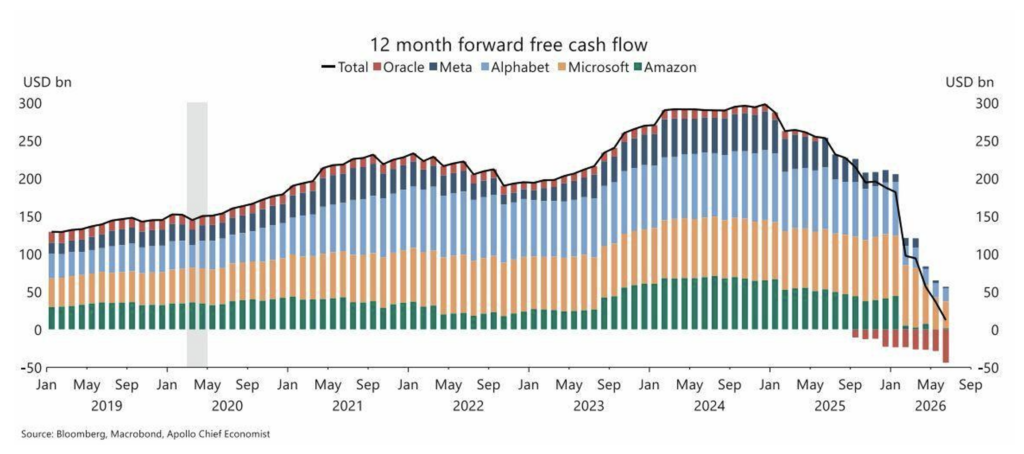
As Torsten Slok from Apollo Global Management revealed, there are already signs that the investment race is changing corporate finances.
Figure 1. Hyperscaler free cash flow
Source: Bloomberg, Apollo Chief Economist
Amazon generated US$161 billion of operating cash flow during the 12 months to June 2026, yet US$169 billion of net property expenditure pushed reported free cash flow to negative US$7.6 billion. Alphabet spent US$44.9 billion on capex in the June quarter alone and has raised fresh equity specifically to help fund AI infrastructure. Meta issued US$25 billion of additional bonds in May, lifting long-term debt to almost US$84 billion.
None of this implies these companies are financially distressed. They remain extraordinarily profitable businesses.
But AI is progressively transforming Big Tech from an extraordinarily cash-generative, relatively asset-light industry into something much more capital intensive. As Jeremey Grantham recently noted, the dynamics have radically changed. The era of low-risk, high-margin, unassailable Big Tech monopolies has given way to an expensive, high-stakes war of attrition.
And if cheaper Chinese and American models become ‘good enough’ for most corporate applications, the economics of frontier AI become considerably more difficult. Frontier providers may spend billions producing the world’s most capable models only to discover that customers can accomplish most of the everyday tasks they need covered with substantially cheaper alternatives.
Meanwhile, European AI regulation is now moving into active enforcement, while copyright litigation is creating genuine liabilities. In July, a U.S. court approved Anthropic’s US$1.5 billion copyright settlement with authors.
The real AI bear case
Microsoft, Google and Amazon are demonstrating substantial AI-related revenue growth. Demand remains strong enough that several providers say they are still capacity constrained.
But that’s not the same thing as proving the industry will earn satisfactory returns on trillions of dollars of investment.
The most credible bearish thesis is therefore subtler than “AI is useless” or “nobody will pay for it.”
AI may prove extraordinarily useful.
The problem is that everybody knows it.
That knowledge has produced a simultaneous rush to build chips, models, data centres and power infrastructure. Meanwhile, technological progress keeps lowering the cost of computation and fierce competition keeps lowering the price customers pay.
That combination – exploding capital investment, rapidly depreciating assets and falling unit prices – is ‘ground zero’ for future disappointment.
Investors should therefore watch three numbers more closely than model benchmarks:
- AI revenue generated per dollar of capital expenditure,
- depreciation growth relative to operating profit, and
- free cash flow after infrastructure spending.
Even though AI technology may continue to improve, a crisis could emerge if those numbers fail to improve. In other words, the technology worked brilliantly, but too many companies spent too much money trying to own it all.

Roger Montgomery is the Founder and Chairman of Montgomery Investment Management. Roger has over three decades of experience in funds management and related activities, including equities analysis, equity and derivatives strategy, trading and stockbroking. Prior to establishing Montgomery, Roger held positions at Ord Minnett Jardine Fleming, BT (Australia) Limited and Merrill Lynch.
He is also author of best-selling investment guide-book for the stock market, Value.able – how to value the best stocks and buy them for less than they are worth.
Roger appears regularly on television and radio, and in the press, including ABC radio and TV, The Australian and Ausbiz. View upcoming media appearances.
This post was contributed by a representative of Montgomery Investment Management Pty Limited (AFSL No. 354564). The principal purpose of this post is to provide factual information and not provide financial product advice. Additionally, the information provided is not intended to provide any recommendation or opinion about any financial product. Any commentary and statements of opinion however may contain general advice only that is prepared without taking into account your personal objectives, financial circumstances or needs. Because of this, before acting on any of the information provided, you should always consider its appropriateness in light of your personal objectives, financial circumstances and needs and should consider seeking independent advice from a financial advisor if necessary before making any decisions. This post specifically excludes personal advice.


