

Draining the moat
Jeremy Grantham is considered one of the giants of the investment world. After his start as an economist for Royal Dutch Shell, he earned his MBA from Harvard before co-founding his first asset management firm and helping pioneer commercial indexing strategies in the early 1970s. He subsequently co-founded Grantham, Mayo, & Otterloo (GMO) in Boston, growing it into a global powerhouse managing over US$100 billion.
He is also considered a permanent bear, or a Cassandra in the investment world. Indeed, he takes a tongue-in-cheek swipe at that label in his 2026 book, The Making of a Permabear.
In this post, we summarise his current view that the moats that once protected the hyperscalers are being drained as they shift from operating as quiet, polite monopolists to direct competitors.
For the past decade, investing in the mega-cap tech giants was the closest thing financial markets had to easy money. Simply find businesses with wide, pristine economic moats, protected by massive network effects, high switching costs, and regulatory inertia.
Alphabet dominated search; Meta owned social media; Microsoft locked in corporate productivity; Amazon controlled e-commerce and cloud infrastructure. They operated as comfortable, highly lucrative quasi-monopolies. When they did overlap – such as in cloud computing – they behaved like a polite oligopoly. Nobody started a price war, everyone maintained staggering profit margins, and shareholders reaped the rewards.
Then came ChatGPT.
The U.S. economy was arguably drifting toward a mid-sized recession in late 2022. The post-pandemic inflationary shock was biting, interest rates were surging, and a cyclical bear market was gaining momentum. The launch of generative artificial intelligence (AI), however, and ChatGPT in particular, completely interrupted that economic trajectory. It triggered a massive, capital-intensive technology boom that artificially reinvigorated the market by kicking the recession down the road.
Yet, beneath the surface of this AI-driven market rally lies a problem. The technology that reignited market euphoria is dismantling the monopolies that made these companies so extraordinarily profitable in the first place.
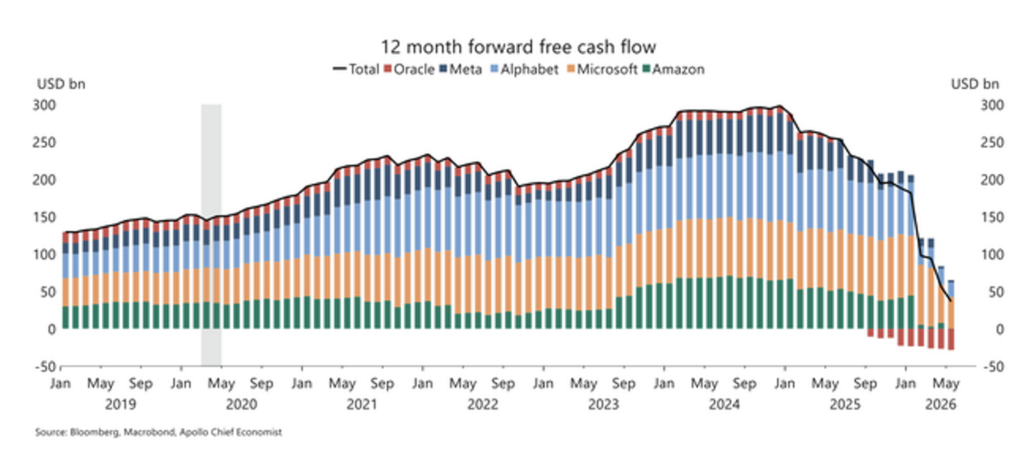
For a time, the scale of spending on the AI race by the likes of Meta, Alphabet, Amazon and Microsoft was dismissed because of the massive cash flows these businesses generated.
But the spending is exceeding those cash flows forcing those same companies to borrow vast amounts of debt. At the same time, we’ve transitioned from an era of polite oligopoly and monopoly to an era of corporate warfare.
Draining the moats
Consider how the Magnificent Seven (Alphabet, Amazon, Apple, Meta, Microsoft, Nvidia, Tesla) used to operate. They controlled separate territories. They were cash machines with minimal defensive capital expenditure requirements relative to their revenues.
Grantham suggests that pact is dead.
Five years ago, these firms operated as distinct monopolies or tightly controlled oligopolies. Today, those same companies – joined by a secondary ring of peripheral or unlisted hopefuls – are beating their chests in an all-out capital spending race. One commits US$80 billion to annual capital expenditures, so another counters with US$120 billion. Every single one of them believes they’re in a winner-take-all arms race, that achieving early dominance in frontier AI models will unlock multi-trillion-dollar revenue streams and value, so none of them can afford to come in second.
The comfortable oligopoly has been replaced by a bare-knuckle “cage fight”. These are aggressive, cash-rich enterprises now fighting on the same battlefield.
The way Graham sees it, they’re no longer just defending their historical moats but setting fire to their own capital, only to build new, overlapping battlegrounds.
Super-normal profits are an illusion
Historically, tech manias follow a familiar structural pattern. Investors point to the 19th-century railroad expansion or the late-1990s fibre-optic boom as historical parallels. As I have written many times in recent years, in those cycles, overbuilding destroyed investor capital, even though the underlying infrastructure eventually transformed society.
The current AI infrastructure race, however, resembles the battles for market dominance in ride-sharing, food delivery, and co-working spaces.
In those market battles, tech-enabled platforms poured billions of dollars into subsidising user acquisition and building scale. The goal was to out-bleed the competition, undermine incumbents, achieve market superiority, establish a monopoly, and eventually harvest super-normal profits once rivals collapsed.
But we know how that story ended.
The expected super-normal profits largely failed to materialise at the scale promised because the underlying services remained structurally hyper-competitive or easily substitutable.
AI technology is clearly more profound and macroeconomically significant than ride-sharing or office leasing, but the market mechanics have the same flaw.
Pervasive adoption does not equal excess profit
As Grantham notes, while AI is a genuine technological breakthrough that will transform productivity, history shows widespread corporate adoption rarely yields permanent corporate profit expansion.
When every business adopts a technology – much like enterprise computing or quantitative algorithms in previous decades – it simply becomes the baseline cost of doing business. Efficiency gains are passed along to consumers through competition, rather than accumulating as permanent excess margins on corporate balance sheets.
Commoditisation of models
As frontier AI models proliferate, the marginal cost of intelligence drops quickly. The AI model is not a moat. It’s just a proprietary distribution and hardware ecosystem – and all the tech giants are now competing directly against one another.
This cycle won’t stop anytime soon
In previous market manias, capital deployment eventually faced a hard ceiling. In the ride-sharing or telecom busts, the spending spree ended when cash reserves dwindled, credit markets tightened, or public equity markets refused to fund further burn rates.
Financial discipline was forced upon the participants by external capital constraints.
That discipline is absent in the current AI cycle.
Microsoft, Alphabet, SpaceX/xAI, Amazon, Meta, and Apple, as well as private operators like OpenAI and Anthropic, possess unprecedented financial means. They entered the AI arms race backed by hundreds of billions in cash, massive cash flow from legacy businesses, and virtually unlimited access to capital markets.
Because they don’t face short-term liquidity constraints, there’s no immediate market mechanism to force capital discipline. They can continue to fund unprecedented capital expenditures year after year, absorbing lower return on invested capital (ROIC) in pursuit of strategic survival.
Of course, if one of them decides, itself, to slow down its build-out, watch out.
A fundamental shift
For equity investors, this shift alters the risk profile of the market’s most popular stocks.
The Magnificent Seven earned their premium valuations because they offered a rare combination of high growth, dominant market share, low capital intensity, and massive profit margins. Indeed, as they grew, their returns on capital rose!
But as hyperscalers, those same companies are inverting that formula.
Figure 1. Hyperscaler free cash flows
Source: Bloomberg, Macrobond, Apollo Chief Economist
First, a far larger percentage of operating cash flow is now locked into rapidly depreciating hardware, data centres, and energy infrastructure.
Second, companies are actively invading adjacent territories. Search, software, social media, and cloud platforms are no longer insulated silos. They’re competing directly for the same AI-driven enterprise and consumer journeys.
And finally, when ultra-capitalised industry leaders engage in direct competition, prices fall, and costs rise.
The ongoing rollout of AI will undoubtedly yield incredible technological breakthroughs and societal utility. That means consumers will be better off. But as an investment thesis, Graham adds that the dynamics have radically changed. The era of low-risk, high-margin, unassailable Big Tech monopolies has given way to an expensive, high-stakes war of attrition. Investors who assume the next decade of tech returns will look like the last decade may want to take a closer look at the balance sheets of the companies funding the fight.

Roger Montgomery is the Founder and Chairman of Montgomery Investment Management. Roger has over three decades of experience in funds management and related activities, including equities analysis, equity and derivatives strategy, trading and stockbroking. Prior to establishing Montgomery, Roger held positions at Ord Minnett Jardine Fleming, BT (Australia) Limited and Merrill Lynch.
He is also author of best-selling investment guide-book for the stock market, Value.able – how to value the best stocks and buy them for less than they are worth.
Roger appears regularly on television and radio, and in the press, including ABC radio and TV, The Australian and Ausbiz. View upcoming media appearances.
This post was contributed by a representative of Montgomery Investment Management Pty Limited (AFSL No. 354564). The principal purpose of this post is to provide factual information and not provide financial product advice. Additionally, the information provided is not intended to provide any recommendation or opinion about any financial product. Any commentary and statements of opinion however may contain general advice only that is prepared without taking into account your personal objectives, financial circumstances or needs. Because of this, before acting on any of the information provided, you should always consider its appropriateness in light of your personal objectives, financial circumstances and needs and should consider seeking independent advice from a financial advisor if necessary before making any decisions. This post specifically excludes personal advice.


