

Keep dancing a little closer to the door
BCA Research (BCA), a global investment research firm, recently released its August 2026 market update, in which the authors argue against becoming defensive too early.
According to BCA, the current bull market contains many of the necessary ingredients for a future bust – geopolitical risk, an extraordinary artificial intelligence (AI) capital expenditure boom, and a looming wave of very large initial public offerings (IPOs) – but BCA believes the immediate evidence still favours investing in risk assets such as shares.
BCA specifically note the U.S. economy is reaccelerating, or gaining momentum again, liquidity remains supportive, private-sector balance sheets aren’t overextended, and the equity rally is being driven by profit growth rather than simply by higher valuation multiples.
This latter point is precisely the one also made by perma-bull Ed Yardeni, the veteran U.S. investment strategist and President of Yardeni Research, who says this bull market is being fuelled by FEMO (Fantastic Earnings Momentum) rather than FOMO (Fear of Missing Out).
Oiling the bull market
The geopolitical argument centres on the Middle East. BCA contends oil prices aren’t simply an outcome of conflict; they’re an “independent variable” that helps determine its intensity.
To wit, when oil prices fall, Iran and the United States have more room to escalate their conflict. When oil prices rise sharply, both sides face stronger incentives to pull back because disruption to energy supply inspires the rest of the world to get involved.
Figure 1. BCA Research. Brent crude’s US$85-US$100 price range
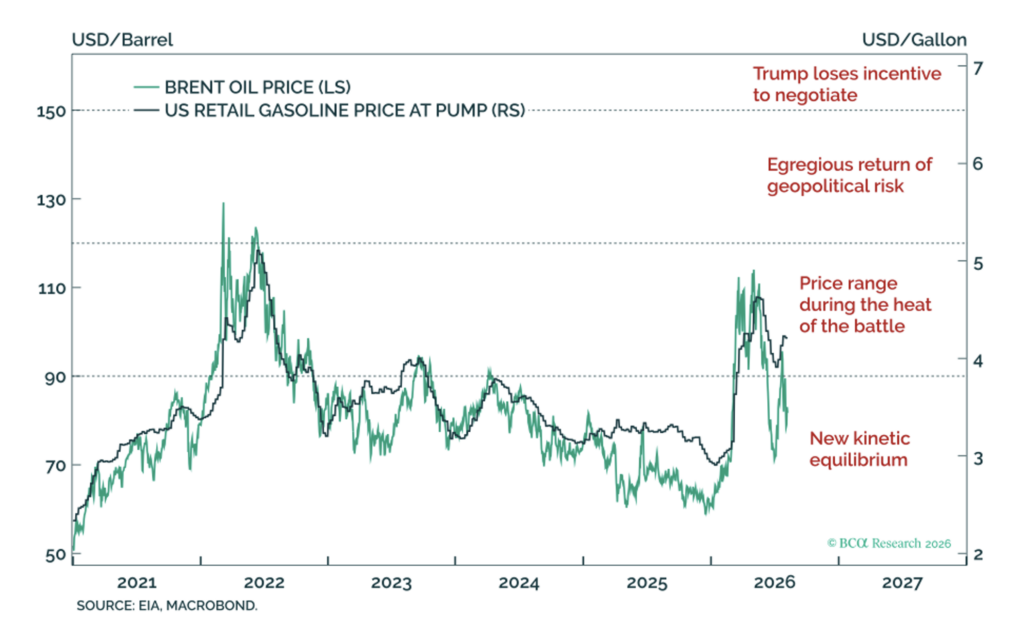
*Brent crude is a type of crude oil and is used as a major global oil price benchmark.
BCA therefore sees the confrontation settling into a “new kinetic equilibrium”: intermittent military activity, but continued traffic through the Strait of Hormuz.
BCA believes Brenthas established a new US$85-US$100 range, with a repeat of the March peak unlikely. Yet depleted inventories also mean BCA sees limited downside and believes longer-dated Brent contracts look too cheap.
Russia
BCA’s relatively sanguine view of the Middle East comes, however, with an important caveat. BCA identifies Russia, not Iran, as the largest geopolitical threat to its outlook.
Ukrainian drone operations have broken what BCA describes as a three-to-four-year battlefield equilibrium by bringing the economic cost of the war more directly onto Russia. Consequently, BCA expects this will provoke a Kremlin response before any meaningful ceasefire.
BCA highlights, in particular, the extraordinary domestic burden Russia is bearing: estimated war deaths equal 0.59 per cent of its working-age population and the annualised economic cost is put at 6.3 per cent of gross domestic product (GDP) .
Political insecurity can make President Vladimir Putin more aggressive, while higher oil prices reduce Russia’s material constraints by increasing resources and making sanctions harder to impose. The result could be more hybrid warfare in Europe and potentially more overt activity.
Food
BCA also warns that food could become another geopolitical fault line. Higher fertiliser costs linked to the Strait of Hormuz and a severe El Niño weather pattern, which can cause droughts and extreme weather, create what it calls a “double whammy” for food prices. Wheat, cocoa and palm oil appear particularly exposed, with wheat expected to be the most vulnerable. Emerging and frontier economies, especially non-energy-exporting Middle Eastern states, are seen as most exposed to the political consequences.
Bullish nevertheless
Despite that somewhat bearish or negative backdrop, BCA’s economic view is surprisingly constructive.
The collapse in the U.S. leading economic index, a measure designed to signal future economic activity, during 2024 and 2025 did not produce a recession, and the indicator is now turning higher. The labour market has stabilised, with BCA’s forward-looking labour model strengthening.
Elsewhere, private-sector leverage is low and global liquidity remains ample. Inflation appears to have peaked, assuming energy prices stay range-bound, while subdued wage growth should limit pressure from housing costs. Households have also continued to spend despite expectations that the savings rate has to rise.
The bottom line
BCA believes the AI capital expenditure boom may ultimately end badly, but it suggests it’s too soon to position for the bust.
While U.S. information technology (IT) spending contributed 0.8 percentage points to quarterly real GDP growth in the first quarter of 2026, the strongest contribution this century, it’s worth keeping in mind that technology investment remained elevated for years in the 1990s, and before that cycle eventually crashed.
BCA suggests the current AI cycle could, therefore, continue for another three to five years and, mapped onto the 1990s experience, may be only around two-thirds complete.
BCA also separates AI infrastructure spending from the eventual success of frontier language models – the most advanced AI models. Even if proprietary models disappoint, open-source competition could drive usage costs lower and increase demand for computing power. That would be very good for data centre demand.
Meanwhile, corporate AI adoption is rising, and electricity generation has broken out of a decade-long stagnation – evidence, in BCA’s view, that the boom has a real economic footprint.
Like railways, AI infrastructure may ultimately prove to be a successful technology but a poor investment once overbuilding becomes extreme. BCA’s point is that “eventually” may not mean “now”.
Reinforcing that message, BCA’s history of bull markets shows unusually strong returns can occur in the final decile, making an early retreat to cash potentially expensive.
Things change, however, in 2027. BCA is concerned about a coming wave of “monster IPOs”. Its historical work shows that the probability of an S&P 500 peak rises with IPO size, increasing from roughly 20 per cent for the smallest IPOs to about 40 per cent for the largest.
Very large new IPOs increase equity supply, while investable funds sitting outside the equity market are already at a record low relative to market capitalisation.
That leaves financial conditions as the deciding variable. If inflation stays contained, central banks remain accommodative and global liquidity remains supportive, BCA believes the economic and AI-capex cycle can keep running and large IPOs may be absorbed.
If, however, renewed energy or food inflation forces policy tightening, the IPO wave could become the catalyst for a market peak.
In the end, BCA isn’t calling the end of the bull market yet. While late-cycle risks are becoming visible – investors may still have meaningful upside to capture before they matter.
Keep dancing, but a little closer to the door.

Roger Montgomery is the Founder and Chairman of Montgomery Investment Management. Roger has over three decades of experience in funds management and related activities, including equities analysis, equity and derivatives strategy, trading and stockbroking. Prior to establishing Montgomery, Roger held positions at Ord Minnett Jardine Fleming, BT (Australia) Limited and Merrill Lynch.
He is also author of best-selling investment guide-book for the stock market, Value.able – how to value the best stocks and buy them for less than they are worth.
Roger appears regularly on television and radio, and in the press, including ABC radio and TV, The Australian and Ausbiz. View upcoming media appearances.
This post was contributed by a representative of Montgomery Investment Management Pty Limited (AFSL No. 354564). The principal purpose of this post is to provide factual information and not provide financial product advice. Additionally, the information provided is not intended to provide any recommendation or opinion about any financial product. Any commentary and statements of opinion however may contain general advice only that is prepared without taking into account your personal objectives, financial circumstances or needs. Because of this, before acting on any of the information provided, you should always consider its appropriateness in light of your personal objectives, financial circumstances and needs and should consider seeking independent advice from a financial advisor if necessary before making any decisions. This post specifically excludes personal advice.


