
Investors are selling the disruptors and the disrupted
On December 18, in a blog entitled Time Magazine Cover Curse, I wrote, “…Gracing the cover of the [TIME] mag isn’t a coronation but a harbinger of doom, because the moment a public figure has permeated the public discourse sufficiently to land the cover, the trajectory inevitably reverses.”
Politicians have suffered landslide defeats after being featured on the cover, as have business tycoons whose stocks plummet, and celebrities whose reputations are assassinated under sudden, intense scrutiny.
Elon Musk appeared on the cover in 2021. In 2022, he bought Twitter; his reputation was damaged, and he lost US$200 billion in net worth as the Tesla share price declined 72 per cent from its high on 5 November 2021 to early 2023.
Jeff Bezos was TIME’s Person of the Year in 1999, right at the peak of the dot-com bubble. Amazon’s stock fell more than 90 per cent when the bubble burst in 2000.
And who graced the cover two months ago in December 2026? “The Architects of AI” – Mark Zuckerberg; CEO of Meta, Lisa Su; CEO of Advanced Micro Devices (AMD), Elon Musk; CEO of xAI and Tesla, Jensen Huang; CEO of Nvidia, Sam Altman; CEO of OpenAI, Demis Hassabis; CEO of Google DeepMind, Dario Amodei; CEO of Anthropic, and Fei-Fei Li; AI pioneer and founder of World Labs.
Oh-oh. If the Time Magazine Cover curse plays out again…
Since TIME’s publication, a series of developments has signalled to investors the exit.
Most recently, a set of new plugins for Claude Cowork, an artificial intelligence (AI)-powered workplace assistant that can autonomously author documents and organise files, has triggered genuine concerns about the durability of the Software-as-a-Service (SaaS) business and revenue models, especially for those serving the legal, finance, and data sectors, including Thomson Reuters, a data and services firm, legal-tech company Legalzoom.com, RELX, the London-based parent company of data-analytics firm LexisNexis, and financial-data company FactSet.
One observer wrote, “Investors are finally waking up to a terrifying reality. The very SaaS applications that have dominated the last two decades are not just ripe for disruption by A.I; they are ripe to be eaten alive.”
Figure 1. Software performance versus Nasdaq100.
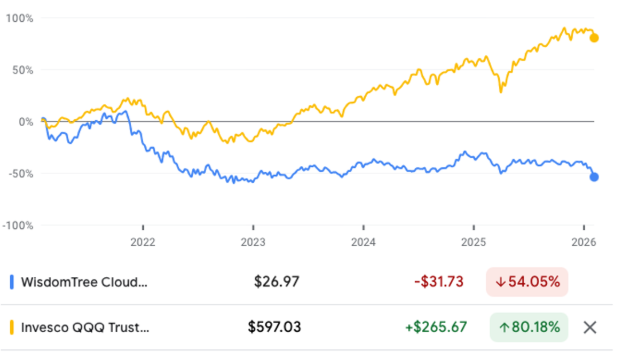
Source: Google Finance
Figure 1., shows the performance of the Wisdom Tree Cloud Computing Fund, a diversified basket of SaaS companies, against the Invesco QQQ Trust, an ETF that tracks the Nasdaq 100. Since ChatGPT’s release in November 2022, SaaS companies have failed to keep up with the broader technology market as measured by the Nasdaq 100.
So, we have investors selling software businesses because AI is going to disrupt them.
Meanwhile, a few weeks ago, Anthropic CEO Dario Amodei, penned and published a viral essay, noting, “I think that it should be clear that this is a dangerous situation…Humanity needs to wake up.”
So, there’s the lingering concern that AI could be harmful, although, admittedly, this isn’t a major influence on investors now.
Today, investors are also realising something we warned them about last year. Their straight-line assumptions for AI-related growth – a straight 45-degree line between the invention of AI and its global, broad-based adoption – is a fantasy that will be interrupted by the reality of a cyclical consumer and a cyclical roll-out.
In other words, as well as being concerned AI will disrupt software companies, AI investors are also concerned AI isn’t disrupting fast enough. Investors are selling the companies being disrupted and selling the disrupters.
How the AI General-Purpose Technology boom ends
AI is another General-Purpose Technology (GPT). Throughout history there have been many. As I discuss in this video, all GPTs end. And they tend to end the same way – through overcapacity and the end of the assumption that the tech will change the course of human history right now.
GPT’s of the past, such as the automobile, electricity, commercial flight, steam locomotion and TV, have all changed the course of human history and yet more than a thousand car manufacturers have disappeared from the U.S., and none exist today that are profitable and weren’t bailed out by government or private equity. Commercial aviation changed the course of history, yet, in aggregate, airlines have not made much money over the decades. History is replete with GPTs that were good for consumers – that did indeed change the course of history – but not so great for early investors.
The hype surrounding a new technology generally lowers the cost of investment for participants, and they naturally take advantage of that cheap capital to build out and scale that technology in a rapid land grab. Today, it’s the AI data centre rollout. The big problem is the consequence of this massive land grab. It’s called overcapacity. When overcapacity occurs, investment returns disappoint. Disappointing returns transpire because even though “this-technology-is-going-to-change-history”, it usually isn’t going to right ‘now’.
The perception or assumption over the last year has been that the AI theme is structural and uninterruptible. Few question whether the tech will change the course of human history. I believe it will. But I also believe the suppliers of this tech must ultimately sell their products and services to customers whose demand isn’t structural – theirs is cyclical.
When a structural theme (AI today) meets a cyclical commerciality, it’s the cyclical commerciality that wins.
What’s next is a period of Creative Destruction. Those of you who remember the tech wreck of 2000 will recall the term Creative Destruction. As price gains unwind, everyone other than the earliest investors loses between 60 and 95 per cent. Many are wiped out – destroyed despite investing in the creation of history-changing tech.
Investors cry out – “but nothing has changed!”. Why are shares collapsing if the theme remains true? What’s happened is a reality check – the time frames are wrong. As the share prices plunge and volatility increases, the cost of capital rises and all that debt that was amassed at the end of the boom sends some companies to the wall. That’s what’s changed.
Investors are now exiting despite reported record revenues, cash flows, and customer counts from AI-related companies and the hyperscalers.
Nothing has changed? Everything has changed!

Roger Montgomery is the Founder and Chairman of Montgomery Investment Management. Roger has over three decades of experience in funds management and related activities, including equities analysis, equity and derivatives strategy, trading and stockbroking. Prior to establishing Montgomery, Roger held positions at Ord Minnett Jardine Fleming, BT (Australia) Limited and Merrill Lynch.
He is also author of best-selling investment guide-book for the stock market, Value.able – how to value the best stocks and buy them for less than they are worth.
Roger appears regularly on television and radio, and in the press, including ABC radio and TV, The Australian and Ausbiz. View upcoming media appearances.
This post was contributed by a representative of Montgomery Investment Management Pty Limited (AFSL No. 354564). The principal purpose of this post is to provide factual information and not provide financial product advice. Additionally, the information provided is not intended to provide any recommendation or opinion about any financial product. Any commentary and statements of opinion however may contain general advice only that is prepared without taking into account your personal objectives, financial circumstances or needs. Because of this, before acting on any of the information provided, you should always consider its appropriateness in light of your personal objectives, financial circumstances and needs and should consider seeking independent advice from a financial advisor if necessary before making any decisions. This post specifically excludes personal advice.


