

“Go West, young man” – to Switzerland
Travellers to Switzerland overwhelmingly describe the alpine nation as breathtaking, safe, and efficient – a dream destination with dreamlike Alpine landscapes. Those with a keen eye will also notice that one of the most beautiful places they have ever visited is
expensive, but it’s clean, the public transport is punctual, and the villages are charming. I have often heard friends return with the phrase “Everything just works”.
Those with an interest in economics will have already noted the rest of the Western world is currently defined by ballooning sovereign deficits, ballooning debt and a creeping erosion of purchasing power.
Switzerland, however, remains an outlier – even a stubbornly outperforming one – that demands the attention of any serious investor or anyone with an interest in government policy.
In many of Switzerland’s European neighbours, government spending has climbed to between 45 and 55 per cent of Gross Domestic Product (GDP). In Australia, according to Statista, the ratio of government expenditure to GDP was 39.45 per cent in 2025. By contrast, the Swiss model operates on a remarkably lean 33 to 35 per cent.
This is not a matter of luck but the result of a small state design. Instead of central ‘federal’ control of the purse, in Switzerland, “sovereignty” sits with the Cantons. The federal government handles only tasks that cannot be performed at the local level. In Switzerland, this is a constitutional mandate. So, foreign policy, national defence and national transport systems like railways are handled by the federal government, but everything else – schools, policing, and most importantly, tax rates – is decided locally.
Imagine the Boroondara or Manningham Councils in Victoria or the Canada Bay or Leichardt Councils in NSW handling taxes or anything beyond bins and footpaths!
In Switzerland, the lion’s share of power is left to the 26 cantons and thousands of municipalities. Interestingly, Switzerland has fostered an environment of internal tax competition that prevents the predatory fiscal policy seen in more centralised nations.
But in a world defined by ballooning debt, Switzerland’s ‘alpha’ is its constitutional debt brake, known as the Schuldenbremse (literally ‘debt brake’). Introduced in 2003 and backed by a massive 85 per cent of voters, this mechanism effectively strips politicians of the ability to fund current public services with the capital of future generations.
The rule is simple: the federal government has to balance its budget over the course of an economic cycle. In periods of expansion, the government is legally required to run a surplus, which provides the necessary fiscal ‘dry powder’ to fund deficits during a recession. This disciplined approach has kept Switzerland’s debt-to-GDP ratio hovering around 37 to 40 per cent even as the United Kingdom and the U.S. contend with ratios well over 100 per cent.
Switzerland’s restrained fiscal policy is mirrored in its monetary policy. Like many other central banks, the Swiss National Bank maintains a focus on price stability, but it has done so successfully. Consequently, the Swiss Franc remains the world’s premier safe-haven currency, largely because it serves as a vote of confidence in the nation’s long-term solvency.
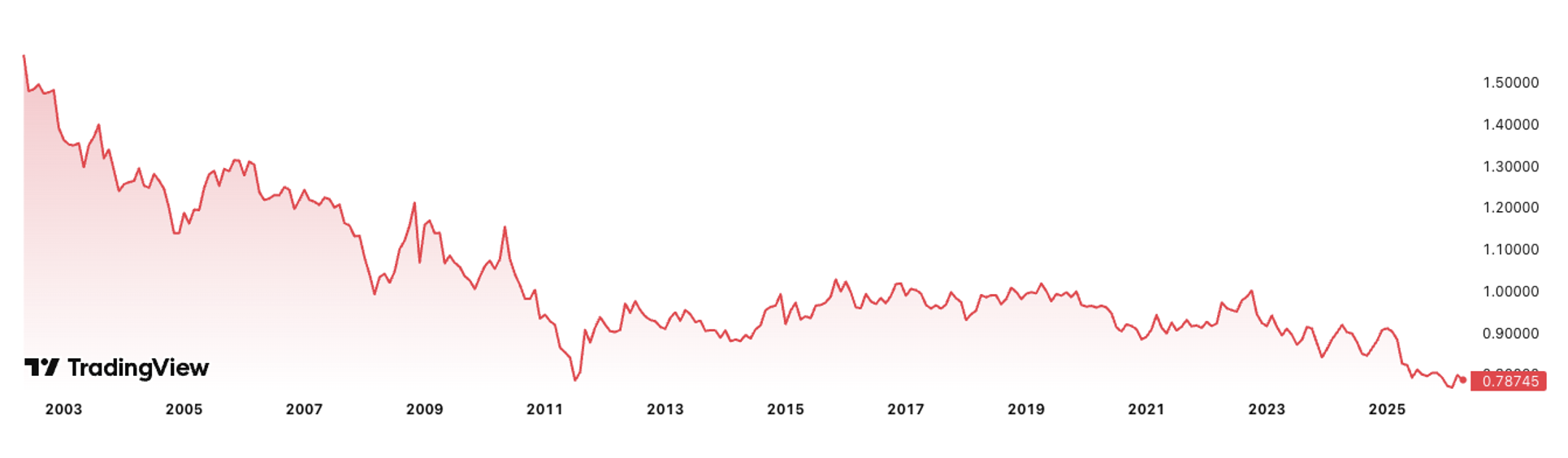
As Figure 1., reveals, the USD has declined 50 per cent against the Swizz Franc over the last 23 years
Figure 1. USD/CHF
Source: TradingView
With Swiss inflation rarely crossing the two per cent threshold, the Franc offers investors predictability. For those looking to preserve capital, it’s the Swiss system, rather than the U.S. system, that provides a hedge against the quantitative easing and currency debasement of the west.
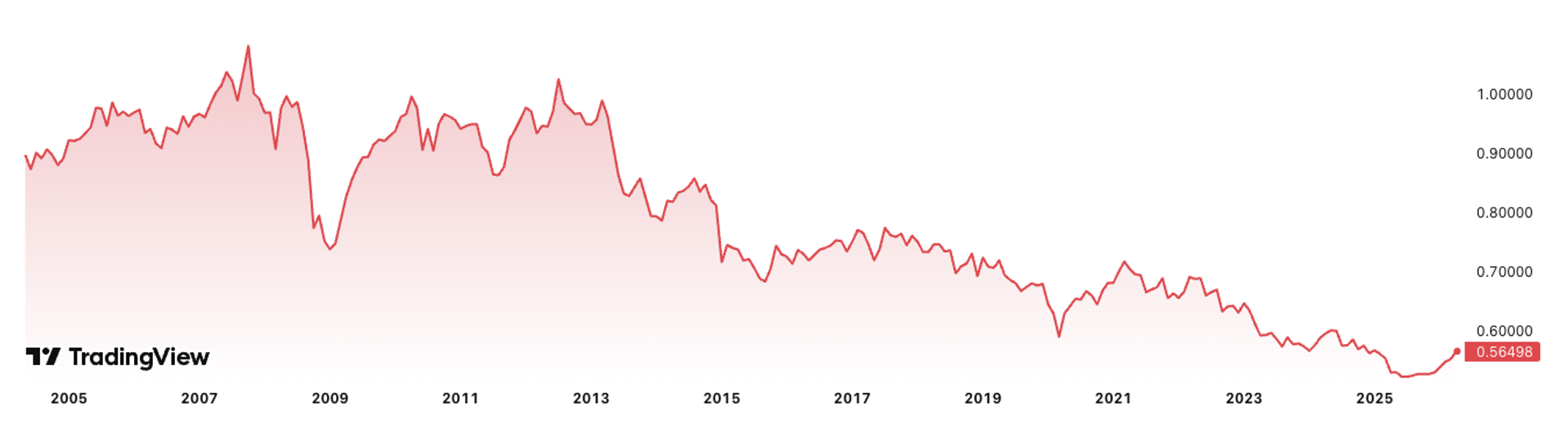
Figure 2. AUD/CHF is down 47 per cent since its October 2007 high
Source: TradingView
Beyond the balance sheet, the Swiss “operating system” is defended by a unique form of direct democracy that acts as a powerful risk-mitigation tool for the private sector. Unlike systems of parliamentary sovereignty, such as in Australia, where a simple majority can trigger radical policy swings, the Swiss constitution belongs to the citizens.
Any major legislative change can be challenged by a popular referendum, and citizens can propose their own amendments through initiatives. This bottom-up governance model forces politicians to build broad consensus and stay aligned with taxpayers’ “common sense”. In other words, pollies are required to represent the people, whether the pollies like it or not.
This constant threat of a public veto keeps the ruling class humble and ensures that the rules of the game remain stable, a critical factor for long-term capital allocation.
Even the nation’s approach to immigration, often a source of social fragmentation elsewhere, is managed with a pragmatism that prioritises economic contribution. While Switzerland has one of the highest proportions of foreign-born residents in the West – at approximately 26 per cent in 2026 – the system is strictly labour-market oriented.
By prioritising high-skilled workers who can contribute immediately, and by managing welfare at the communal level, the state creates built-in incentives for integration and self-sufficiency.
Ultimately, Switzerland represents perhaps the last example of a sane government that prioritises hard rules over political ideology.

Roger Montgomery is the Founder and Chairman of Montgomery Investment Management. Roger has over three decades of experience in funds management and related activities, including equities analysis, equity and derivatives strategy, trading and stockbroking. Prior to establishing Montgomery, Roger held positions at Ord Minnett Jardine Fleming, BT (Australia) Limited and Merrill Lynch.
He is also author of best-selling investment guide-book for the stock market, Value.able – how to value the best stocks and buy them for less than they are worth.
Roger appears regularly on television and radio, and in the press, including ABC radio and TV, The Australian and Ausbiz. View upcoming media appearances.
This post was contributed by a representative of Montgomery Investment Management Pty Limited (AFSL No. 354564). The principal purpose of this post is to provide factual information and not provide financial product advice. Additionally, the information provided is not intended to provide any recommendation or opinion about any financial product. Any commentary and statements of opinion however may contain general advice only that is prepared without taking into account your personal objectives, financial circumstances or needs. Because of this, before acting on any of the information provided, you should always consider its appropriateness in light of your personal objectives, financial circumstances and needs and should consider seeking independent advice from a financial advisor if necessary before making any decisions. This post specifically excludes personal advice.


