

Can plunging AI costs outrun the spending spree?
Artificial intelligence (AI), inference is getting cheaper at a pace that is rewriting the usual rules of technological progress.
Figure 1. Technology cost index over time (years since prices began declining)
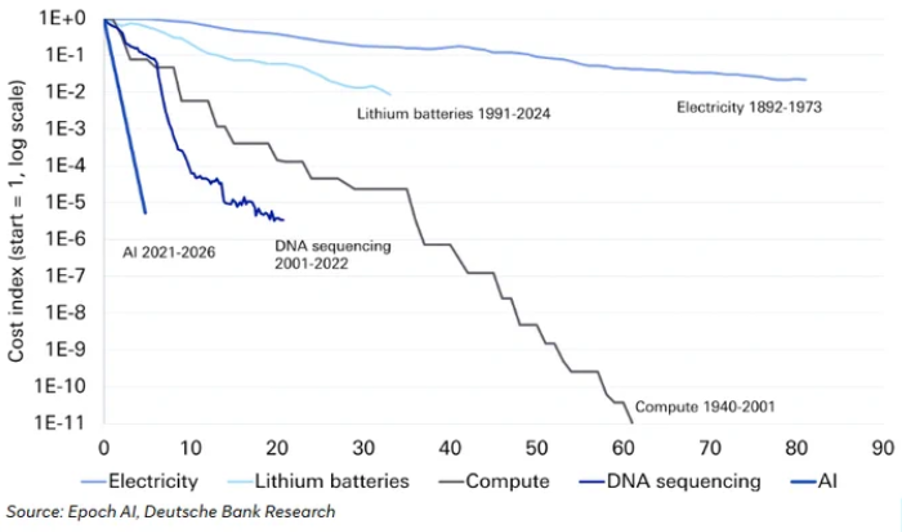
Source: Epoch AI, Deutsche Bank Research
According to research firm Epoch AI, the cost of achieving a fixed level of AI performance has declined 47 per cent every quarter since 2023. Compounded, that works out to a 13-fold decline per year.
In an historical context, that number looks absurd. The decline is about six times faster than the long-run fall in computing costs and roughly 18 times faster than the drop in lithium-battery prices.
On other quirky benchmarks, the pace of price compression is even more dramatic. Take the performance on GPQA Diamond (a test designed to measure how well AI models answer difficult science questions). On a PhD-level science exam a model that scored 75 per cent for about 30 cents per question in early 2025 was matched by a later system at four-hundredths of a cent – a 725-fold price collapse in under 18 months. In other words, AI models are achieving the same level of performance at a fraction of the cost.
Figure 1., plots the cost index of electricity, lithium batteries, general compute, DNA sequencing, and AI on a log scale from the start of each technology’s price decline, illustrating AI’s line plunging almost vertically while the others descend at a more leisurely pace.
Abundance and capex
At the same time that inference is becoming drastically cheaper, capital expenditure (capex) is exploding. U.S. and Chinese technology firms are projected to pour nearly US$1 trillion into AI infrastructure this year alone – data centres, chips, power, cooling, and the associated supply chains.
The question is: If the unit cost of intelligence is collapsing, why are the biggest players still investing like massive returns are guaranteed?
There are many facetious answers to that question, but the first more realistic one from the AI optimists is that cheaper inference doesn’t automatically translate into lower revenue. As models become more capable and agents more autonomous, usage can also explode. This is known as Jevons Paradox.
Jevons Paradox states that when technological improvements make the use of a resource more efficient (and therefore cheaper), overall consumption of that resource often rises rather than falls, because lower costs stimulate greater demand that can more than offset the efficiency gains.
A task that once required careful human prompting can now be handed to a swarm of agents, each making dozens of model calls. So as individual Application Programming Interface (API) costs fall, aggregate demand can still rise.
At this point, sceptical enterprise users of AI might look at Figure 1., and note that while costs are down 13X, their monthly AI bills keep climbing.
Second, even though older AI capabilities are rapidly becoming much cheaper (thanks to efficiency gains), the leading companies are still spending heavily because they’re competing to push the frontier of what AI can do (and hey it’s not their money, mostly!), and create new, more powerful models that don’t yet exist at low cost. Staying ahead requires continuous investment in bigger training runs, advanced chips, and better architectures. Yesterday’s models get cheap; tomorrow’s cutting-edge ones still demand massive capital. Clearly the sustainability of this is questionable.
Third, infrastructure spending is partly anticipatory. Hyperscalers are building capacity for workload demand that doesn’t exist at scale yet. Permanent agents, real-time multimodal systems, scientific discovery loops, and industrial control systems will only become economical once intelligence is cheap enough.
So, the US$1 trillion spent thus far is a bet that demand will materialise once the price of ‘thought’ falls far enough.
Quite simply, the bulls say the bet will pay off. Bears like Ed Zitron believe it won’t even come close to producing an economic return, and frontier model builders, including Anthropic and OpenAI, will go broke.
What cheap intelligence actually unlocks
If the declining cost trend continues, the economic implications are substantial. A task that costs US$130 today could cost US$10 a year from now. Putting aside whether AI does a good enough job for now, entire categories of work that were previously uneconomical become profitable.
Small teams can run sophisticated analysis, simulation, or content pipelines that once required large, specialised staff. New business models such as continuous monitoring, personalised tutoring, automated research, and real-time decision support could appear where they were once cost-constrained.
But on whether AI is good enough to replace a human, current AI systems, for all their impressive benchmark scores, still struggle with reliability, long-horizon planning, and genuine novelty in many domains. Today’s capabilities may not yet generate returns large enough to amortise the current wave of capex.
That concern or scepticism is the reason credit-default-swap markets for some AI-related credits have already begun to widen substantially. To sustain the investment cycle will likely require not just incremental efficiency gains but step-function advances in usefulness.
The real race
We are watching two steep curves intersect. One is the cost of intelligence, falling at a historically unprecedented rate. The other is the capital committed to producing that intelligence, rising toward the trillion-dollar mark. Whichever curve bends first will shape the industry’s next phase.
If algorithmic and systems progress continue to deliver double-digit annual efficiency gains, the capex may be absorbed by an expanding universe of profitable applications. If, however, progress slows while capital commitments remain elevated, the industry will face a more classic investment cycle – overbuild, rationalisation, and consolidation.
The open question is whether new uses enabled at each lower price point will emerge quickly enough and generate enough economic surplus to justify the extraordinary sums being invested today. My concern is that downstream customers of frontier model providers like Anthropic and OpenAI are almost entirely unprofitable,venture capital (VC) -backed startups. As bond rates rise, investors become less willing to fund startups with uncertain futures, since bonds have become an attractive investment at those higher rates.
The consequence is that consumers may not be prolific enough to support further bets on AI-enabled tools such that they can continue paying billions to Anthropic and OpenAI. And given these two companies are responsible for about 80 per cent of the demand for the Hyperscalers’ servers, hardware and networks, one fallen domino will lead to many more.

Roger Montgomery is the Founder and Chairman of Montgomery Investment Management. Roger has over three decades of experience in funds management and related activities, including equities analysis, equity and derivatives strategy, trading and stockbroking. Prior to establishing Montgomery, Roger held positions at Ord Minnett Jardine Fleming, BT (Australia) Limited and Merrill Lynch.
He is also author of best-selling investment guide-book for the stock market, Value.able – how to value the best stocks and buy them for less than they are worth.
Roger appears regularly on television and radio, and in the press, including ABC radio and TV, The Australian and Ausbiz. View upcoming media appearances.
This post was contributed by a representative of Montgomery Investment Management Pty Limited (AFSL No. 354564). The principal purpose of this post is to provide factual information and not provide financial product advice. Additionally, the information provided is not intended to provide any recommendation or opinion about any financial product. Any commentary and statements of opinion however may contain general advice only that is prepared without taking into account your personal objectives, financial circumstances or needs. Because of this, before acting on any of the information provided, you should always consider its appropriateness in light of your personal objectives, financial circumstances and needs and should consider seeking independent advice from a financial advisor if necessary before making any decisions. This post specifically excludes personal advice.


