

Aswath Damodaran on the AI capex boom
In a recent Substack post, NYU Stern School of Business Professor Aswath Damodaran – widely recognised as the ‘Dean of Valuation’ – delved into the current state of the equity market and the wave of artificial intelligence (AI) capital expenditures (capex).
As has been widely reported, despite 10-year U.S. Treasury yields surging 54 basis points in September 2026 to hit 5.29 per cent, stock markets have held firm.
The AI capex loop
To explain why markets are holding up, Damodaran argues the main force protecting equities from rising rates is a massive surge in corporate earnings driven by AI spending.
Damodaran notes that trillions of dollars are currently flowing into AI infrastructure and data centres, creating a double-sided economic cycle across corporates.
On one side, tech giants like Meta, Alphabet, Amazon, and Microsoft are spending heavily on AI architecture. In the short term, this capex depresses free cash flow and increases amortisation expenses on their income statements.
On the other side, hyperscalers’ capital spending directly becomes top-line revenue and net profit for chipmakers (Nvidia, TSMC), networking equipment vendors (Broadcom, Micron), energy/power providers (Constellation Energy), and specialised real estate developers (Equinix, Digital Realty).
Public company disclosures show corporate capital expenditures surged nearly 36 per cent year-over-year in Q2 2026 to US$503.7 billion. Consequently, aggregate net income for U.S. companies jumped 57 per cent in Q2 2026 versus Q2 2025 – rising from US$576 billion to US$904 billion – driven primarily by the technology, financial, and communication services sectors.
The cash flow disconnect (and balance sheet stress)
Damodaran, however, has urged investors to look beyond top-line earnings growth. Because companies are currently recycling earnings straight back into property, plant, and equipment (PP&E) for AI architecture, free cash flow isn’t keeping pace with reported net income.
We have reported on this in the past, sharing Apollo Global’s illustration of a slump in free cash flow for the Mag 7.
Figure 1. Hyperscaler free cash flow slump
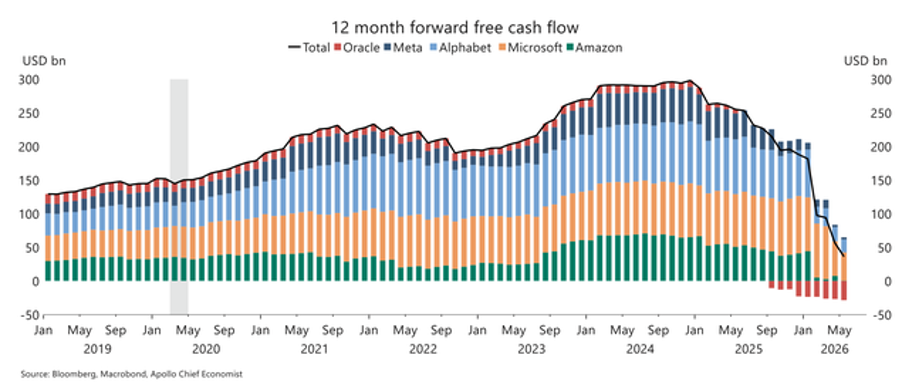 Source: Bloomberg, Macrobond, Apollo Chief Economist
Across the S&P 500, companies returned just 63 per cent of their earnings to shareholders via dividends and net share buybacks over the last twelve months – a low unseen since 2004.
Furthermore, book equity and debt across U.S. public firms increased by US$1.8 trillion and US$1.9 trillion respectively over the past year. In short, corporate balance sheets are becoming significantly more capital-intensive and debt-laden.
That’s a deterioration in quality at the same time that market breadth is slumping and so much of the S&P 500’s support relies on just a handful of companies at the apex of the AI theme.
Best and worst-case AI scenarios
Damodaran has outlined what happens if the actual business payoffs from AI diverge from current market expectations:
|
Scenario |
Accounting impact |
Market & credit consequences |
|
Best case (AI delivers high growth & ROI) |
Amortisation absorbed; incremental profits exceed the cost of capital. |
Builders convert capex into sustained cash flows; debt made whole. |
|
Moderate success / failure |
Partial impairment of assets; returns fall short of hurdle rates. |
Stock prices re-rate downward; cash flows remain under pressure. |
|
Worst case (AI fails to monetize) |
Massive write-offs of AI assets and data centres. |
Equity market carnage, default risks on AI debt, severe loss of trust. |
The stock market will re-price companies long before accountants write down failed assets. Waiting for formal accounting write-offs before selling underperforming AI businesses and bets means waiting far too long.
The AI trade: four options
Investors can’t sit out the AI debate; whether through active portfolios or passive index funds, everyone is exposed.
Damodaran offers four possible strategies:
- Go all-in on AI disruption: Buy the disruptors and short the disrupted, betting on rapid transformation.
- Follow market consensus: Accept current pricing, which assumes AI will create massive, enduring value. This is the path taken by most passive index investors (e.g., S&P 500 funds).
- Be an AI sceptic: Steer new capital away from AI-heavy sectors and toward industries least vulnerable to disruption (such as food processing or leisure) or regions where adoption is slower due to regulation or labour costs (e.g., Europe or developing Asia).
- Crash out (actively short / go to cash): Cash out of U.S. equities or short heavily hyped AI stocks. It’s worth remembering markets can remain irrational longer than short-sellers can remain solvent.
What Damodaran is doing
Damodaran says he’s taking a pragmatic approach designed to pass his ‘sleep test’:
First, he’s maintaining exposure through his long-term holdings in four AI-investing hyperscalers (Amazon, Alphabet, Meta, and Microsoft).
But, for the past year, he has directed almost all new capital into cash and short-term U.S. Treasuries yielding circa 4 per cent. While acknowledging he may be leaving upside on the table, the buffer provides peace of mind in a market priced for perfection.
A special note for younger investors: It’s worth considering the source of your future income. If your primary source of earnings is at risk of AI disruption, you are already significantly exposed to the AI trade. So, your financial portfolio should hedge against that risk by tilting away from AI-exposed assets.
The equity market’s resilience amid 5 per cent+ interest rates rests on an unprecedented surge in AI capital spending. While suppliers are reaping immediate windfall profits, hyperscalers are taking on high capital intensity and debt.
As we’ve noted here many times, during this AI boom and bubble, long-term investors need to balance exposure to the market, but with capital preservation uppermost in mind. Just as Damodaran is pumping inflows into cash, we have suggested diversifying into cash and even a little AA-rated private credit without exposure to property developments.
To discuss our private credit solutions, and whether they might be right for you, give our team a call on (02) 8046 500.
Disclaimer:
You should read the relevant Product Disclosure Statement (PDS) or Information Memorandum (IM) before deciding to acquire any investment products.
Past performance is not a reliable indicator of future performance. Returns are not guaranteed and so the value of an investment may rise or fall.
This information is provided by Montgomery Investment Management Pty Ltd (ACN 139 161 701 | AFSL 354564) (Montgomery) as authorised distributor of the Aura Core Income Fund (ARSN 658 462 652) (Fund). As authorised distributor, Montgomery is entitled to earn distribution fees paid by the investment manager and may be issued equity in the investment manager or entities associated with the investment manager.
The Aura Core Income Fund (ARSN 658 462 652)(Fund) is issued by One Managed Investment Funds Limited (ACN 117 400 987 | AFSL 297042) (OMIFL) as responsible entity for the Fund. Aura Credit Holdings Pty Ltd (ACN 656 261 200) (ACH) is the investment manager of the Fund and operates as a Corporate Authorised Representative (CAR 1297296) of Aura Capital Pty Ltd (ACN 143 700 887 | AFSL 366230).
You should obtain and carefully consider the Product Disclosure Statement (PDS) and Target Market Determination (TMD) for the Aura Core Income Fund before making any decision about whether to acquire or continue to hold an interest in the Fund. Applications for units in the Fund can only be made through the online application form that accompanies the PDS. The PDS, TMD, continuous disclosure notices and relevant application form may be obtained from www.oneinvestment.com.au/auracoreincomefund or from Montgomery.
The Aura Private Credit Income Fund is an unregistered managed investment scheme for wholesale clients only and is issued under an Information Memorandum by Aura Funds Management Pty Ltd (ABN 96 607 158 814, Authorised Representative No. 1233893 of Aura Capital Pty Ltd AFSL No. 366 230, ABN 48 143 700 887).
Any financial product advice given is of a general nature only. The information has been provided without taking into account the investment objectives, financial situation or needs of any particular investor. Therefore, before acting on the information contained in this report you should seek professional advice and consider whether the information is appropriate in light of your objectives, financial situation and needs.
Montgomery, ACH and OMIFL do not guarantee the performance of the Fund, the repayment of any capital or any rate of return. Investing in any financial product is subject to investment risk including possible loss. Past performance is not a reliable indicator of future performance. Information in this report may be based on information provided by third parties that may not have been verified.

Roger Montgomery is the Founder and Chairman of Montgomery Investment Management. Roger has over three decades of experience in funds management and related activities, including equities analysis, equity and derivatives strategy, trading and stockbroking. Prior to establishing Montgomery, Roger held positions at Ord Minnett Jardine Fleming, BT (Australia) Limited and Merrill Lynch.
He is also author of best-selling investment guide-book for the stock market, Value.able – how to value the best stocks and buy them for less than they are worth.
Roger appears regularly on television and radio, and in the press, including ABC radio and TV, The Australian and Ausbiz. View upcoming media appearances.
This post was contributed by a representative of Montgomery Investment Management Pty Limited (AFSL No. 354564). The principal purpose of this post is to provide factual information and not provide financial product advice. Additionally, the information provided is not intended to provide any recommendation or opinion about any financial product. Any commentary and statements of opinion however may contain general advice only that is prepared without taking into account your personal objectives, financial circumstances or needs. Because of this, before acting on any of the information provided, you should always consider its appropriateness in light of your personal objectives, financial circumstances and needs and should consider seeking independent advice from a financial advisor if necessary before making any decisions. This post specifically excludes personal advice.


