

BCA equity outlook review
BCA Research has published its latest equity strategy report authored by Noah Weisberger, Yifei Liu, and Allen Li, titled Cerberus Paribus: The Three-Headed Threat To Equity Valuations (Bonds, Earnings, and IPOs).
BCA’s principal stance on United States equities remains “constructive”, however the report warns about the shifting mechanics driving the market. Specifically, the path toward their S&P 500 8,100 year-end target is transitioning from a regime fuelled by price-to-earnings (P/E) multiple expansion to one increasingly reliant on fundamental earnings growth.
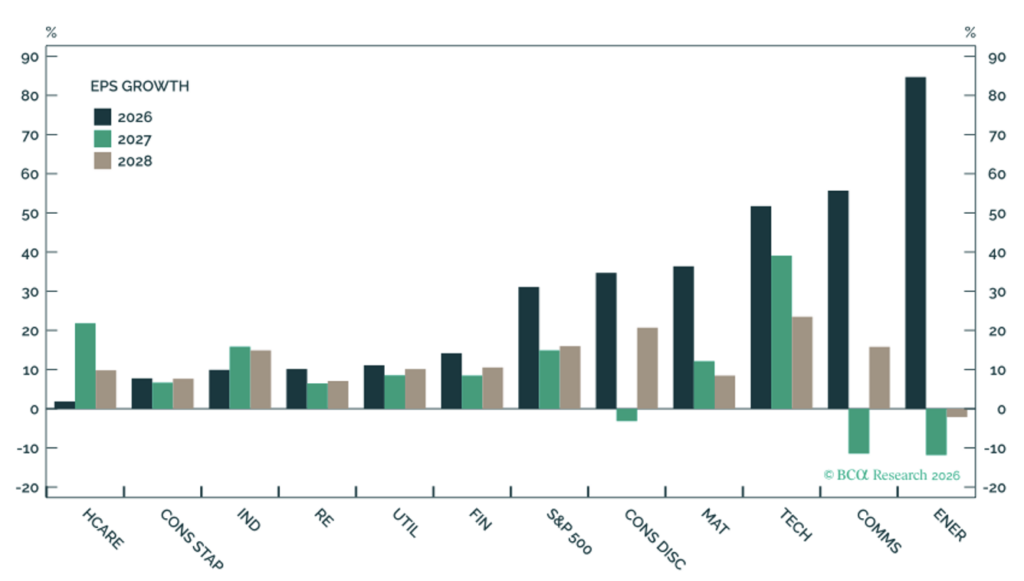
To sustain momentum, equities will have to navigate three headwinds – dubbed the “Cerberus Paribus” (all else being equal) threat – comprising bond market pressures, slowing earnings per share (EPS) growth dynamics, and heavy initial public offering (IPO) issuance.
Figure 1. 2026 EPS growth: big shoes to fill
Source: BCA Research, FACTSET
Bond yields and fixed income pressures
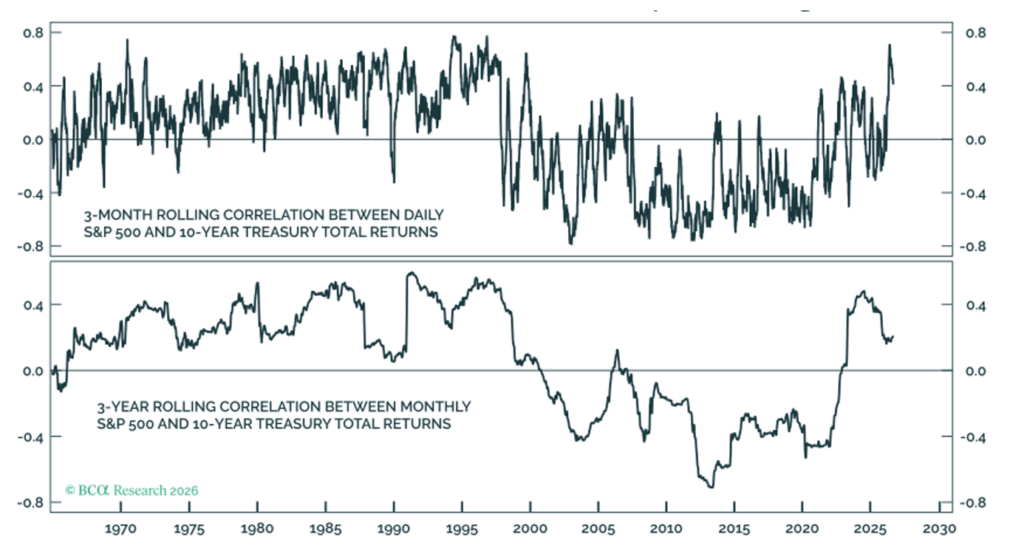
The first major threat BCA identifies is the fixed income market. They explicitly highlight that “bond yields remain the key risk to equity multiples given today’s positive stock/bond correlation regime.”
Historically, bonds and equities were negatively correlated – meaning fixed income served as a reliable portfolio hedge because bond prices rose (yields fell) when stocks fell during economic slowdowns – but this dynamic flipped to a positive correlation in 2022. This regime shift occurred because, in 2022, soaring inflation and aggressive central bank tightening pushed bond yields up (prices down), while higher discount rates and tighter monetary conditions compressed equity valuations, causing both major asset classes to fall in tandem.
Today, as long-term yields climb, fixed income is becoming a formidable competitor for capital and creating putting a lid on equity multiple expansion.
Figure 2. 2022 reverses prior 22 years of negative stock/bond correlations
Source: BCA Research, S&P Global, US Treasury
Earnings and multiple compression
The second threat revolves around earnings momentum and valuation adjustments. BCA believes “higher yields, slower EPS growth and heavy IPO issuance remain significant risks to valuations, leaving the path to their year-end S&P500 target of 8,100 (3.1 per cent higher from current levels) increasingly dependent on earnings.
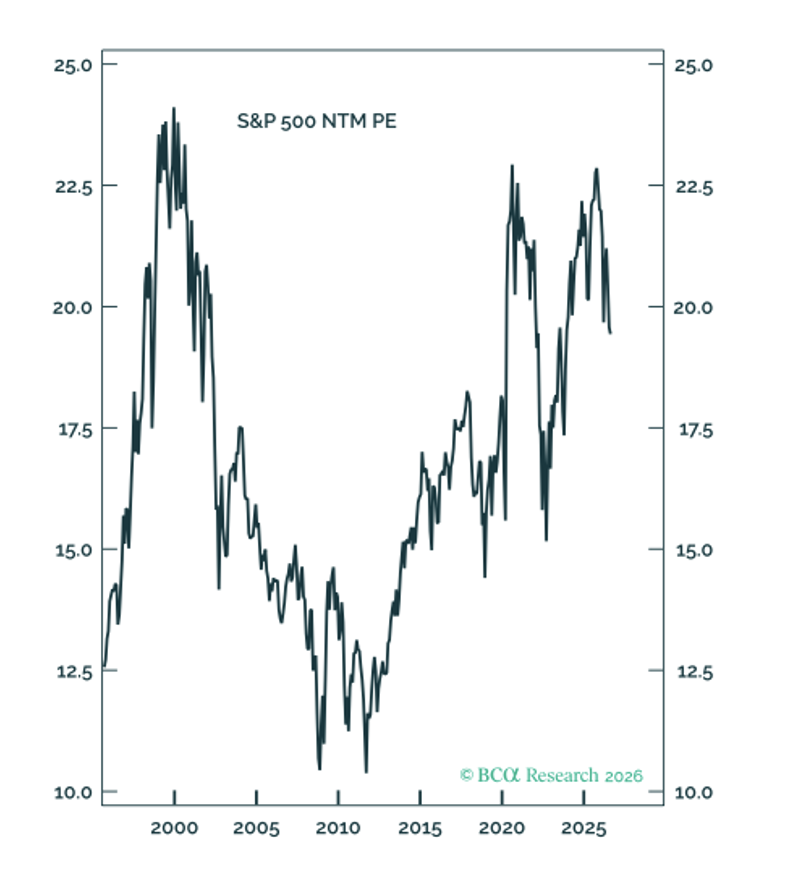
There has already been a significant, but benign, compression in multiples, as earnings have outpaced prices.
Figure 3. The S&P 500 NTM P/E ratio has fallen to 33-month lows
Source: BCA Research, FACTSET
P/E multiple compression is typically viewed by investors with alarm. And that’s because it often corresponds to price falls, such as we saw in 2022, when the S&P 500 fell about 25 per cent.
The recent compression is described by BCA as “benign” because it has occurred organically through robust earnings outperforming price appreciation rather than through destructive price liquidations.
One observation I will make is that BCA seems to have missed the fact that fully a quarter (25 per cent) of the stocks in the S&P 500 are down at least 11 per cent year to date (YTD). Meanwhile, 59 per cent of S&P 500 stocks have fallen at least 20 per cent from their individual 52-week highs, demonstrating how heavily a few AI and chipmaking mega-caps (like Sandisk and Micron) are masking severe under-the-surface weakness in individual sectors.
According to BCA, because multiple expansion has largely exhausted its immediate scope to drive index gains, future market progress must be underwritten by fundamental operational earnings execution. Any stumbles in EPS growth will leave equities vulnerable.
Heavy IPO issuance
BCA notes “heavy IPO issuance remains a significant risk to valuations.” This is because massive primary market listings, like SpaceX, Anthropic, and OpenAI (the latter have been delayed), absorb institutional equity market liquidity and ‘crowds-out’ the opportunity for secondary market equities, and, by extension, the broad market, to be re-rated higher.
Monetary policy, Federal Reserve hikes, and bond volatility
Beyond the core valuation threats discussed, BCA Research believe that “a well-communicated Fed hike could ease rather than intensify bond-market uncertainty.”
Market anxiety often stems from policy ambiguity and fear of the unknown. BCA suggests that if the central bank clearly communicates its trajectory, a rate hike doesn’t automatically spell disaster for risk assets. In fact, BCA’s analysis of historical indicate that equities have successfully navigated past tightening cycles as multiple adjustments absorb initial rate shocks.
Clear central bank signalling helps stabilise term premia and rate volatility, removing the “vibes-based” panic currently afflicting fixed-income traders.
Portfolio takeaways
Despite the report being dominated by a discussion of what could go wrong, BCA holds a constructive posture towards equities and a 8,100 year-end objective for the S&P 500.
They do, however, suggest pivoting portfolio allocations toward high-quality, cash-generative companies capable of compounding earnings independently of multiple expansion.
In the near future, stock prices are likely to be capped by interest rates on bonds – because when bond yields rise, safe investments offer better returns, making riskier stocks less attractive and placing a limit on how high stock prices can go.
Because stocks and bonds are moving together right now rather than offsetting each other, researchers at BCA are keeping a close eye on this relationship to protect portfolios against sudden jumps in interest rates (‘duration shocks’) that could cause both stocks and bonds to drop at the same time.
They also remain cautious around newly issued mega-cap tech IPOs, recognising that heavy primary supply creates near-term valuation headwinds across benchmark indices.
Feel free to reach out if you would like to discuss any aspect of the above with a representative at Montgomery Investment Management. You can reach us on (02) 8046 5000.

Roger Montgomery is the Founder and Chairman of Montgomery Investment Management. Roger has over three decades of experience in funds management and related activities, including equities analysis, equity and derivatives strategy, trading and stockbroking. Prior to establishing Montgomery, Roger held positions at Ord Minnett Jardine Fleming, BT (Australia) Limited and Merrill Lynch.
He is also author of best-selling investment guide-book for the stock market, Value.able – how to value the best stocks and buy them for less than they are worth.
Roger appears regularly on television and radio, and in the press, including ABC radio and TV, The Australian and Ausbiz. View upcoming media appearances.
This post was contributed by a representative of Montgomery Investment Management Pty Limited (AFSL No. 354564). The principal purpose of this post is to provide factual information and not provide financial product advice. Additionally, the information provided is not intended to provide any recommendation or opinion about any financial product. Any commentary and statements of opinion however may contain general advice only that is prepared without taking into account your personal objectives, financial circumstances or needs. Because of this, before acting on any of the information provided, you should always consider its appropriateness in light of your personal objectives, financial circumstances and needs and should consider seeking independent advice from a financial advisor if necessary before making any decisions. This post specifically excludes personal advice.


