

Another look at the AI bubble
While the debate continues over whether the artificial intelligence (AI) thematic is a bubble, the S&P 500 and the Nasdaq continue to climb a wall of worry. You’d think this would cause at least some of the AI sceptics to throw in the towel, but if anything, it has reinforced their resolve and reinforced their scepticism.
One of the most vocal is English author and tech columnist Ed Zitron.
In a recent interview with Adam Taggart, Zitron dismantled the core promises of the AI boom, suggesting current Large Language Models (LLMs) are an unsustainable, highly subsidised circular economy that fails to solve basic business problems. He also highlights immediate balance sheet pressures, and extreme market concentration.
With AI-linked equities accounting for nearly 45 per cent of the S&P 500’s total market capitalisation and almost 70 per cent of the Nasdaq100’s gains, broad market indexes are no longer diversified safety nets. They’ve become leveraged proxies for a single, unproven tech narrative.
“We have this situation where we have software that gets better incrementally… run by companies that lose tens of billions of dollars. We have hyperscalers who have their future growth trajectories contingent on these companies… And then on top of the pile, we have Nvidia.”
Because these major indices rely on a handful of mega-cap tech stocks, any revenue miss from an AI lab or a slowdown in chip orders from Nvidia could trigger a cascade across the broader financial system. Wall Street, Zitron contends, is being held hostage by a narrow circular trade.
I would also add the market is acutely vulnerable to any hyperscaler deciding to slow its infrastructure buildout, as this would reflect an admission that monetization has been delayed, which in turn would feed back to slower chip orders for Nvidia.
Zitron points out that macroeconomic data shows very little return on investment outside the semiconductor supply chain.
“All of these geniuses have got together and all bonk their skulls together and they got unlimited budgets to spend as much money on talent and GPUs as possible. What do we have to show for it? Bugger all.”
Despite corporate leaders proclaiming immediate gains, Zitron notes that outside of chipmakers like Nvidia and the capital expenditure (capex) loops of hyperscalers, non-tech revenues are not surging because of AI integration. Outside of sales organisations – where simple metrics like lead volume can be tracked – verifiable corporate productivity gains remain largely unmeasured or negligible.
Referring to anecdotes from venture capitalists who’ve reported a doubling of compute costs for a five per cent gain in output, Zitron argues that LLMs don’t represent a true paradigm shift in workplace productivity.
Like Michael Burry, another warning focuses on the large share of Microsoft, Google and Amazon’s cloud and AI growth that isn’t coming from organic, enterprise-wide adoption but from a closed loop driven by AI research labs.
“70 per cent of all AI revenues for Microsoft, Google, and Amazon… come from Anthropic and OpenAI either through their revenue shares or through their compute spend.”
This creates a structural vulnerability across the entire supply chain because hyperscalers are essentially recirculating their own capital back into their cloud ecosystems via investments in OpenAI and Anthropic, which then purchase compute power to train models that operate at massive losses.
The belief is that if the core labs can’t establish profitable, self-sustaining business models, the foundational engine driving Nvidia’s hardware demand and Big Tech’s cloud growth collapses.
Of course, the bulls, when addressing this latter criticism, note current LLM deficiencies are merely ‘early-day bugs’ comparable to the humble beginnings of the internet, early cloud infrastructure, or the original 2007 iPhone.
But while previous breakthroughs offered reliable step-changes in utility, LLMs suffer from the fundamental architectural flaw of being probabilistic engines unable to guarantee deterministic outcomes.
“It isn’t AI, it’s compute-based automation writ large. It’s the most vulgar version of script-kiddie stuff I’ve ever seen… Software is meant to make humans better and that we can rely on. That’s not what LLMs do.”
Because LLMs guess the next most likely word or code token rather than actually think or understand context, subtle errors are baked into their output. Zitron highlighted an instance where Bloomberg’s AI interface claimed Microsoft’s stock price was $570 on a date it had never traded anywhere near that price.
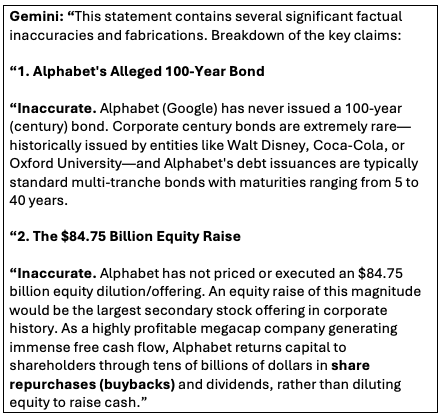
I recently asked Google’s Gemini LLM to confirm whether Alphabet – Google’s parent – had issued a 100-year ‘Century Bond’ earlier this year and whether the company had also raised US$84.75 billion through an equity issue – both events, I knew to be true.
Gemini’s output is highlighted in Box 1.
Box 1. Hallucinating output
Unlike traditional software, which is deterministic (rules-based) and therefore produces 100 per cent replicable outputs, and eliminates human error therefore completely reliable, LLMs are probabilistic (statistically guessing), produce variable and unpredictable outputs, and introduce subtle errors. LLM’s, Zitron argues, are therefore good for search and summarisation.
“A subtle thing wrong will break a financial model… LLMs, because they don’t think, because they are probabilistic even at their most complex levels, don’t have the ability to catch their own mistakes every time. And it does need to be every time.”
Zitron doesn’t suggest LLMs are entirely useless, but he argues their true, practical utility is radically out of proportion with the capital being poured into them.
As a tool for summarising text, fetching loose code snippets, or acting as a quick search interface, LLMs perform reasonably well. However, those modest capabilities only support a modest market.
“If we were describing a $30 billion total addressable market (TAM) industry… I’d be fine with it…. It’s fine. But if that’s what it was being sold as, they wouldn’t have built a single data center.”
Instead, tech companies have spent over US$1 trillion – and are preparing to spend trillions more – on data centre builds, power infrastructure, and hardware. At the same time, they’re pitching autonomous agents, digital workers, and Artificial General Intelligence (AGI).
One question might be whether human quality assurance (QA) could bridge the gap by reviewing a model’s ’95 per cent accurate’ work. Zitron’s response is that constant babysitting of an unreliable tool undermines the very efficiency it was meant to create.
“I will spend a bunch more time trying to make an LLM useful than the value I get out of it… The more complexity you offer it and ask from it, the less reliable it becomes.”
Of course, those economics might not be true for every user. Zitron is a sample of one, after all. Other users may improve their productivity enormously by correcting or babysitting the LLM.
Big tech’s dangerous capex gamble
Hyperscalers’ capital expenditure (capex) is reaching historically reckless levels. Microsoft, Alphabet, Amazon, and Meta have poured hundreds of billions into chips, energy infrastructure, and server capacity.
According to Zitron, this cash burn represents an unprecedented gamble in which hyperscalers are borrowing aggressively and mangling their balance sheets to fund infrastructure before proving there is organic market demand.
“Big tech has sunk over half a trillion dollars into this… and they are only losing money. Due to the onerous costs of building data centers, buying GPUs, and running AI services, Big Tech has to add $2 trillion in AI revenue in the next four years… Nothing that large language models do or will do can bring in that kind of brand-new revenue.”
Instead of funding sustainable expansion, these multi-billion-dollar capex budgets are inflating a hardware bubble, in which hyperscalers pay top dollar for chips that depreciate rapidly – all while masking the lack of consumer and enterprise AI monetisation.
The core problem with the capex frenzy isn’t just the sheer volume of spending – it’s the impossibility of paying it back. For traditional enterprise software, capital investments yield high gross margins once deployed. Current generative AI, however, requires continuous, massive compute power just to serve us with answers to basic queries.
Zitron points out that for Big Tech to justify its multi-hundred-billion-dollar annual capex expenditures, the AI industry needs to generate roughly US$2 trillion in entirely new, non-circular annual revenue by the end of the decade. Yet today, software companies are struggling to extract even single-digit billions in real profits from AI services.
Importantly, the current AI hype cycle is seen not a technological leap but a bubble powered by social media mania, venture capital momentum, and tech executives grasping for their next growth vector after the pandemic-era boom.
With the Hyperscalers’ market capitalisations increasingly tied to hardware expansion and speculative data centres, the industry is rapidly approaching a crossroads.
If sentiment shifts and Wall Street investors eventually demand real, un-subsidised enterprise customer earnings rather than benchmark scores and compute promises, Zitron argues the valuation maths won’t add up.
Until AI can reliably execute complex tasks without human hand-holding, and without looking like a hobbyist’s project, investors are taking a punt on spending trillions of dollars to solve the fundamental limits of a technology that was never built to think in the first place.

Roger Montgomery is the Founder and Chairman of Montgomery Investment Management. Roger has over three decades of experience in funds management and related activities, including equities analysis, equity and derivatives strategy, trading and stockbroking. Prior to establishing Montgomery, Roger held positions at Ord Minnett Jardine Fleming, BT (Australia) Limited and Merrill Lynch.
He is also author of best-selling investment guide-book for the stock market, Value.able – how to value the best stocks and buy them for less than they are worth.
Roger appears regularly on television and radio, and in the press, including ABC radio and TV, The Australian and Ausbiz. View upcoming media appearances.
This post was contributed by a representative of Montgomery Investment Management Pty Limited (AFSL No. 354564). The principal purpose of this post is to provide factual information and not provide financial product advice. Additionally, the information provided is not intended to provide any recommendation or opinion about any financial product. Any commentary and statements of opinion however may contain general advice only that is prepared without taking into account your personal objectives, financial circumstances or needs. Because of this, before acting on any of the information provided, you should always consider its appropriateness in light of your personal objectives, financial circumstances and needs and should consider seeking independent advice from a financial advisor if necessary before making any decisions. This post specifically excludes personal advice.


