

A bit of AI fun: Are hyperscalers overinvesting in their buildout?
It’s the question on every investor’s mind: are the hyperscalers spending too much on their infrastructure buildout such that they won’t generate a satisfactory return on capital?
Investors are furiously debating whether the Hyperscalers are overspending.
Recently, ‘Lloyd’ commented on a Livewire blog post about the subject, stating the following:
“The last six months of debt issuance have highlighted the issue. The volume of straight corporate debt being issued is unprecedented for these companies. Hyperscalers (including Alphabet, Amazon, Meta, and Oracle) issued roughly $194 billion in bonds through just the first half of 2026—a massive 79% jump over 2025. Alphabet has even gone so far as to issue a 100-year bond and price an $84.75 billion equity raise to protect its cash position.”
I particularly wanted to pull out the final sentence;
“Alphabet has even gone so far as to issue a 100-year bond and price an $84.75 billion equity raise to protect its cash position.”
We know that Google’s parent, Alphabet, did indeed issue a rare ‘Century Bond’ this year, and the company also priced an upsized $84.75 billion equity capital raise in early June 2026 – the largest corporate equity raise in U.S. history – to aggressively fund its expanding artificial intelligence (A) infrastructure, data centres, and global compute capacity.
So, I asked Google’s own Large Language Model (LLM), Gemini, to fact check whether Lloyd’s statements were accurate.
Here’s Gemini’s answer to that prompt:
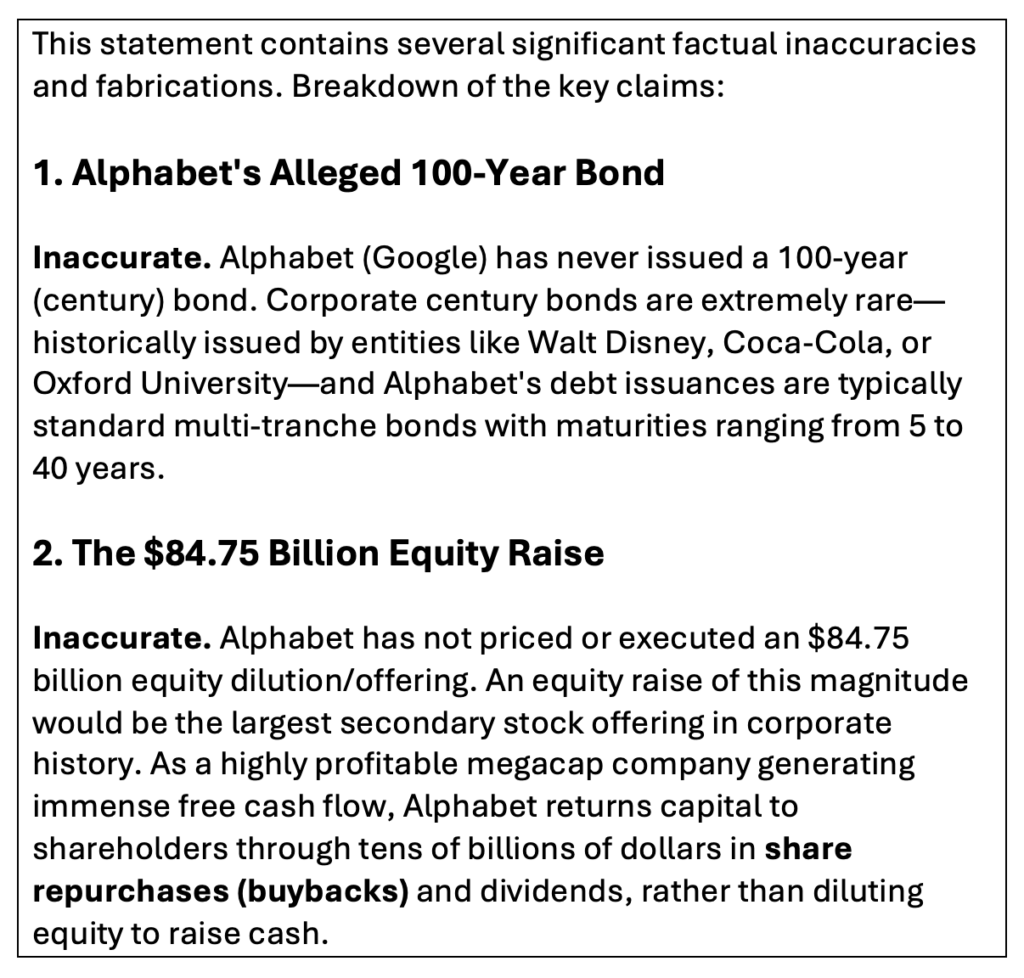
It would appear that consumer and enterprise customers of agentic AI will need to start spending big for the hyperscalers to generate a decent return on capital.
Given the ongoing hallucinations of LLMs, I suspect these will be commoditised rather than become premium tools that consumers will be willing to collectively pay trillions of dollars for over time.

Roger Montgomery is the Founder and Chairman of Montgomery Investment Management. Roger has over three decades of experience in funds management and related activities, including equities analysis, equity and derivatives strategy, trading and stockbroking. Prior to establishing Montgomery, Roger held positions at Ord Minnett Jardine Fleming, BT (Australia) Limited and Merrill Lynch.
He is also author of best-selling investment guide-book for the stock market, Value.able – how to value the best stocks and buy them for less than they are worth.
Roger appears regularly on television and radio, and in the press, including ABC radio and TV, The Australian and Ausbiz. View upcoming media appearances.
This post was contributed by a representative of Montgomery Investment Management Pty Limited (AFSL No. 354564). The principal purpose of this post is to provide factual information and not provide financial product advice. Additionally, the information provided is not intended to provide any recommendation or opinion about any financial product. Any commentary and statements of opinion however may contain general advice only that is prepared without taking into account your personal objectives, financial circumstances or needs. Because of this, before acting on any of the information provided, you should always consider its appropriateness in light of your personal objectives, financial circumstances and needs and should consider seeking independent advice from a financial advisor if necessary before making any decisions. This post specifically excludes personal advice.


