

Potential ground floor opportunity for Magellan investors
Magellan Financial Group’s operating profit for the 2026 financial year (FY26) modestly beat consensus, but the quality of the result was read as weaker, with pressure in investment management and a softer-than-expected contribution from Barrenjoey offset by unusually strong distribution income. Meanwhile, the conference call revealed several additional headwinds that lower the starting point for the 2027 financial year (FY27).
Figure 1. Magellan Financial Group (ASX:MFG) share price: 1/1/2026 to 27/8/26
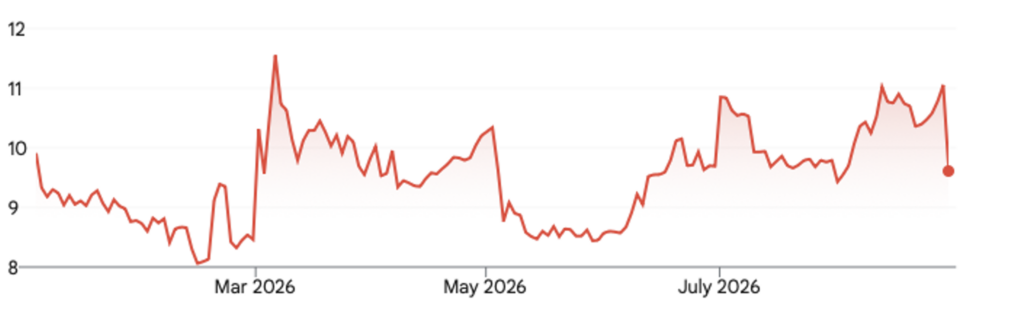 Could this be an opportunity for value investors?
Magellan’s FY26 result is best understood as two stories unfolding at the same time.
The first is the legacy Magellan story: a funds-management business still dealing with the long decline of its global equities franchise, lower funds under management, falling fee margins and weaker investment-management earnings.
The second is the new combined-group story: the addition of investment bank Barrenjoey has created a much broader financial-services business with meaningful earnings from financial markets, corporate finance and private capital, reducing the group’s reliance on traditional funds management.
For investors, this distinction is important.
The $145 million operating profit after tax tells us how the old Magellan business performed in FY26, while the $215 million pro-forma operating profit gives a better sense of the earnings scale of the business shareholders now own.
The investment question is no longer simply whether Magellan can stop losing funds under management; it is whether Barrenjoey’s growth and diversification can more than offset the continuing decline in the economics of the legacy investment-management business.
Magellan reported three different profit figures, because FY26 straddled the merger with Barrenjoey.
At the risk of belabouring the point, the simplest way to think about it is this:
$145 million was the underlying operating profit after tax earned by the old Magellan business on a standalone basis during FY26. This excludes some accounting and one-off items and is therefore the cleaner measure of how the existing Magellan business performed operationally.
$88 million was Magellan’s statutory net profit. This number is much lower because it includes items such as the $38 million negative fair-value movement on fund investments and $11 million of merger-related costs. In other words, statutory profit includes accounting movements and transaction costs that operating profit strips out.
$112 million was Barrenjoey’s separate operating profit after tax for FY26. Barrenjoey was not yet legally part of Magellan during the financial year – the merger completed on 1 July 2026 – so its FY26 earnings were reported separately.
Finally, Magellan showed investors what the business would have looked like if it had been combined with Barrenjoey for the whole year. On that pro-forma basis, the merged group generated $215 million of operating profit after tax. This is not simply $145 million plus $112 million, because some revenues and profits between the two businesses have to be eliminated to avoid double counting.
The summary is:
$145 million = old Magellan underlying profit
$112 million = Barrenjoey underlying profit
$215 million = what the combined group would have earned on a full-year pro-forma basis
$88 million = Magellan’s statutory accounting profit
For investors trying to value the company today, however, the $215 million is probably the more relevant starting point, because the company now owns Barrenjoey. The catch – and this is what the analyst Q&A exposed – is that you cannot simply assume $215 million repeats in FY27.
There are several known earnings headwinds, including lower investment-management fees, lower opening funds under management, reduced returns from Magellan’s investment portfolio, higher share-plan amortisation and New Zealand establishment costs. That is why the FY26 headline numbers looked respectable while the market focused much more heavily on the weaker FY27 starting point.
The distinction matters because investors are ultimately interested not in how FY26 finished, but in the earnings base from which FY27 begins.
Old Magellan still under pressure
Standalone Magellan revenue declined 11 per cent to $291 million and, as reported above, operating profit after tax fell nine per cent to $145 million.
Statutory net profit after tax (NPAT) fell much more sharply, down 47 per cent to $88 million, partly reflecting the $38 million negative fair-value movement on fund investments and $11 million of merger-related costs.
More significant for future earnings was the continuing deterioration in investment-management economics.
Investment-management revenue fell 21 per cent, or $53 million, as net outflows reached $3.3 billion. Magellan Global Equities recorded $4.2 billion of net redemptions, almost 90 per cent of which came from relatively high-margin retail products.
Airlie Funds Management, Magellan’s Australian equities business, and Vinva Investment Management (Vinva), an equities manager in which Magellan holds a minority stake, together attracted $1.5 billion of inflows, but this was insufficient to offset the erosion of Magellan’s historically most profitable pool of assets.
The effect on margins has been dramatic. Average management fees declined from 61 basis points to 52 basis points during FY26. Importantly, however, 52 basis points is not the appropriate number for forecasting FY27. The Heritage Global Equity Funds were repriced and transitioned to Vinva only late in the year, meaning the full impact was barely visible in FY26. Management said the exit fee margin was approximately 42 basis points.
That is arguably one of the most important numbers in the entire result.
The restructuring of the Heritage Global Equity Funds, involved transferring $4.9 billion to Vinva and reducing fees by 55 basis points. Management estimates the full-year impact at approximately $21 million after tax, partially offset by approximately $5 million in after-tax cost savings. The arrangement changes the product’s economics from a relatively fixed internal cost base to one that is much more variable across assets.
That is strategically sensible. But it doesn’t eliminate the revenue loss.
On the analyst call, Macquarie equity analyst, Elizabeth Miliatis, suggested the investment-management business could be generating little profit in perhaps 12 months. Management emphasised that transitioning the funds to Vinva makes the cost base more scalable. They also acknowledged the history of the global equities franchise: assets that once peaked around $88 billion are now “in the fours”.
Of course, whether the runoff finally stabilises is ultimately a decision for clients, not management. And clients may be driven by considerations beyond relative performance metrics or ‘alpha’.
The FY27 bridge
Perhaps a more revealing exchange on the call came when JP Morgan asked exactly what was – and was not – included in management’s FY27 earnings bridge.
Magellan Chief Financial Officer, Gavin Buchanan confirmed that the disclosed headwinds do not include the lower starting level of funds under management. Average FY26 assets under management (AUM) were $39.1 billion, but Magellan exited June 26 at just $36.7 billion. Analysts therefore need to incorporate that lower starting point separately.
Certain legacy arrangements included in FY26 also disappear following the merger, which means investors can’t simply take the combined FY26 pro forma earnings figure and deduct the explicitly identified restructuring costs.
First is the approximately $16 million net after-tax effect from repricing the Heritage funds after allowing for cost savings.
Second is the decision to de-risk Magellan’s investment portfolio. The group redeemed approximately $251 million from Magellan funds, retaining $118 million as strategic seed capital and moving the balance progressively into cash and high-quality liquid fixed income.
Management estimates this will reduce annual after-tax earnings by approximately $17 million relative to FY26. During questioning, Buchanan explained the arithmetic: the company is effectively comparing roughly $40 million of FY26 fund-investment returns with the return on an assumed average $350 million cash balance earning around 4.5 per cent.
Third, legacy employee share-plan amortisation is expected to increase from around $18 million after tax in FY26 to approximately $20 million in FY27. It should subsequently decline by around $4 million annually and disappear within roughly five years.
Fourth, Barrenjoey’s New Zealand expansion will cost approximately $5-$10 million in FY27 before meaningful revenue arrives. Management described FY27 as the establishment year, FY28 as commencement and FY29 as the point at which benefits should become visible.
Against these pressures are merger synergies – principally technology and supplier harmonisation. The conference call reiterated the previously identified $6 million pre-tax synergy target, while the post-call guidance notes supplied with the result put the figure at $7 million pre-tax. Either way, management made clear this was never primarily a cost-cutting merger because the businesses are complementary rather than heavily overlapping.
Sub-advisory fees are also expected to approximately double, implying around $22.4 million against brokers’ previous forecasts of $18 million, adding another drag to investment-management economics.
Barrenjoey is the growth engine
The strategic attraction of the merger remains Barrenjoey.
For FY26, Barrenjoey generated $573 million of revenue, up 34 per cent, while operating profit after tax rose 68 per cent to $112 million. Return on equity approached 33 per cent, versus 24 per cent two years earlier, while the cost-to-income ratio fell materially as the business has scaled. Financial-markets revenue increased 40 per cent and corporate-finance revenue rose 20 per cent.
Yet the second-half numbers were softer relative to some analyst expectations. UBS estimates Barrenjoey profit at $53.7 million on a 100 per cent basis, around 12 per cent below its $61 million forecast. Second-half revenue declined around six per cent half-on-half, although the comparison with the first half is distorted by a $22 million private-capital performance fee boost generated from the investment in Guzman y Gomez (ASX: GYG), the Australian-founded fast-food restaurant group.
The Financial Markets division remained the standout, with revenue up 32 per cent on the prior corresponding period and six per cent half-on-half, while corporate finance grew 15 per cent year-on-year but slipped one per cent sequentially. The cost-to-income ratio nevertheless improved to 71.3 per cent from 73.3 per cent.
Q&A
Management argued the combination of equities and fixed income creates a natural diversification effect. Equity activity weakened in the second half, partly amid Middle East uncertainty, whereas fixed-income activity benefited from volatility as clients repositioned bond portfolios.
There are also genuine growth options. Barrenjoey has received its U.S. swap-dealer licence and has begun executing transactions, although revenue will build only gradually as clients are onboarded. Offshore expansion into Abu Dhabi, Hong Kong and New York is not an attempt to build unrelated international franchises; management stressed these offices are principally distribution channels for Australian-dollar products.
Private Capital may be another important growth avenue. Barrenjoey has built approximately $5 billion of AUM, initially through closed-ended, single-asset structures, and is now expanding into open-ended vehicles.
The Barrenjoey Asset Backed Income Fund and First Ag Credit Fund are early examples of what management clearly hopes will become a much larger business using Magellan’s established distribution network.
A better business. What’s it worth?
To most experienced investment professionals, the merger unquestionably improves Magellan’s strategic position. The combined group is more diversified, Barrenjoey has demonstrated attractive growth and high returns on equity, private markets offer a credible new distribution opportunity, and the balance sheet remains substantial.
Management indicated approximately $1.1 billion of net assets following completion of the transaction, while clarifying that the $611 million capital number discussed in the presentation represented working capital circulating through Barrenjoey rather than surplus net tangible assets (NTA).
Shareholders should also receive significant cash returns. The FY26 second-half dividend is 25.5 cents fully franked, and the new policy targets a payout of 60-90 per cent of operating profit after tax. Management expects the payout to remain at the upper end of that range in the short- to medium-term.
But FY27 is clearly a transition year, and the market now has to absorb a 42-basis-point investment-management fee run rate, lower opening AUM, rising sub-advisory costs, reduced investment income, New Zealand establishment expenditure and elevated share-plan amortisation.
Meanwhile, Barrenjoey – which increasingly carries the growth expectations of the combined group – delivered a softer second half than analysts had anticipated. But investors must be mindful not to underestimate the talent and determination of Barrenjoey’s founders and staff to succeed.
The investment case is not that Magellan is a turnaround story or a wager on stopping global-equities outflows. The group is becoming a diversified financial-services business whose value will depend on whether Barrenjoey can continue to compound revenue, extend its fixed-income and corporate-finance franchises and use Magellan’s distribution network to build a meaningful investment-management business around private capital and new listed products.
That may ultimately prove a much better, more resilient and larger business.
The FY26 result, however, and, in particular, the analyst questioning that followed it make it clear that the earnings starting point for the journey is lower than the headline profit beat initially suggests.

Roger Montgomery is the Founder and Chairman of Montgomery Investment Management. Roger has over three decades of experience in funds management and related activities, including equities analysis, equity and derivatives strategy, trading and stockbroking. Prior to establishing Montgomery, Roger held positions at Ord Minnett Jardine Fleming, BT (Australia) Limited and Merrill Lynch.
He is also author of best-selling investment guide-book for the stock market, Value.able – how to value the best stocks and buy them for less than they are worth.
Roger appears regularly on television and radio, and in the press, including ABC radio and TV, The Australian and Ausbiz. View upcoming media appearances.
This post was contributed by a representative of Montgomery Investment Management Pty Limited (AFSL No. 354564). The principal purpose of this post is to provide factual information and not provide financial product advice. Additionally, the information provided is not intended to provide any recommendation or opinion about any financial product. Any commentary and statements of opinion however may contain general advice only that is prepared without taking into account your personal objectives, financial circumstances or needs. Because of this, before acting on any of the information provided, you should always consider its appropriateness in light of your personal objectives, financial circumstances and needs and should consider seeking independent advice from a financial advisor if necessary before making any decisions. This post specifically excludes personal advice.


