

Insights from the latest ANZ-Roy Morgan Australian Consumer Confidence survey
When investors are confident, greater risk is taken, greater debt levels are serviced, and greater liquidity is prevalent. And the opposite is also true. The response to a loss of confidence is to reduce risk, pay down debt, and “batten down the hatches”. Liquidity can quickly get tight.
When the ANZ-Roy Morgan Australian Consumer Confidence survey for the week to Sunday 22 March 2026 was released, I thought it was worth highlighting, given consumer confidence fell to its lowest level since records began in 1973 (1).
Apart from the COVID-19-related period in late March 2020, what sets the latest survey apart is:
1. The Reserve Bank of Australia (RBA) had just pushed the cash rate up twice in two months, by 0.25 per cent to 3.85 per cent on 4 February 2026 and subsequently to 4.10 per cent on 18 March 2026. In addition, there are concerns around a third RBA rate increase of 0.25 per cent to 4.35 per cent in May 2026.
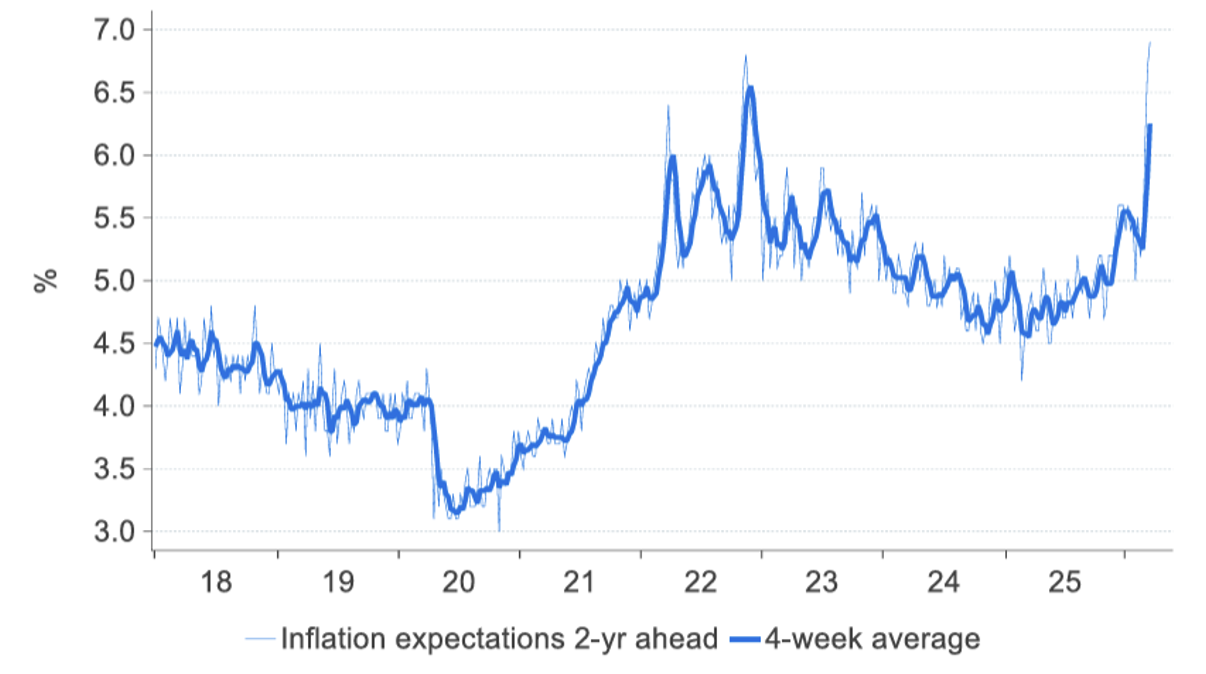
2. The Consumer Price Index (CPI) was running at 3.8 per cent annually to January 2026, and with the war-induced dramatic jump in the price of fuel and other oil-related commodities, the survey’s “weekly inflation expectations” hit 6.9 per cent, the highest level for decades.
Figure 1. Weekly inflation expectations’ rose 0.2ppt to 6.9 per cent
Source: ANZ-Roy Morgan, Macrobond, ANZ Research
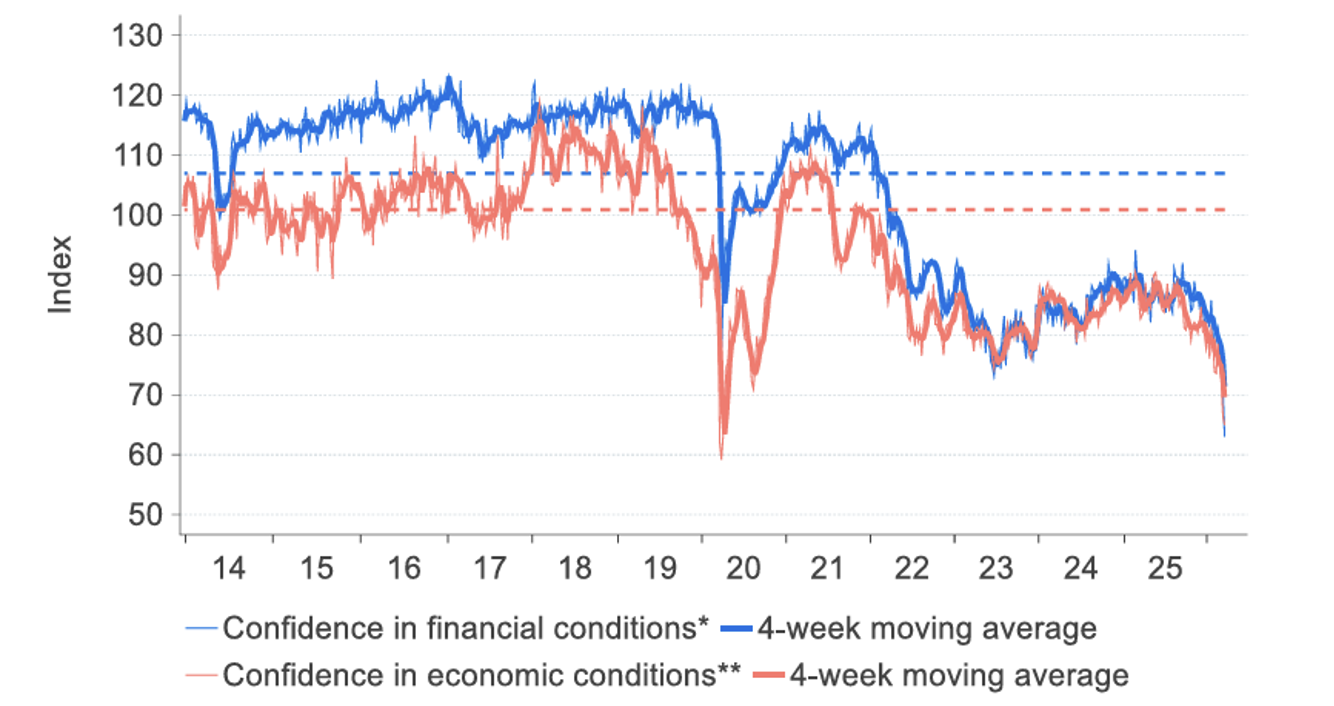
3. “Future financial conditions” decreased 9.0 points to 69.2, a multi-decade low.
Figure 2. Confidence in financial and economic conditions weakened
Source: ANZ-Roy Morgan, Macrobond, ANZ Research
*Financial conditions index is an average of ‘financial situation compared to a year ago’ and ‘financial situation next year’ subindices. **Economic conditions index is the average of the ‘economic conditions in 12 months’ and ‘economic conditions in five years’ subindices.
For example, according to online real estate platform Domain.com.au (2), there were 2,522 residential auctions reported in Australia’s major capital cities last week, and 1,093 or 43 per cent of these were either “withdrawn” or “passed in”.
Let’s not forget the maximum negativity from COVID-19 provided a wonderful buying opportunity. The outlook for the price of fuel and in turn inflationary expectations needs to be closely gauged before we see a sustainable bounce in future “confidence surveys”.
Sources:
(1) ANZ-Roy Morgan Australian Consumer Confidence Survey, week ending 22 March 2026
(2) Domain Group auction results

Chief Executive Officer of Montgomery Investment Management, David Buckland has over 40 years of industry experience.
David is a deeply knowledgeable and highly experienced financial services executive. Prior to joining Montgomery in 2012, David was CEO and Executive Director of Hunter Hall for 11 years, as well as a Director at JP Morgan in Sydney and London for eight years.
This post was contributed by a representative of Montgomery Investment Management Pty Limited (AFSL No. 354564). The principal purpose of this post is to provide factual information and not provide financial product advice. Additionally, the information provided is not intended to provide any recommendation or opinion about any financial product. Any commentary and statements of opinion however may contain general advice only that is prepared without taking into account your personal objectives, financial circumstances or needs. Because of this, before acting on any of the information provided, you should always consider its appropriateness in light of your personal objectives, financial circumstances and needs and should consider seeking independent advice from a financial advisor if necessary before making any decisions. This post specifically excludes personal advice.


