
Go Harvey Go
Harvey Norman Financial Year 2026 (FY26) results: Australian squeeze, overseas drag, and what it signals for the broader economy
Harvey Norman Holdings (ASX: HVN) released its FY26 full-year financial results and early FY27 trading update. While property revaluations boosted top-line profit, the underlying retail and franchising operations reflect the well-documented challenges in the domestic consumer environment, as well as overseas operational challenges.
Market expectations were high coming into the announcement, so the earnings miss across Australian franchising and the escalating losses in the UK have pressured the stock.
Retail compression masked by property
Harvey Norman’s group profit metrics benefited from accounting. Pre-tax profit (PBT) reached A$334 million in the property division (or A$177 million, up 5.7 per cent, excluding net property revaluations). This surge in property revaluations allowed reported numbers to beat consensus expectations in some areas.
Looking past property adjustments, however, into the core operational engine tells a different story:
Australian franchising operations
Aggregate franchisee sales came in at A$6.58 billion (+2.4 per cent), trailing consensus expectations of $6.62 billion. PBT for Australian franchising was A$345 million (+0.2 per cent), also missing consensus of A$365 million. Franchising margins contracted by 12 basis points to 5.24 per cent, reflecting persistent second-half margin pressure on domestic franchisees.
International retail
New Zealand: Delivered strong PBT of A$85 million (+31.2 per cent), easily outperforming expectations of circa A$73 million.
Ireland: Earned A$31 million (+36.2 per cent), beating estimates of A$28 million.
Singapore & Malaysia: Combined PBT of A$45 million (+8.3 per cent).
Slovenia & Croatia: Contributed A$6.1 million (+38.8 per cent).
United Kingdom: Was the major drag, reporting a PBT loss of -A$31 million. This was significantly worse than expectations of a A$20 to $25 million loss. The loss was also much larger than FY25’s $23.3 million loss and was explained by ongoing establishment costs including a head office function as well as soft trading conditions. HVN will wait until the first store is profitable before scaling up.
As an aside, Harvey Norman’s UK experience contrasts materially with Nick Scali’s move there via the acquisition of the loss-making Fabb Furniture. Nick Scali Limited’s (ASX: NCK) FY26 full-year results and subsequent trading update revealed United Kingdom operations are experiencing a strong operational turnaround and return to profitability. While the retailer is investing heavily in store refurbishment, which causes disruption, momentum surged significantly in the second half and into early FY27
Harvey Norman’s operating cash flow dropped to A$537 million, well below forecasts of A$738 million, and drove net debt up sharply to A$941 million compared to A$659 million in the prior corresponding period (PCP) and consensus estimates of A$691 million.
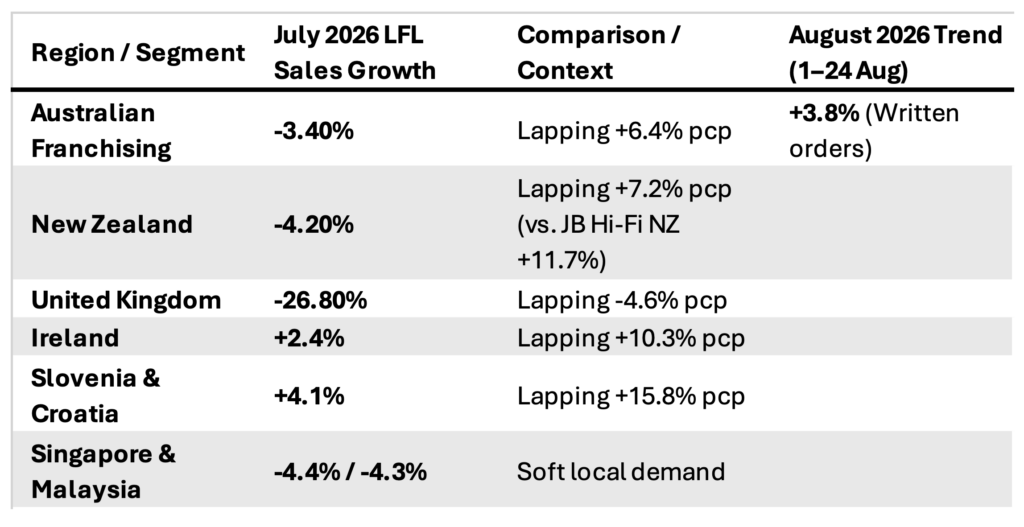
Table 1. Trading update (Australia): July slump vs. August rebound
Product launch timing shift
The steep -3.4 per cent drop in Australian July sales was noticeably weaker than peers (The Good Guys at -1.7 per cent, Nick Scali flat, JB Hi-Fi Australia at -1.4 per cent). Management directed investors to a change in the release date of the flagship Samsung Galaxy Fold phone to August. Presumably this also impacts JB Hi-Fi, and yet they still performed better.
This explanation, however, aligns with the rebound in written sales for August 1–24 (+3.8 per cent), signalling that tech upgrade cycles remain intact, even if discretionary timing fluctuates month to month.
The Aussie consumer
Because Harvey Norman’s product mix spans big-ticket furniture, bedding, whitegoods, and consumer electronics, its trading updates are seen as a proxy for broad Australian household financial health.
Negative LFL sales in Australia demonstrate consumers are exercising caution on large-ticket discretionary purchases. Persistent cost-of-living pressures and high interest rates continue to strain household cash flows.
Furniture and home appliance turnover closely mirrors housing market liquidity. Softness in HVN’s domestic franchise margins points to minimal turnover in housing-related retail, forcing retailers to trade on tighter margins to move inventory.
Finally, the pivot from negative July sales to positive August order growth highlights a divided consumer mindset: households hold back on standard replacement buying but remain willing to spend on status-signalling tech upgrades.
Summary
Broader broker valuations (such as Barrenjoey’s DCF/SOTP valuation of A$5.15) remain intact due to the underlying buffer of Harvey Norman’s property portfolio. However, near-term share price performance could face pressure. Until UK retail expansion losses are contained and Australian franchising margins stabilise, investors are likely to treat short-term or month-to-month sales changes, even positive ones, with caution.
The Montgomery Small Companies Fund owns shares in Nick Scali. This article was prepared 4 September 2026 with the information we have today, and our view may change. It does not constitute formal advice or professional investment advice. If you wish to trade Nick Scali, you should seek financial advice.

Roger Montgomery is the Founder and Chairman of Montgomery Investment Management. Roger has over three decades of experience in funds management and related activities, including equities analysis, equity and derivatives strategy, trading and stockbroking. Prior to establishing Montgomery, Roger held positions at Ord Minnett Jardine Fleming, BT (Australia) Limited and Merrill Lynch.
He is also author of best-selling investment guide-book for the stock market, Value.able – how to value the best stocks and buy them for less than they are worth.
Roger appears regularly on television and radio, and in the press, including ABC radio and TV, The Australian and Ausbiz. View upcoming media appearances.
This post was contributed by a representative of Montgomery Investment Management Pty Limited (AFSL No. 354564). The principal purpose of this post is to provide factual information and not provide financial product advice. Additionally, the information provided is not intended to provide any recommendation or opinion about any financial product. Any commentary and statements of opinion however may contain general advice only that is prepared without taking into account your personal objectives, financial circumstances or needs. Because of this, before acting on any of the information provided, you should always consider its appropriateness in light of your personal objectives, financial circumstances and needs and should consider seeking independent advice from a financial advisor if necessary before making any decisions. This post specifically excludes personal advice.


