

‘Malum Australiae’
There is an old political adage that if you want to understand a government’s true philosophy, don’t look at its speeches, look at its accounts.
Under Labor, Australians have been treated to a masterful exercise in political misdirection. The old ‘bait-and-switch.’
On one hand, the government trumpets marginal, highly structured tax cuts – like the Working Australians Tax Offset (WATO) – to soothe voters battered by cost-of-living pressures. On the other hand, a quieter but more profound structural shift is taking place across the Australian economy.
It may sound extreme and even alarmist, but federal Labor’s economic model is built entirely on a singular, stubborn premise: the wealth generated by the private sector is nothing more than uncollected revenue waiting to be harvested by the state.
Through a combination of bracket creep, regulatory interventions, and targeted tax overhauls, the Labor government has perfected a form of ‘stealth socialism’ – a quiet redistribution of capital away from individuals and businesses who take risks, innovate new products and services, grow businesses and employ people, toward a sprawling, self-perpetuating public apparatus.
When it comes to Labor’s approach to managing finances, the economy and the public sector, it is, as my friend and fellow observer Chris Joye noted recently in an interview;
“These guys are just [lying] because they ultimately just want to claim more power by controlling more and more of the economy and putting larger and larger parts of the economy under the remit of the public service and paying themselves more money.”
Indeed, Chris Joye was onto something. This lesser-known Margaret Thatcher quote from her 1992 comments about Labour governments, captures what the 2026 Australian federal budget caused all Australians to realise:
“The fact is Labour are still socialists and they deliberately set out to impose more government control over people’s lives. That is where their whole belief starts. It starts with the power of government over the lives of the people. That is why, that is the reason why they increase taxation. More power for them over our money, less power for the citizen. That is why they multiply controls and bureaucracy. More power for them, less for the wealth creators of our country. That is why they like nationalisation, more control over industry…That is why they want more council housing, because they want to have more control over the lives of the housing of the people and to use it for political purposes.”
And on Thatcher’s last point, anyone seen a Labor Party wanting to build more apartments in Sydney’s eastern suburbs and North Shore, or in Melbourne’s Brighton East?
The underlying math of this strategy is simple, even if its execution is masked. To fund a
vision of society where the government acts as the primary economic arbiter, the state must expand. But because voters naturally recoil from overt, blanket tax hikes, revenue must be extracted indirectly. The consequence? A massive transfer of human and financial resources out of the productive private sector and straight into the waiting arms of bureaucracy.
Canberra booms
While small businesses struggle to keep people employed and keep the lights on amid high energy costs and increasingly complex industrial relations laws and compliance requirements, there remains one sector that’s booming, as Margaret Thatcher predicted it would: the public service.
Depending on who you ask, Australia’s public sector is as rotund as Augustus Gloop.
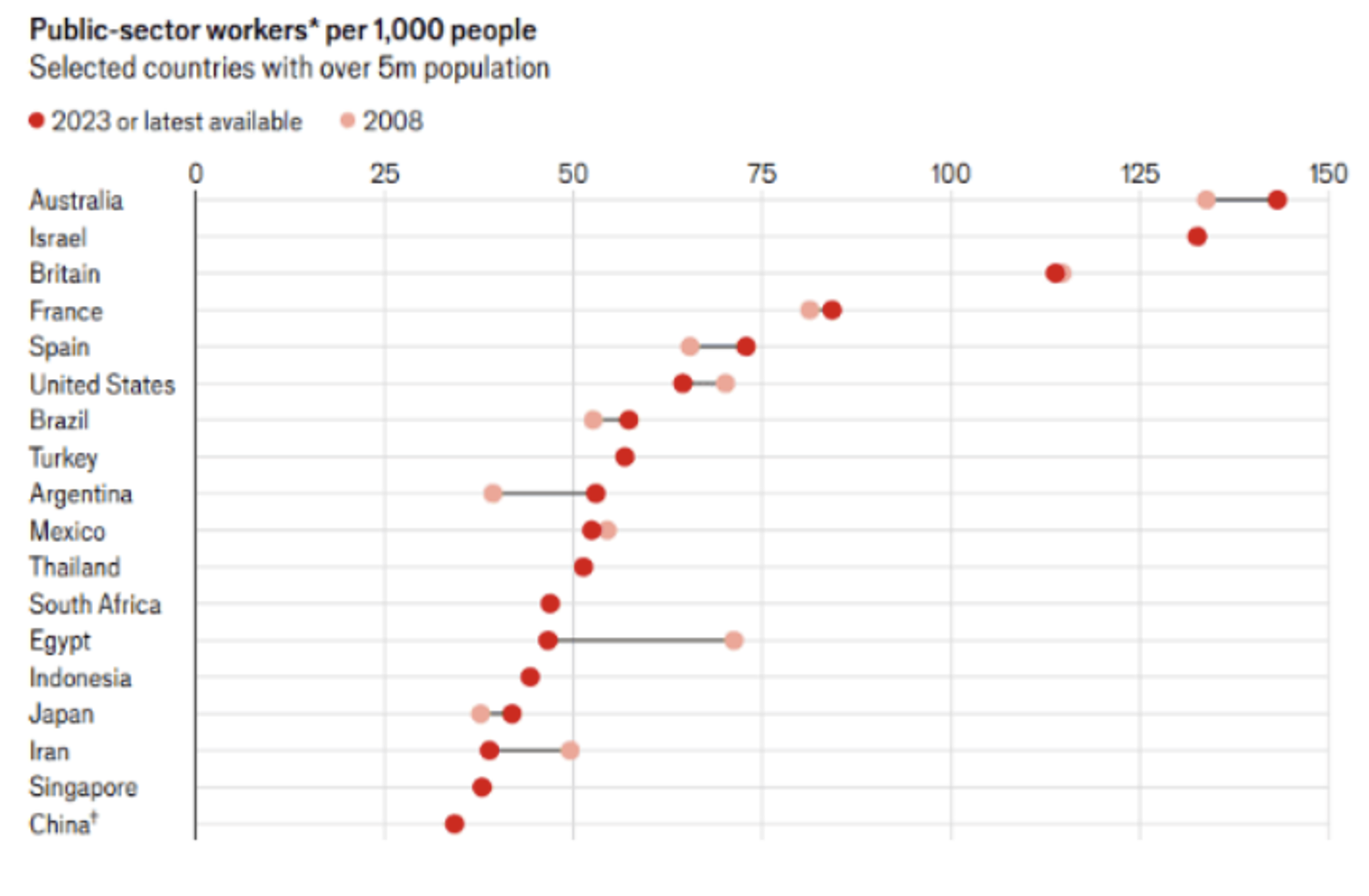
According to the Economist, whose data includes all government institutions, state-owned enterprises with more than 50 per cent government ownership and government-controlled non-profit institutions, Australia leads the world in government employees (Figure 1.) with 143 public sector employees per 1,000 people or about 29 per cent of all workers, placing it among the largest public sector workforces in the world.
Figure 1. Australia, the outlier.
Source: The Economist, International Labour Organisation
According to the Organisation for Economic Co-operation and Development (OECD), 2,257,700 people, or 15.7 per cent of the workforce, were employed in all levels of government (federal, state and local). That’s roughly 85 public sector employees per 1,000 people. That would still put Australia at the top of the Economist’s chart in Figure 1.
And finally, according to data released by the Australian Bureau of Statistics (ABS) tracking public sector employment through the 2024–25 financial year, the total public sector workforce across all levels of government reached a staggering 2.59 million employees and includes 768,300 public primary/secondary school teachers, TAFE instructors, and university staff, 668,700 public hospital nurses, doctors, midwives, and paramedics, and 880,600 jobs federal/state desk bureaucrats, as well as frontline safety personnel like police officers, firefighters, and correctional services.
Nevertheless, a government employs 18 per cent of Australia’s workforce.
To put this expansion into perspective, consider the pace of its growth. The public sector expanded by roughly 3.26 per cent over the 2025 financial year alone, growing at more than double the rate of Australia’s population growth, which hovered around 1.60 per cent.
Writing on this phenomenon, Dr Kevin You, a Senior Research Fellow at the Institute of Public Affairs (IPA), observed a troubling economic correlation:
“It is not a coincidence that the growth of the public sector has occurred hand-in-hand with the collapse and stagnation in Australia’s economic productivity and per capita economic growth. Australia’s economy is increasingly becoming dominated by the public sector.”
When a nation’s main growth industry is its own management, the long-term outlook for genuine innovation is grim.
The Federal Australian Public Service (APS) headcount alone sat at 198,529 ongoing and non-ongoing workers by mid-2025. This massive recruitment drive has created a severe ‘crowd-out’ effect.
Private companies, from tech startups to local manufacturers and home builders, must compete with a government treasury that can offer premium, taxpayer-funded salaries, iron-clad job security, soft work conditions and easy hours with nine-day fortnights, Rostered Days Off (RDOs), mental health days, a day in lieu if your RDO falls on a public holiday and blocks of RDOs bundled with public holidays for a week or two of continuous paid leave. IPA research suggests that when comparing full-time adult positions, public sector workers earn roughly 10 per cent more on average than their private sector counterparts.
But where does all the money come from? It’s the private sector that is asked to fund the very entity that is competing with it and pricing it out of the labour market.
Wealth extracted via the fine print
To sustain this heavy, unproductive machinery, the government requires an endless stream of capital. Because Labor’s headline policy remains focused on providing minor, staged adjustments to low and middle-income tax thresholds – such as dropping the 16 per cent rate down to 15 per cent – they maintain a thin veneer of being a low-tax government.
But the wealth extraction under Labor happens via the fine print.
Most recently, Labor has targeted the structural pillars of private wealth generation. Modifications to negative gearing allowances and capital gains tax (CGT) concessions systematically erode the primary avenues everyday Australians use to build independent wealth outside of state-controlled pension schemes.
By altering these tax settings, the government effectively caps the upward mobility of property investors and independent entrepreneurs, forcing more capital into state-vetted investments or directly back into the pay as you go (PAYG) tax pool.
Simultaneously, the private sector is being choked by a massive compliance burden. The IPA notes the federal government is on track to employ more than 107,000 personnel in purely regulatory roles.
This is where the concept of ‘stealth socialism’ is writ largest. It’s not an overt nationalisation of factories or mines. Instead, it’s the creation of a system in which the private sector bears all the risk, while the state extracts an ever-increasing share of the reward through compliance, altered concessions, and unadjusted tax brackets that fail to account for inflation (unlike their new CGT rules).
Again, it may initially seem like an exaggeration, but businesses are being transformed into administrative branches of the state, spending less time innovating and more time filling out forms for the 107,000 regulators watching over their shoulders.
The productivity penalty
The natural casualty of an economy designed this way is productivity. True wealth is generated when labour and capital are deployed efficiently to create new goods, services, and technologies. The public service, by its very design, is a consumer of wealth, not a generator of it.
When nearly one-fifth of the workforce is tied up in government administration, national productivity inevitably plummets. Every dollar taxed away from a private enterprise to fund a departmental expansion in Canberra is a dollar that can’t be spent on research and development, machinery upgrades, or expanding a business’s footprint.
Furthermore, the domestic market is left with a deep structural imbalance. The private sector has to operate under market rules – if a business fails to deliver value, it goes broke.
The public sector, however, operates under no such constraints; when a government program underperforms, the typical government department response is to demand a larger budget and hire more staff to fix it.
As one commenter on our social media channel noted: Labour In, Money Out.
Indeed, as the Commonwealth Bank noted in response to the 2026 Federal Budget, “In the 2026–27 Federal Budget, Treasury projected that productivity growth will remain structurally challenged, forecasting it will take approximately 5 years to return to its long-term average rate of 1.2 per cent. This reflects a downgrade from previous forecasts, with expectations that the historic 1.2 per cent long-term target will not be reached until the early 2030s.”
“Tax and Take, From Those Who Generate”
Australia’s current economic path is fundamentally and intrinsically unsustainable. No nation can tax itself into prosperity, nor can it build a resilient future by prioritising the growth of the bureaucracy over the growth of existing and new markets.
According to some, if not many, observers, the federal Labor Party functions like an economic parasite, slowly draining the energy of the host.
If Australia wants to avoid a permanent era of low productivity and stagnant per capita growth, and the destruction of its prosperity and competitive advantage, the fundamental approach to governance must change.
The state must step back, prune regulation, and allow the private sector to do what it does best: take risks, innovate, and generate genuine, independent wealth. Until that happens, the state will continue to grow, and the engine of Australian prosperity will continue to stall.

Roger Montgomery is the Founder and Chairman of Montgomery Investment Management. Roger has over three decades of experience in funds management and related activities, including equities analysis, equity and derivatives strategy, trading and stockbroking. Prior to establishing Montgomery, Roger held positions at Ord Minnett Jardine Fleming, BT (Australia) Limited and Merrill Lynch.
He is also author of best-selling investment guide-book for the stock market, Value.able – how to value the best stocks and buy them for less than they are worth.
Roger appears regularly on television and radio, and in the press, including ABC radio and TV, The Australian and Ausbiz. View upcoming media appearances.
This post was contributed by a representative of Montgomery Investment Management Pty Limited (AFSL No. 354564). The principal purpose of this post is to provide factual information and not provide financial product advice. Additionally, the information provided is not intended to provide any recommendation or opinion about any financial product. Any commentary and statements of opinion however may contain general advice only that is prepared without taking into account your personal objectives, financial circumstances or needs. Because of this, before acting on any of the information provided, you should always consider its appropriateness in light of your personal objectives, financial circumstances and needs and should consider seeking independent advice from a financial advisor if necessary before making any decisions. This post specifically excludes personal advice.


I remember reading an article in the last couple of years that said something like approaching 50% or over 50% of Australians are paid by the government in some form. Whether working in the public sector, NDIS funding, grants, Centrelink payments, etc. Socialist government indeed!
Thanks for sharing, Dennis.