

Musk’s crystal ball says AI bubble is over
Elon Musk issued a warning over the weekend about the state of artificial intelligence (AI) financing.
According to the SpaceX and Tesla founder, the debt markets have seized up for pure-play AI data centre operators, and more than 200 neocloud companies face severe consolidation or total collapse.
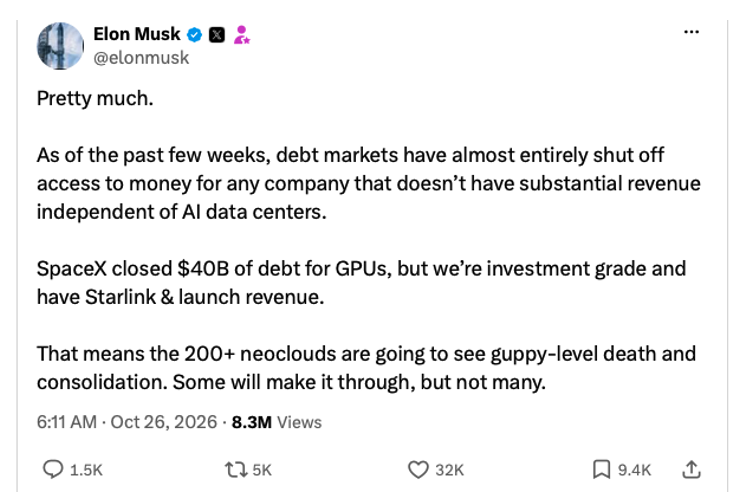 Musk noted that while mega-cap companies with independent cash flows – such as SpaceX, backed by Starlink and rocket launch revenue – can still secure capital, pure-play graphics processing unit (GPU) middleman operations are rapidly being frozen out of the credit ecosystem.
To understand why the credit taps just turned off for the AI trade, we need to look at how the ecosystem was built, who built it, and Australia’s own recent initial public offering IPO flop that actually helped break the hype on Wall Street.
At the centre of the AI explosion sits Nvidia. Boasting a US$6 trillion market capitalisation, its proprietary CUDA software layer and market-dominating AI chips power virtually all model training and inference worldwide.
Its chief executive, Jensen Huang, has become something of an international statesman, advising world leaders and putting global politicians on speakerphone at tech conferences.
Yet beneath Nvidia’s epochal corporate earnings growth lies a practice known as “circular financing.” In simple terms, Nvidia invests its cash directly into its own customers so those customers can buy more of its hardware.
Sometimes this arrangement operates through multi-tiered corporate partnerships – such as funding OpenAI, which leases computing power from Oracle, which in turn buys chips from Nvidia. In other instances, Nvidia funds specialised infrastructure companies known as neoclouds.
A neocloud is essentially a specialised corporate vehicle – a shell composed of real estate, server racks, massive debt, and Nvidia GPUs – designed to keep heavy balance-sheet liabilities off the books of the major AI labs.
Circular scam?
The playbook has been pretty straightforward: Nvidia or another technology giant takes a strategic equity stake in a neocloud. Then Wall Street analysts assume that because Nvidia is involved, the venture is bulletproof, and they send the valuation soaring. Next, armed with a multi-billion-dollar valuation, the neocloud borrows heavily from banks and hedge funds to order tens of thousands of GPUs. Nvidia then logs record chip sales, boosting profits and fuelling further investments in more neoclouds.
This private-market feedback loop works seamlessly, of course, until public market investors are asked to hold the bag.
The cracks came into public view when Firmus, the Australian AI data centre company backed by Nvidia, Jane Street, and Blackstone, attempted to go public earlier this month.
It was positioned to become Australia’s largest IPO in history at a valuation of up to US$30 billion, but the deal collapsed when investors revolted, forcing underwriting banks to scrap the offering entirely.
The backlash has been well documented and essentially stemmed from loose listing terms and questionable executive backgrounds.
In a typical IPO, founders and early insiders agree to lock up their shares for a set period to prove they have long-term faith in the company and its prospects, and to prevent immediate market dumping. Firmus, however, structured its terms to let some insiders sell immediately, signalling to Wall Street that insiders saw the listing as a quick exit.
Like many neoclouds, Firmus did not start as an advanced artificial intelligence infrastructure firm; it began as a bitcoin mining operation before pivoting to capitalise on the AI boom.
Firmus is far from an isolated case. Across the technology sector, dozens of neoclouds and adjacent infrastructure plays feature similar trajectories. TeraWulf, which secured major leasing deals with Anthropic and Google, pivoted from bitcoin mining to AI data centres, with reports suggesting major ownership ties to family members of an executive said to be previously involved in Securities and Exchange Commission market manipulation charges.
Sharon AI, an operator backed by Oaktree Capital with Nvidia deals, is reportedly led by an executive who was previously interviewed by police following a historic hotel fire in 2008.
Applied Digital rapidly shifted from staff provisioning to plasma technology, potato processing, cryptocurrency mining, and finally Nvidia-backed AI data centres – before Nvidia sold its stake in 2026 after the firm had accumulated billions in debt.
New tech, old scams?
Short-sellers might just be right in observing that stock promoters rarely invent new models; they simply migrate to whichever sector is attracting uncritical capital. In 2000, it was dot-com shells; in 2010, Chinese reverse mergers; in 2017, crypto miners; in 2021, special purpose acquisition companies (SPACs); and today, GPU-laden neoclouds.
The dynamic is strikingly reminiscent of the 2008 subprime mortgage crisis.
Back then, non-bank subprime lenders like Ameriquest didn’t thrive on superior credit analysis; they generated short-term origination fees using capital from Wall Street investment banks. Institutions like Goldman Sachs, Deutsche Bank, and Morgan Stanley provided warehouse lines of credit that allowed subprime lenders to originate junk loans, package them into mortgage-backed securities, and pass the ultimate risk onto pension funds and institutional investors.
Today, Nvidia’s prestige plays the role major Wall Street banks played two decades ago. By lending its balance sheet and reputation to speculative neocloud entities, Nvidia bestows instant legitimacy on businesses with flimsy underlying economics. As long as private markets keep inflating valuations, involved parties collect fees and log paper gains – until debt and equity markets draw the line.
End of the line?
The market now faces a turning point where cheap credit for unproven AI infrastructure has dried up. With debt markets closing to entities lacking non-AI revenue streams, financial analysts expect a wave of restructurings, fire sales, and insolvencies across the neocloud ecosystem. Moving forward, capital is returning to companies with independent, cash-generative core businesses, signalling an end to the era of raising billions solely on the promise of leasing GPUs at thin margins.

Roger Montgomery is the Founder and Chairman of Montgomery Investment Management. Roger has over three decades of experience in funds management and related activities, including equities analysis, equity and derivatives strategy, trading and stockbroking. Prior to establishing Montgomery, Roger held positions at Ord Minnett Jardine Fleming, BT (Australia) Limited and Merrill Lynch.
He is also author of best-selling investment guide-book for the stock market, Value.able – how to value the best stocks and buy them for less than they are worth.
Roger appears regularly on television and radio, and in the press, including ABC radio and TV, The Australian and Ausbiz. View upcoming media appearances.
This post was contributed by a representative of Montgomery Investment Management Pty Limited (AFSL No. 354564). The principal purpose of this post is to provide factual information and not provide financial product advice. Additionally, the information provided is not intended to provide any recommendation or opinion about any financial product. Any commentary and statements of opinion however may contain general advice only that is prepared without taking into account your personal objectives, financial circumstances or needs. Because of this, before acting on any of the information provided, you should always consider its appropriateness in light of your personal objectives, financial circumstances and needs and should consider seeking independent advice from a financial advisor if necessary before making any decisions. This post specifically excludes personal advice.


