

The end is near!
I have often joked that billionaire Ray Dalio, the founder of hedge fund Bridgewater, has predicted 15 of the last 3 recessions. In other words, far more than transpired.
It’s worth remembering the late Charlie Munger’s observation about forecasts: The only thing one needs to do to be a successful forecaster is to forecast often.
Dalio is certainly a frequent prognosticator.
I can tell you, from painful personal experience, that trying to accurately predict a complex system like the global economy and financial system is nearly impossible, and it’s made more difficult by the fact that investors respond unpredictably even to the same scenarios presented at different times.
The headlines can help explain what I’m alluding to:
One year it will be, “Markets slump on jump in inflation”
And in another year, “Investors ignore inflation spike to push stocks to record high”
Dalio’s latest scare – a prediction on X – and in his “Big Cycle” update argues the post-1945 international order has officially “broken down,” moving from a rules-based system to one defined by “might makes right” and intense geopolitical rivalry.
Dalio warns we are currently in a “capital war” phase, where financial assets – particularly sovereign debt – are being weaponised through sanctions and trade embargoes. As trust in fiat currencies and the stability of the U.S. dollar-led system erodes, Dalio believes geopolitics will become the primary driver of portfolio construction, forcing investors to look beyond traditional “safe” assets that are now subject to confiscation or devaluation risks.
His core investment advice – to buy gold and sell debt (government bonds) – derives from the historical pattern of late-stage debt cycles, in which governments print money to fund conflicts and service massive liabilities. Dalio posits that central banks and sovereign wealth funds are already pivoting toward gold as a “neutral” and universal reserve asset with no counterparty risk, effectively making it the “second-largest reserve currency.”
He suggests that a strategic allocation of 5 per cent to 15 per cent in gold serves as essential insurance against the dual threats of high inflation and a sudden, disorderly shift in the global monetary system.
It all sounds very credible, but which bonds should you buy? And is Dalio suggesting allocating 15 per cent of your portfolio to gold at record-high prices, AFTER one of the biggest bull runs in history?
Speaking of history, it’s history that’s required to give the latest, seemingly logical and credible prediction context.
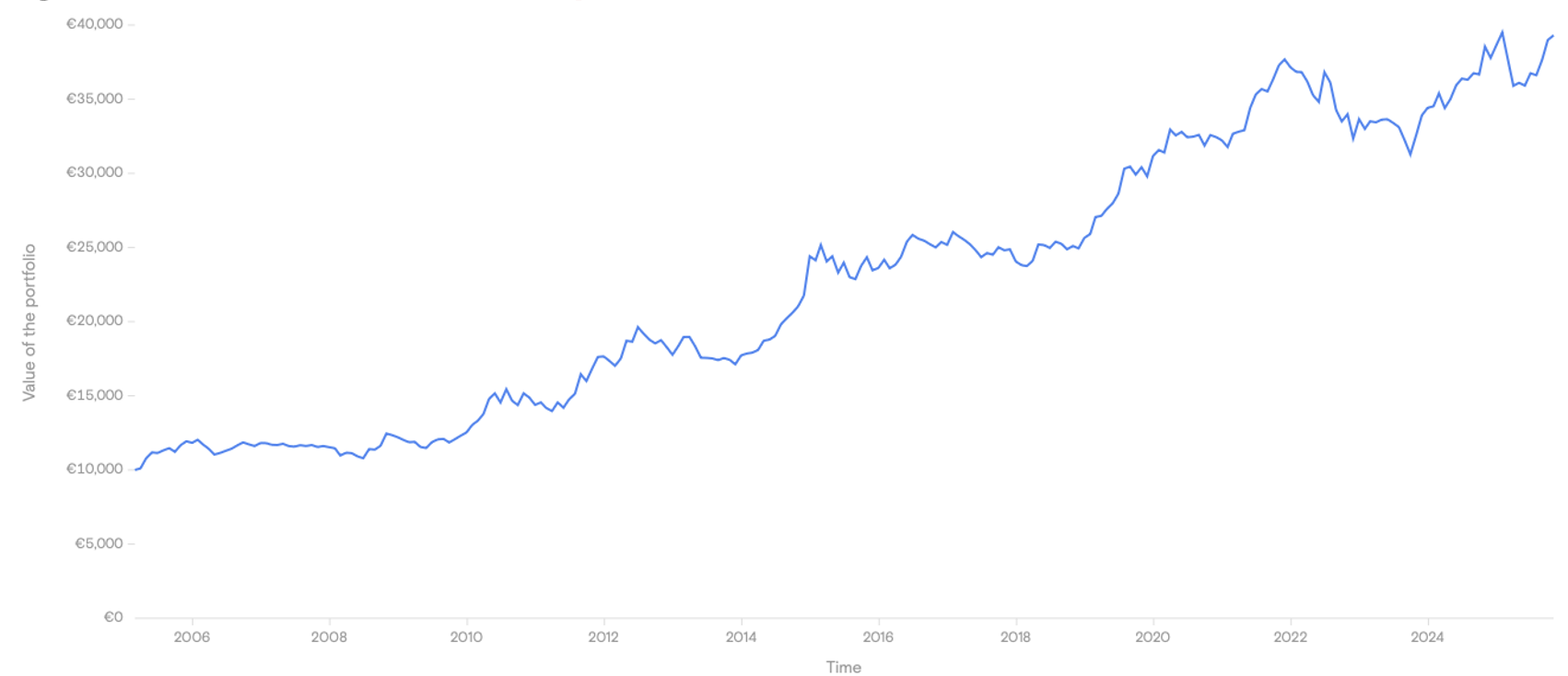
A dozen year’s ago Dalio came out with his All Weather Portfolio. The allocations were 30 per cent equities, 40 per cent long duration bonds, 15 per cent medium duration bonds, 7.5 per cent gold and 7.5 per cent commodities.
Figure 1. U.S. Treasury Bond yield (Invert for price)

Source: Trading Economics
The All-Weather Portfolio has generated a compounded annual return of just 5.8 per cent over the 11-year period from November 2014 to November 2025. Importantly, the Sharpe Ratio, a measure of return for every unit of risk, is just 0.63, and well below 1, according to Curvo.eu., leading some to describe the portfolio as an underperformer.
Figure 2. All Weather Portfolio performance
Source: Curvo.eu
Part of the reason for the underperformance is the constant and very large allocation to bonds as interest rates have risen after the COVID pandemic. And now, with bonds arguably offering better relative value than in 2014, Dalio is reversing course.
Perhaps investors should be doing the opposite and betting that bonds beat gold over the next 11 years.
Of course, nobody can predict the future, not even billionaires with five decades in markets under their belt, but it’s worth remembering Dalio will eventually be right. Even a stopped clock is right twice a day.

Roger Montgomery is the Founder and Chairman of Montgomery Investment Management. Roger has over three decades of experience in funds management and related activities, including equities analysis, equity and derivatives strategy, trading and stockbroking. Prior to establishing Montgomery, Roger held positions at Ord Minnett Jardine Fleming, BT (Australia) Limited and Merrill Lynch.
He is also author of best-selling investment guide-book for the stock market, Value.able – how to value the best stocks and buy them for less than they are worth.
Roger appears regularly on television and radio, and in the press, including ABC radio and TV, The Australian and Ausbiz. View upcoming media appearances.
This post was contributed by a representative of Montgomery Investment Management Pty Limited (AFSL No. 354564). The principal purpose of this post is to provide factual information and not provide financial product advice. Additionally, the information provided is not intended to provide any recommendation or opinion about any financial product. Any commentary and statements of opinion however may contain general advice only that is prepared without taking into account your personal objectives, financial circumstances or needs. Because of this, before acting on any of the information provided, you should always consider its appropriateness in light of your personal objectives, financial circumstances and needs and should consider seeking independent advice from a financial advisor if necessary before making any decisions. This post specifically excludes personal advice.


