Monthly Archives: January 2012
Are two lemons better than one?
Roger Montgomery
January 31, 2012

Robert Gottliebsen penned an interesting piece in the Business Spectator today. Using data provided by James Stuart of Ferrier Hodgson that revealed Internet penetration – as a portion of sales for large US retailers – as high as 18% and comparing that to average penetration of online sales from retailers in Australia of 1%, Robert concluded that time is ticking for owners of commercial property.
I agree with Bob’s conclusions. Oroton’s online store is now its biggest store in terms of sales and sagging bricks and mortar retail growth will force many retailers to also move online and embrace the structural change or go the way of the dinosaurs.
Tight margins, expensive staff and exorbitant rents spell trouble for any business that cannot maintain prices in the face of an online and overseas onslaught.
The impact on rents of commercial buildings such as shops will ultimately be negative And on this point I agree with Bob. But we can add one more step to the scenario. Either a new generation of offerings replaces the old school tenants who are departing and rents are maintained or declining rents lead to lower real estate prices which encourages buyers who are both retail operators and store owners rather than tenants.
Incidentally, at Montgomery Investment Management we cannot find a single listed property trust that meets our criteria. If you can find value in the listed property sector do let us know, but we cannot.
I feel for those who bought shops in strips like to Toorak Road, Chapel Street and Oxford Street on capitalisation rates of less than 3% or 4%.
I also feel for fruit and vegetable growers in Australia who are about to find out what grocery suppliers and milk producers have recently experienced. Many farmers have told me of the mere cents per kilo received by them from major supermarkets who in turn sold the same produce at multiples of 10 and 11 times while explaining to farmers that they needed to charge such high multiples to cover the cost of business. The announcement on Today Tonight last night by Coles staffer Greg Davis of 50% cuts in the prices of fruit and vegetables, suggests the real cost of doing business is much lower than what the supermarkets have been telling farmers.
And if they’ve been dishonest with farmers then perhaps it’s a little disingenuous for Greg Davis to say on national television “We’re investing in prices as well, but our growers are working with us to plan our crops, to ensure that we’ve got certain year-round volumes. We buy in such huge volumes, it brings down the cost of the produce, so customers benefit and growers benefit, because we can move stock really quickly”. Do we reallyt need ore food to be produced? It seems Coles would like us to forget just how many thousands of tonnes of fruit and veg is thrown out by each of the supermarkets each year. According to the National Waste Report 2010, food waste constituted 4.5 million tonnes or 35% of municipal waste. When Coles talks about moving more products at lower prices are obviously not referring to us eating it!
Bruno writes in the comments below:
“Hi Roger,
Just a comment on what farmers are getting for their produce. Being a farmer I can tell you that the very most we have received for citrus is 40c per kg, but on average we get about 20c then we must pay 10c of that just to have them picked. My next door neighbor grew onions this year and also received 20c per kg. pumpkins are the same price. Rice is being sold by farmers for 18c per kg. wine grapes are being harvested right now for an average price of about 24c per kg (1kg is the amount of grapes needed for one bottle of wine) most if not all these crops cost about 10c per kg just to harvest! Of course farming is a cyclical business, and sooner or later what us farmers are paid will have to come up, otherwise there won’t be any farmers left. Where I live we are starting to see banks foreclose on farms, the irony is that no one is willing to buy a business that makes no money. So banks are forced to either lend more money, or spend their own cash to run the farms so the property value isn’t destroyed as fruit trees die. While we worry about the Europe crisis effect on the banks balance sheets we have a very big problem much closer to home which, if farmers don’t start to make a profit soon, will most defiantly effect the share values of the banks as bad debts get written off. if my wide went to work at woollies and at the end of the day she was given a bill from her boss for a days work, there’d be outrage. But when farmers are left in that exact situation, politicians and the like tell us “there’s healthy competition in the market place which benefit consumers” maybe in the short term but as more farmers abandon their farms which is happening, the price of all fruit and vege will definitely go up in the medium term as more and more farmers leave their land.”
Further, the wholesale buying of arable agricultural land by foreign interests, the decimation of profitable agricultural enterprises due to irrational competition of the major supermarkets and the replacement of their product by foreign alternatives will not ultimately produce the best outcome for Australia.Australians cannot buy freehold land in China and foreigners are banned from owning the ground floor apartment in any building in Singapore so one does wonder whether our generosity is well placed all in the name of pursuing lower prices for short sighted consumers.
Posted by Roger Montgomery, Value.ableauthor and Fund Manager, 31 January 2012.
by Roger Montgomery Posted in Insightful Insights.
- 47 Comments
- save this article
- 47
- POSTED IN Insightful Insights.
Perhaps one of the most important charts?
Roger Montgomery
January 31, 2012
 Late last year the Federal Bank of San Francisco’s research department published their findings about a relationship between the ageing baby boomers and P/E ratios. I have long held the view that when Australia’s baby boomers (the majority of whom are asset rich and cash poor) reach the age that they need to fund their retirement spending and healthcare, they will need to sell their assets (typically real estate). Given the next generation have long complained of being unable to afford a house, it seems logical that prices for homes will need to fall. Only if prices fall can a generation of sellers meet the generation of buyers who say they cannot afford to pay current prices.
If that is indeed true for one asset classes then perhaps it makes sense for other asset classes. Wealthier baby boomers with DIY share portfolios will also need cash. They may not sell the family home (although downsizing is a very real trend), instead they may use their share portfolios as their ATM. This could put pressure on the multiples of earnings, sales and book values that trade in a free market.
The FRBSF seems to agree…Zheng Liu and Mark M. Spiegel discovered a strong relationship between the age distribution of the U.S. population and stock market performance.
“A key demographic trend is the aging of the baby boom generation. As they reach retirement age, they are likely to shift from buying stocks to selling their equity holdings to finance retirement. Statistical models suggest that this shift could be a factor holding down equity valuations over the next two decades.
The baby boom generation born between 1946 and 1964 has had a large impact on the U.S. economy and will continue to do so as baby boomers gradually phase from work into retirement over the next two decades. To finance retirement, they are likely to sell off acquired assets, especially risky equities. A looming concern is that this massive sell-off might depress equity values.
Many baby boomers have already diversified their asset portfolios in preparation for retirement. Still, it is disconcerting that the retirement of the baby boom generation, which has long been expected to place downward pressure on U.S. equity values, is beginning in earnest just as the stock market is recovering from the recent financial crisis, potentially slowing down the pace of that recovery.
We examine the extent to which the aging of the U.S. population creates headwinds for the stock market. We review statistical evidence concerning the historical relationship between U.S. demographics and equity values, and examine the implications of these demographic trends for the future path of equity values.
Demographic trends and stock prices: Theory
Since an individual’s financial needs and attitudes toward risk change over the life cycle, the aging of the baby boomers and the broader shift of age distribution in the population should have implications for capital markets (Abel 2001, 2003; Brooks 2002). Indeed, some studies attribute the sustained asset market booms in the 1980s and 1990s to the fact that baby boomers were entering their middle ages, the prime period for accumulating financial assets (Bakshi and Chen 1994).
However, several factors may mitigate the effects of this demographic shift. First, demographic trends are predictable and rational agents should anticipate the impact of these changes on asset demand. Consequently, current asset prices should reflect the anticipated effects of demographic changes. In addition, retired individuals may continue to hold equities to leave to their heirs and as a source of wealth to finance consumption in case they live longer than expected (e.g., Poterba 2001).
Foreign demand for U.S. equities might also reduce the downward pressure on asset prices. However, the effect is probably limited for two reasons. First, other developed nations have populations that are aging even more rapidly than the U.S. population (Krueger and Ludwig, 2007). Second, there is substantial evidence of home bias in equity holdings. Individual investors typically hold disproportionate shares of domestic assets in their portfolios. For example, in 2009, the foreign equity holdings of U.S. investors were only 27.2% of the share of foreign equities in global market capitalization. While the low level of international equity diversification is still not well understood (Obstfeld and Rogoff 2001), it suggests that foreign demand for U.S. equities is unlikely to offset price declines resulting from a sell-off by U.S. nationals.
Demographic trends and stock prices: Some evidence
To examine the historical relationship between demographic trends and stock prices, we consider a statistical model in which the equity price/earnings (P/E) ratio depends on a measure of age distribution (for another example, see Geanakoplos et al. 2004). We construct the P/E ratio based on the year-end level of the Standard & Poor’s 500 Index adjusted for inflation and average inflation-adjusted earnings over the past 12 months. We measure age distribution using the ratio of the middle-age cohort, age 40–49, to the old-age cohort, age 60–69. We call this the M/O ratio.
We prefer our M/O ratio to the M/Y ratio of middle-age to young adults, age 20–29, studied by Geanakoplos et al. (2004). In our view, the saving and investment behavior of the old-age cohort is more relevant for asset prices than the behavior of young adults. Equity accumulation by young adults is low. To the extent they save, it is primarily for housing rather than for investment in the stock market. In contrast, individuals age 60–69 may shift their portfolios as their financial needs and attitudes toward risk change. Eligibility for Social Security pensions is also likely to play a first-order role in determining the life-cycle patterns of saving, especially for old-age individuals.
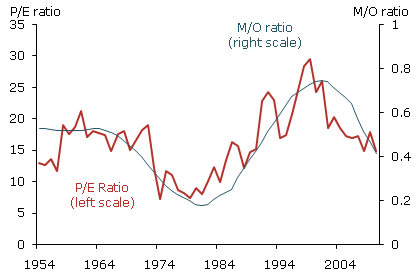
Figure 1 displays the P/E and M/O ratios from 1954 to 2010. The two series appear to be highly correlated. For example, between 1981 and 2000, as baby boomers reached their peak working and saving ages, the M/O ratio increased from about 0.18 to about 0.74. During the same period, the P/E ratio tripled from about 8 to 24. In the 2000s, as the baby boom generation started aging and the baby bust generation started to reach prime working and saving ages, the M/O and P/E ratios both declined substantially. Statistical analysis confirms this correlation. In our model, we obtain a statistically and economically significant estimate of the relationship between the P/E and M/O ratios. We estimate that the M/O ratio explains about 61% of the movements in the P/E ratio during the sample period. In other words, the M/O ratio predicts long-run trends in the P/E ratio well.
Figure 1.
This evidence suggests that U.S. equity values are closely related to the age distribution of the population.”
Posted by Roger Montgomery, Value.able author and Fund Manager, 31 January 2012.
by Roger Montgomery Posted in Value.able.
- 20 Comments
- save this article
- 20
- POSTED IN Value.able.
Dumped by the wave of Fashion
Roger Montgomery
January 31, 2012
 There was a lot of surfing on the Montgomery annual holiday so I thought I’d publish these thoughts on Billabong International for you. Happy new year and all the best for 2012.
Billabong’s trading update in December attracted a great deal of attention – not only from shareholders who rushed the exits to sell their shares, but also from commentators who noted the result was a symptom of a cyclical and structural shift in the way retail goods, particularly fashion, is bought and sold in Australia.
That Billabong had downgraded its earnings guidance should not have come as a surprise: it is not the first time it has done this. In 2009-10, it announced a series of downgrades then failed to even meet the lowered figure in its full-year result. In 2010-11, it announced downgrades in October and December, then again in March 2011. Billabong is not a stranger to downgrades.
But downgrades aren’t the only reason I have never bought shares in this company. On a number of measures it has failed to live up to the high standards I set for a candidate to enter and remain in an A1 portfolio. On some of those measures it may be argued that Billabong has a “challenging road” ahead – a euphemism for the possibility of a serious structural change, which may include a capital raising, asset sales and/or write-downs.
Retailing in Australia has been doing it tough and I have written previously about the perfect storm facing conventional bricks and mortar retailers in this country.
Another retailer, JB Hi-Fi (ASX: JBH, SQR A3, $12.50), had been 5% of the Montgomery [Private] Fund portfolio until we sold out at $15.50. Our reasoning was simple: given present circumstances (the strong dollar and strong outbound tourism, and the consumer shift to online buying) and expectations for retailing (having spoken to many retailers recently), many retailers would have to revise their earlier outlook statements and this would produce lower future valuations.
Notwithstanding today’s speculation that the announced sale of Dick Smiths by Woolworths (ASX: WOW, Skaffold Quality Score B2, $24.45) will trigger a bid by the grocer for JB Hi-Fi, analysts’ forecasts are typically optimistic in the first half of the financial year (this year being no exception to that rule) and we should therefore be demanding much larger discounts and JB Hi-Fi’s shares were not offering that margin of safety.
I have also noted before that the deflation story – as explained by Gerry Harvey, who says selling plasma TVs for $399 last year means he has to sell three times the volume as last year to make the same money – would put pressure on profits because people already had enough plasma TVs.
Finally, we also believe ANZ’s reported profit growth last year, being dominated as it was by bad debt provisioning writebacks, meant that credit growth was non-existent. When you take away growth in credit card purchases that’s got to hurt discretionary retailers.
Billabong cannot be immune. And a long-winded, multipage analysis of the issues plaguing this company is not required because we’ve never suggested it as an investment.
Billabong reported that its first-half EBITDA in constant currency terms would be $4 million higher, but the company is a global retailer and its reported EBITDA is expected to be 20.8% to 26% lower. The company added that strong growth in constant currency terms in 2012 “is not expected”.
Tellingly, the company also noted that a full strategic review is required and a capital raising cannot be ruled out. The reason for this is simple: in light of deteriorating trading conditions the company has bitten off more than it can chew. This is best seen in the cash flow statement.
In 2010-11 Billabong reported profits of $119 million but cash flow from operations of just $24 million. Subtract dividends of $78 million (why pay dividends if you don’t have the cash?) and capex and investments of $266 million and you have a deficit that needs to be plugged with an equity raising or debt.
Turning to the balance sheet, you will find goodwill amounts to about $1.3 billion. That’s $1.3 billion of “oops-I-paid-too-much” and is more than half of the assets of the company. There’s also borrowings of $600 million and, despite the boost, the company is currently forecast to earn a return on equity of just 7%.
Given my bank is offering 90-day term deposits at 5.95%, I wonder how Billabong’s auditors can justify the carrying value of the goodwill on the balance sheet.
So there are two pretty good reasons you haven’t seen Billabong mentioned as a company to conduct more research on this year – or any year, for that matter.
Investing in 2012 could be largely about avoiding losses. To do that, you will need to watch out for companies whose structures are weak, whose performance is undesirable or whose price is too high. Obviously any stock that harbours all three conditions does not require my comment here.
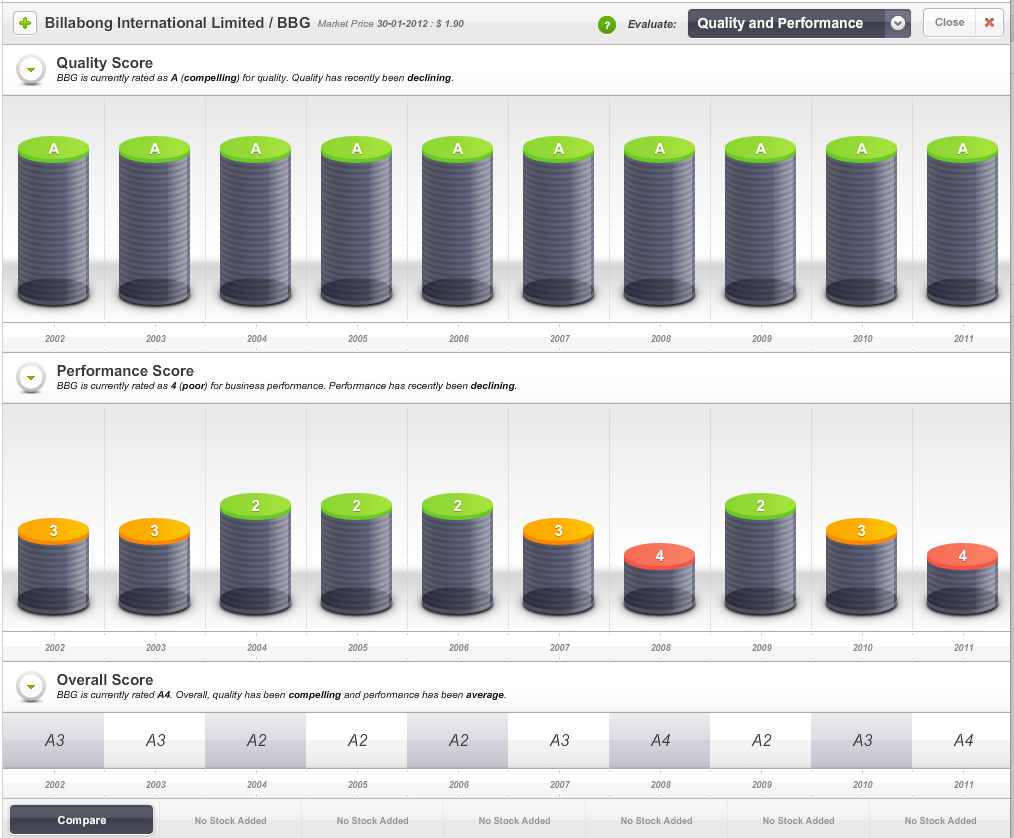
Billabong’s debt has been rising, its return on equity falling, its balance sheet weakening and as an A4 on Skaffold’s quality scale, it was not investment-grade.
Skaffold’s Quality Score History for Billabong
If you are thinking about investing in retail in the coming year, be sure you know what to look for, even if mouth-watering prices are being offered.
Finally, for Skaffold member’s I hope you enjoy update 1.1 you will be receiving today, making Skaffold even more powerful and user friendly. If you are not a member of Skaffold, what are you waiting for? Skaffold is the best way we know of to deal with the market’s main risks;
Don’t miss an opportunity – every stock is covered and updated daily and automatically.
Reduce the risk of paying a high price for a stock – Skaffold’s intrinsic values ten years back and three years forward for every company.
Reduce the risk of buying the wrong company and suffering permanent capital loss – Skaffold’s Quality Scores, cash flow information and projected intrinisic values are updated in real time, keeping you abreast of vital changes to a company’s prospects as an investment candidate.
If you have been thinking about becoming a ‘Skaffolder’ there are few better times to get started than just before companies start releasing their important Half Year results. Skaffold’s intrinsic values are updated live and daily so as company’s prospects are upgraded (or downgraded!) during reporting season, you are likely to find a multitude of opportunities for investigation. Go to www.skaffold.com to get started just as reporting season takes off.
All the best for 2012.
Posted by Roger Montgomery, Value.able author and Fund Manager, 31 January 2012.
by Roger Montgomery Posted in Value.able.
- 10 Comments
- save this article
- 10
- POSTED IN Value.able.
2012 Prediction No#1. Will our banks raise capital?
Roger Montgomery
January 11, 2012
The banks are in the firing line again. A few months ago it was their record profits; today its talks of job cuts that dominate. In November I noted that an industry insider had informed me that tens of thousands of jobs would be cut from financial services in 2012. News today of job losses at one credit union suggests the process is underway.
But is something even bigger brewing? Something that’s getting little or no headline attention? We believe so. Collectively our banks made $24.26b in profits in 2011 (CBA $6.4b,NAB $5.5b, WBC $7b, ANZ $5.36b), but remember, banking is one of if not the most highly leveraged businesses on the Australian stock market. And being highly leveraged into any downturn means the economy can bite and bite hard.
While everyone’s focus is on cost cutting and net interest margins – so that the banks can maintain their profits – what are the numerous issues facing them:
• Elevated funding costs squeezing bank margins – Australian Financial Institutions source $310.5b in offshore borrowings.
• Declines in the share market impacting on wealth management profits.
• A higher frequency of natural disasters impacting insurance profits.
• The implementation of Basel III and higher capital requirements.
• Mortgage margins contracting given heavy competition for new loan business in a low growth environment.
• Low levels of system credit growth.
• Low levels of bad debt provisioning. Levels around pre-GFC 2008 levels and ratings agency Moody’s having serious misgivings about Australia’s housing market amid fears the property bubble will burst if Europe’s debt crisis is not contained.
• Analysts expecting house prices to drop further in 2012.
• Below 40% auction clearance rates across Australia.
• High historical levels of private and corporate debt levels.
• Falling property prices in China – the country’s Homelink property website reported that new home prices in Beijing fell a stunning 35 per cent in November from the month before.
• A broader economic slowdown in China and Japan as a result of Europe and US economies.
• Falling commodity prices for many of Australia’s key exports.
My view is that our highly leveraged banking system faces many pressures – from higher funding costs to increased unemployment (not just in the banking sector, some 100,000 jobs will be lost in retail alone) and the uptake of Basel III and that these pressures will see them needing to increase their capital. The canary in the coal mine is always of course bad debts.
Like my early prediction last year of a possible Qantas takeover, I may be wide of the mark, but I cannot rule out the possibility of the banks needing to raise capital in 2012.
If you work in the banking sector or are an avid follower of the Australian Banking system or know someone who is, I have a question to ask – despite the possible layoffs, what are you seeing? Clearly growth for banks is anemic and there are many headwinds to current consensus analysts’ earnings forecasts and their growth profiles. Are they achievable for our major banks in the coming years?
It is these forecasts that feed into valuation models which determine whether or not a margin of safety exists at current prices, so I’m throwing a call out to you. Do you agree with the current consensus view that jobs cuts are being made to preserve profits, or do you also see more to the story?
Posted by Roger Montgomery, Value.able author and Fund Manager, 11 January 2012.
by Roger Montgomery Posted in Financial Services.
- 77 Comments
- save this article
- 77
- POSTED IN Financial Services.